← The stand
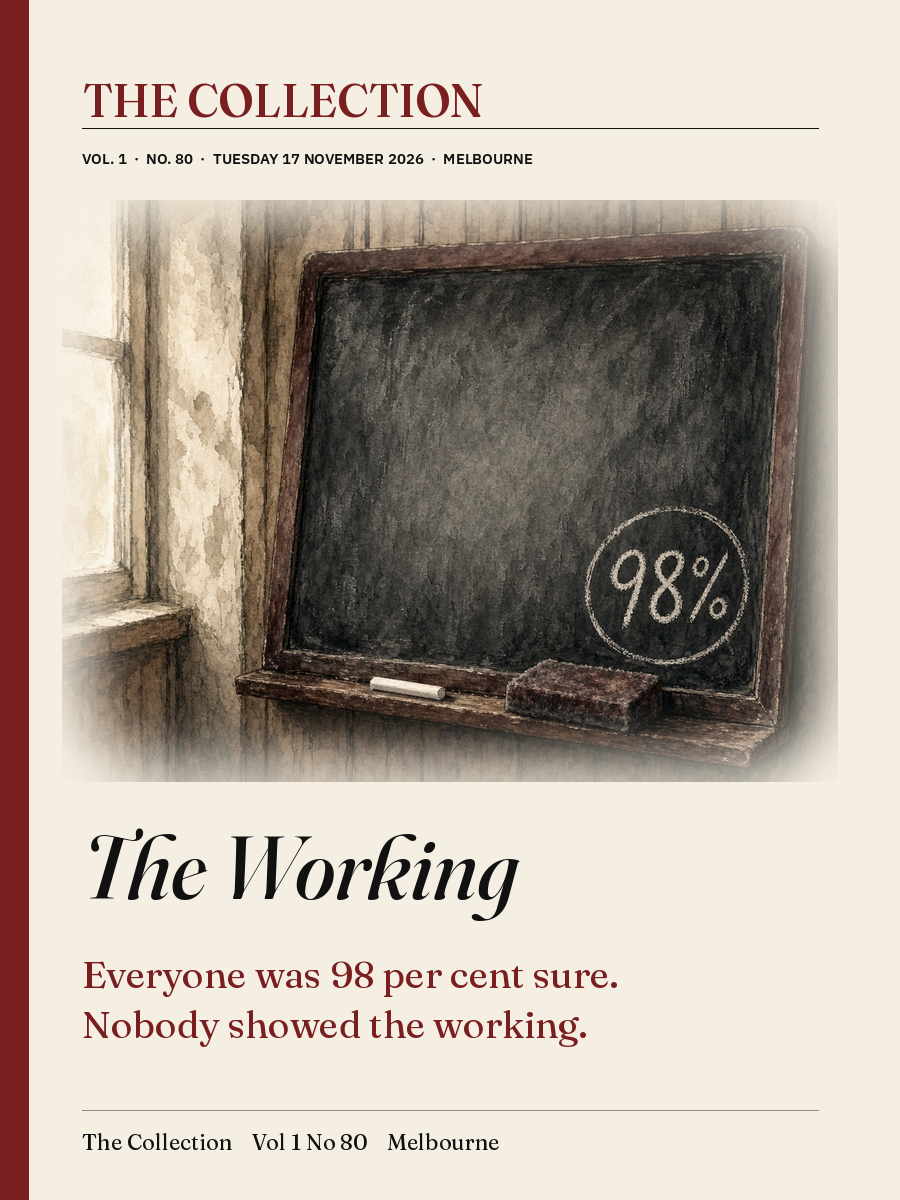
Cover of The Collection, Volume 1, Number 80: The Working. Tuesday 17 November 2026, Melbourne. A watercolour of a schoolroom blackboard leaning against a wooden wall, wiped blank except for a chalk answer, 98 per cent, circled in the corner, with a stub of chalk and a felt eraser on the ledge. Skip cover

Vol. 1  ·  No. 80  ·  Tuesday 17 November 2026  ·  Melbourne


The Collection

The Working

Collected and edited by Newsletter World, for AK

Contents

Tuesday’s letters are about confidence that arrives without its arithmetic. Erik J Larson asks how officials can be 98 per cent sure the aviation outage was not an attack when they have not said what caused it. Gary Marcus and Azeem Azhar, on the eve of Anthropic’s listing, read the same AI economy as a burst bubble and a permanent tithe. ByteByteGo shows Instacart doing the unglamorous thing: checking every model answer against the catalogue. Everyone was 98 per cent sure. Nobody showed the working.

  1. iiiEditor’s LetterEveryone was 98 per cent sure. Nobody showed the working.03
  2. ivNinety-eight per cent of what?Washington says the aviation outage was an equipment upgrade, and that it is 98 per cent sure it was not an attack. Erik J Larson asks where the number came from, and what actually failed.04
  3. vThe bank shut its window before the books were openNvidia financed much of the AI boom. Now its interim chief is expected to rein that in, days before Anthropic is due to list. The bulls see a tithe, the bears a burst bubble. Neither has the ledger yet.05
  4. viInstacart makes the model check its answerA shopper types “bread no gluten.” An LLM can guess what that means. Instacart built the part that checks the guess against what is actually on the shelves.06
  5. viiStanding OrdersFour rules for this issue.07

03  ·  Editor’s Letter

Everyone was 98 per cent sure. Nobody showed the working.

Yesterday the letters were about deciding what to keep. Today they are about what gets left off the board: the working. Every schoolchild learns that the answer alone earns half marks. Tuesday’s mail is full of answers.

Washington is 98 per cent sure the aviation outage was not an attack, and Erik J Larson wants to see the sum. On the eve of Anthropic’s listing, Gary Marcus calls game over and Azeem Azhar sketches a permanent tithe, while the industry’s lender, Nvidia, is reported to be closing its chequebook. Only one letter shows a system built to check itself: Instacart, where a model’s answer is thrown away if it does not match the shelf. Everyone was 98 per cent sure. Nobody showed the working.

The Collection · The Working03

04  ·  The Certainty

Ninety-eight per cent of what?

Washington says the aviation outage was an equipment upgrade, and that it is 98 per cent sure it was not an attack. Erik J Larson asks where the number came from, and what actually failed.

On Sunday this paper printed the official story of America’s aviation communications failure: an upgrade went in, and the job around it did not. Erik J Larson does not accept that story, and his letter is short enough to be read as a list of questions. Technicians were upgrading equipment in Texas and Arkansas. Fine, he says. That is what they were doing. It is not why the system failed.

He takes the official account apart line by line. The FAA has identified abnormal network traffic involving equipment in those two states, but naming the equipment is not the same as explaining why it malfunctioned. Failures at two facilities disrupted communications across much of the national system, so where were the redundancies? Microsoft had a major outage immediately before the aviation failure. Has anyone ruled out a connection?

“How can officials claim to be 98% certain about what did not cause the failure when they haven’t established what actually did cause it?”

The number is the heart of it. Officials say they are 98 per cent certain this was not a cyberattack. Why 98, Larson asks, and not 95 or 99? Is it a calculated probability or someone expressing confidence? If it is calculated, what went into it: network logs, configuration changes, access records? He then does the thing he asks of them, and puts his own judgement on the record. He thinks it was an attack, and he says plainly that he could be wrong. We do not know either. What we can say is that his question stands whichever way the investigation lands. A confidence figure with no working attached is a mood, not a measurement.

The same day’s Cyber Daily briefing carried the other half of the lesson. Coles has disclosed a cyber security incident, engaged outside experts to contain it, and said there is no evidence that customer data has been compromised; an expert quoted in the briefing praised the supermarket for disclosing early to keep trust. That is a statement of what is known and what is not, made before the end of the story. And from the Microsoft outage itself, a smaller report: in a hotel pool at a German theme park, safety systems sent warning emails about raised chlorine levels that nobody could receive, because Outlook was down. The alarm worked. Nobody had checked where it went.

The Collection · The Working04

05  ·  The Ledger

The bank shut its window before the books were open

Nvidia financed much of the AI boom. Now its interim chief is expected to rein that in, days before Anthropic is due to list. The bulls see a tithe, the bears a burst bubble. Neither has the ledger yet.

Gary Marcus calls it plainly: game over for the current AI bubble. His evidence is a market, a headline and a quote. Oracle, he writes, is down around 61 per cent since he called its OpenAI deal “peak bubble” last September. Tech stocks kept falling on Monday after last week’s rout. Ben Thompson of Stratechery, as Marcus quotes him, has written an obituary: the demise of Jensen Huang “was the end of a great many things, including Nvidia’s long-term prospects, the AI bubble, and the exceptional way in which the U.S. viewed itself in the world.”

The sharper point is about money. Marcus quotes a Wall Street Journal headline: “Nvidia’s Days as an Open Checkbook for the AI Economy Are Numbered,” with interim chief executive Colette Kress expected to rein in deals after a stretch in which Nvidia aggressively financed computing deals and startup investments. Alberto Romero, in The Algorithmic Bridge, lists “the end of the Bank of Nvidia” among five ways the crisis could reshape the industry. He labels the whole exercise informed speculation, a developing story, to be taken with a grain of salt. The rest of his argument was not in the email we received.

“With all the circular financing, it was always hard to tell what was really happening.” Gary Marcus

That line is the one to keep. When the supplier is also the lender, the sales and the loans are hard to tell apart. Marcus says he has argued since 2023 that the model makers lack a technical moat and struggle to be profitable; he also mentions unspecified “hints” of funny business in Asia, which we cannot weigh because he gives no detail.

Into this walks Anthropic. Marcus says its IPO is planned for Thursday. Azeem Azhar, in a sketch for Exponential View members, calls it the first real AI company in the West to list on a public market, and argues the bear case misses the point: most value in the S&P 500 now sits in intangibles, so Anthropic’s machine intelligence lets it compete for 92 per cent of that value “before it needs to deploy a single robot.” AI companies, he suggests, might extract a permanent tithe on the economy. He presents these as raw notes, his own words, and the full sketch is for paying members; we read only the opening. So on the eve of the listing the two loudest readings are a tithe and a burst bubble. Both are confident. The working, this time, will be in the filing and the first quarters of public numbers. Read those.
The Collection · The Working05

06  ·  The Guardrail

Instacart makes the model check its answer

A shopper types “bread no gluten.” An LLM can guess what that means. Instacart built the part that checks the guess against what is actually on the shelves.

People do not search the way catalogues are written. They type “bread no gluten” or “x-large zip lock” and expect the right box. ByteByteGo’s letter walks through how Instacart rebuilt that first step, which it calls query understanding: working out the product categories a search points to, alternative phrasings that might find more, and structured tags for brand and attributes.

The old way was a collection of separate systems. A FastText model classified categories. A query rewriter mined patterns from user sessions. Each needed its own data, training and deployment, and they could interpret the same query differently. Learning from behaviour was noisy too. Someone who searches for bread and buys bananas has not taught you that bread is a fruit. Rare searches, such as “2% reduced-fat ultra-pasteurized chocolate milk,” have almost no history to learn from at all.

A model can generate a plausible answer that still does not fit the actual data of the business. So validation is a separate part of the system.

The LLM brings general knowledge: that Italian parsley and flat parsley are the same thing, and curly parsley a substitute. Instacart wraps it in three disciplines. Retrieval puts catalogue records and historical patterns into the prompt. Smaller models are fine-tuned on Instacart’s own examples. And post-processing guardrails check every answer against the catalogue.

The category step shows the shape. Historical purchases propose candidate categories. The LLM re-ranks them into a full path, so buttermilk becomes Dairy, then Milk, then Buttermilk, and “vegan roast” lands in Meat, then Meat Alternatives. Then a guardrail compares the meaning of the original query with the predicted path using embeddings, and if the similarity falls below a set threshold, the pairing is thrown away. History proposes, the model interprets, the check filters. Nobody is asked to trust the model’s confidence. The answer has to show its working against the shelf.

The Collection · The Working06

07  ·  Standing Orders

Four rules for this issue

  1. I

    Say what failed before you say what didn’t.

    Naming the equipment involved is not an explanation. Until you can say why it broke, a statement about what did not break it is a guess with good manners.

  2. II

    Give the number its working.

    Ninety-eight per cent should come with what went into it: the logs, the changes, the access records. If it is confidence rather than calculation, say so.

  3. III

    Read the ledger, not the obituary or the tithe.

    When the supplier was also the lender, sales and loans blur. Both the bubble and the boom arrive confident. Wait for the filed numbers.

  4. IV

    Check the answer against the shelf.

    A plausible answer is not a correct one. Put a separate check between the model and the customer, set the threshold, and throw away what falls below it.