← The stand
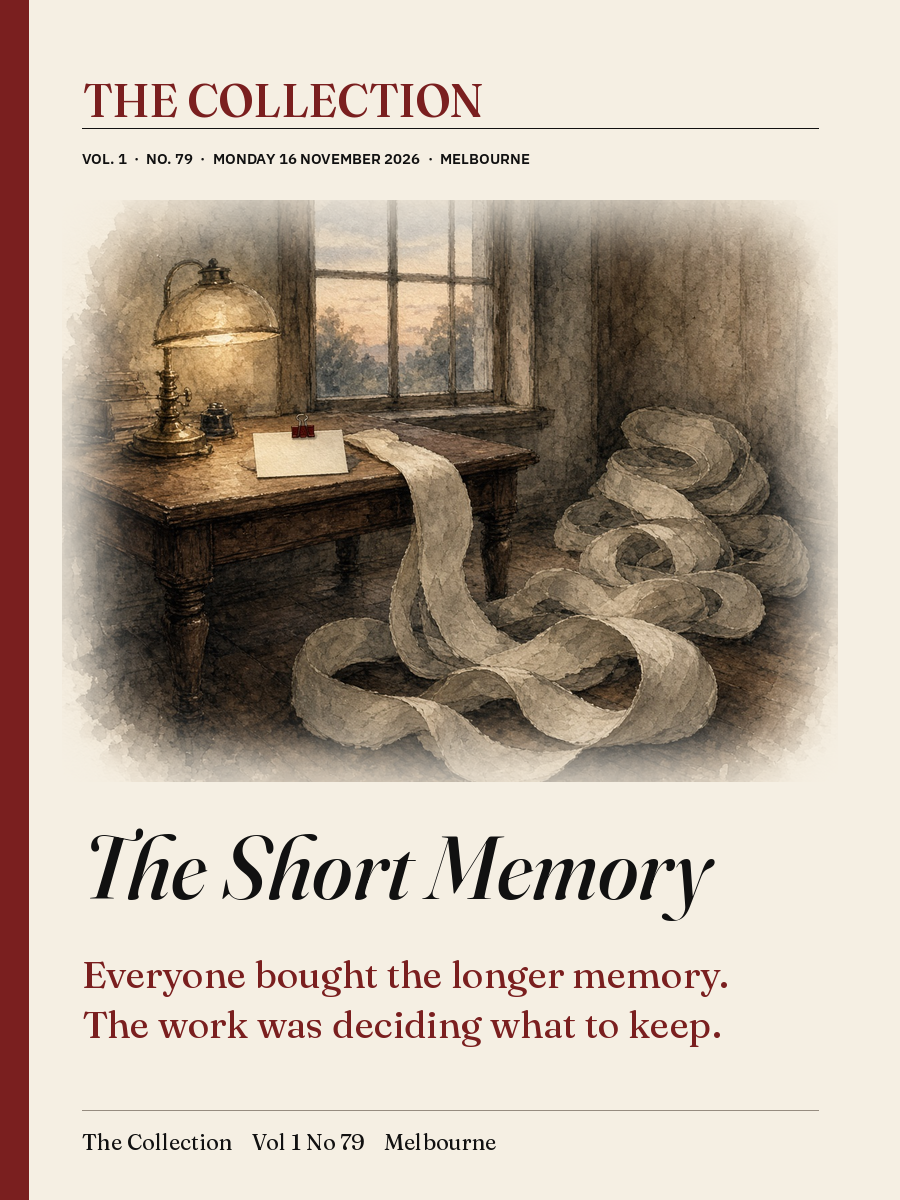
Cover of The Collection, Volume 1, Number 79: The Short Memory. Monday 16 November 2026, Melbourne. A watercolour of a study at dusk: a brass lamp on a wooden desk, a short blank card held by an oxblood clip, and a long pale scroll spilling from the desk and coiling across the floor. Skip cover

Vol. 1  ·  No. 79  ·  Monday 16 November 2026  ·  Melbourne


The Collection

The Short Memory

Collected and edited by Newsletter World, for AK

Contents

Monday’s letters are about a surplus nobody wanted to throw away. Nvidia’s researchers, in AlphaSignal, tested whether agents need the whole history and found that a short briefing often holds the accuracy, and sometimes improves it. Compound With AI ran a newer, dearer model on real stocks and found the process already knew what to keep. Ken Huang describes a decision model that answers yes or no without writing a paragraph. Everyone bought the longer memory. The work was deciding what to keep.

  1. iiiEditor’s LetterEveryone bought the longer memory. The work was deciding what to keep.03
  2. ivThey told the agent to forgetNvidia tested whether long-running agents need all that history. Often they did not. Accuracy held, and sometimes rose, once the briefing was cut to the next step.04
  3. vThe smarter model did not winA new Claude was tested on real stocks, against the model already in use. The process already knew what to keep.05
  4. viA yes should not need a paragraphFor a routing decision, generating thirty to a hundred tokens is the long memory you never needed. Ken Huang’s letter describes a model that answers in one pass, and emits no text.06
  5. viiStanding OrdersFour rules for this issue.07

03  ·  Editor’s Letter

Everyone bought the longer memory. The work was deciding what to keep.

Yesterday the letters found an upgrade that went in, and a job that nobody rewrote. Today they find a different kind of surplus: context, piled up because throwing it away felt like a risk.

Everyone has been buying longer memories for the models. Nvidia’s researchers, writing in AlphaSignal, tested whether the agents actually need them. Often they did not. Compacting the history, or leaving the documents in a file and fetching only a passage, kept accuracy up and, in the best cases, raised it. The expensive part was not the forgetting. It was choosing what to hand on.

Compound With AI ran the new Fable 5.2 against Opus 5.5 on real stocks and came back to the same idea. A good research process already tells the model what to keep. Ken Huang’s letter goes further still. For a yes-or-no routing decision, generating a paragraph of tokens is the long memory you never needed. Everyone bought the longer memory. The work was deciding what to keep.

The Collection · The Short Memory03

04  ·  The Gist

They told the agent to forget

Nvidia tested whether long-running agents need all that history. Often they did not. Accuracy held, and sometimes rose, once the briefing was cut to the next step.

The assumption has been simple: if an agent is going to work for a long time, give it a long memory. Every tool call, every file, every dead end stays in the prompt, because throwing it away might cost an answer. AlphaSignal’s Sunday deep dive, written by Ben Dickson, reports a Nvidia study that tested the opposite. Across long-horizon and long-input tasks, models could often work from a much shorter context and keep their accuracy.

The cost of the long memory is not abstract. When an LLM writes a token it must attend to everything that came before it. The researchers measured three open-weight models on NVIDIA H100 GPUs. Cutting the configured context window from 256,000 tokens to 16,000 increased output-token throughput by 3.6 times for GLM 5.2, 5.6 times for Kimi K2.6, and seven times for Qwen 3 Coder Next.

On the work itself they compared a baseline that kept the full conversation with a compaction that triggered at a threshold, for example 16,000 tokens. The agent then started a fresh conversation with the original instructions and a shortened state. On SWE-bench Verified, Claude Opus 4.5 solved 70 per cent of tasks without compaction and 74.8 per cent at its best compaction setting. GPT-5.6 Sol improved from 84.4 per cent to 88.8 per cent. For long documents, storing the files outside the prompt and letting the agent search them matched or improved accuracy across almost all of seven benchmarks. In many of those tasks the agent never compacted at all. The gain was in deciding what to read.

A good compaction, the researchers said, is a briefing that preserves only “the gist of the agentic trace.”

A recap of prominent events is the wrong briefing. The instructions that worked kept the original objective, the established facts, the relevant files and results, the completed changes, the failed approaches, the remaining work, and the immediate next action. A more aggressive test reset the conversation after every action and still nearly matched the full-history baseline on SWE-bench Verified, with a median peak context of just 7,000 to 9,000 tokens.

The letter is careful, and so should we be. Models do not all take the same cut. Qwen 3 Coder Next fell from 53 per cent accuracy on SWE-bench Verified to 3.6 per cent under a 16,000-token limit; the letter says the collapse came from verbose outputs that left no room to work. Prompt caching can also make a shorter request more expensive: GPT-5.6 Sol’s cost under standard per-token pricing rose from $167.68 without compaction to $203.12 at the 16,000-token limit. The practical rule is not “always forget.” It is: keep a structured handoff, leave the logs and originals where they can be retrieved, and measure cache hits, tokens, latency and cost per finished task before you tighten the window.
The Collection · The Short Memory04

05  ·  The Skills

The smarter model did not win

A new Claude was tested on real stocks, against the model already in use. The process already knew what to keep.

Seven days earlier, the letter says, Anthropic had announced Claude Fable 5.2, and the internet filled with benchmarks. The author does not trust those numbers for the work that matters here: understanding a business, reading the financials, valuing a company, and finding the risk. So the test was run on real stocks, in separate profiles, with the same investing skills the author already uses.

The opening trial was almost unfairly simple. Both models got one line, “I want to understand the business model of [company],” across 20 companies. The answers were scored on business-model understanding, key financial drivers, useful insights, and factual reliability, with the surprising claims fact-checked. Opus won 12 comparisons, Fable won 7, and one was a tie. Opus averaged 17.5 out of 20, Fable 15.9. Both could explain how a business made money. Opus was more consistent at naming the numbers that drive performance and at using the latest results.

The fairer test was the one with a real process attached. On business and industry research, both produced reports of similar length and covered largely the same ground. Opus followed the skill’s structure more closely. Fable was more likely to wander past the brief, sometimes usefully, adding definitions or extra takeaways. The author’s verdict: a small edge to Fable, and “no major difference that justifies using Fable with 2X the cost.” On financial analysis and valuation, there was almost no difference at all. The skills already said which calculations to make and how to check them.

“A good research process matters more than always having the smartest AI model.”

The test that should have favoured the new model was the one that asked both to challenge a Nike investment thesis. Fable caught a valuation inconsistency: a forward exit P/E set against historical trailing multiples, which made the case look more conservative than it was. Opus caught a business point the author found more useful: the expected margin recovery depended heavily on revenue growth, while operating expenses stayed around $12 billion. Both found real weaknesses. Neither, in the author’s judgement, earned a switch. The process already told the model what to research, which numbers mattered, and how to argue back. The extra intelligence had nowhere extra to go.

The Collection · The Short Memory05

06  ·  The Decider

A yes should not need a paragraph

For a routing decision, generating thirty to a hundred tokens is the long memory you never needed. Ken Huang’s letter describes a model that answers in one pass, and emits no text.

Huang’s opening is a complaint about the wrong kind of intelligence. In production agent systems, he writes, routing decisions and security policies are still being asked of ordinary generative models. Those models fail in ways that look petty until you have to live with them: format drift, uncalibrated scores, and the latency of writing a short essay in order to say yes or no. Generating thirty to a hundred tokens to emit a one-bit decision, he says, puts non-determinism into a workflow that cannot afford it.

The alternative he describes is Perplexity’s open-weight Decider family. As reported by Asif Razzaq in MarkTechPost and in a Unite.AI technical analysis, both as Huang cites them, Decider v1.3 was released under the Apache 2.0 licence. It uses bidirectional attention across parallel queries and a “Locate” ability to extract a text span, and scores 91.6 per cent accuracy across 63 classification benchmarks, according to those write-ups as the letter reports them. The architecture, Huang says, produces no generated text tokens. It emits a discrete, calibrated decision in a single forward pass.

Generating thirty to a hundred tokens to emit a one-bit decision, Huang writes, introduces non-determinism a workflow cannot afford.

Two other figures in the opening are worth keeping, and keeping attributed. A case study published by FourWeekMBA, as Huang reports it, said the offline Decider architecture processed one billion tokens across 7,000 live agent sessions in a single day and surfaced policy gaps that produced 14 immediate security-rule fixes, six of them approved and deployed within forty-eight hours. Independent validation highlighted by CASRAI research releases, again as the letter tells it, said the 4-billion-parameter Flash checkpoint ran air-gapped on consumer hardware, with an 835.4 millisecond mean execution speed on an Apple Silicon node, and no cloud API toll. We did not independently verify those studies. We print them as the letter presented them.

The point for this issue does not require the later code. If the job is a gate (tool or no tool, inject or allow, leak or hold) then a paragraph of generated reasoning is surplus context. The short memory is the decision itself.

The Collection · The Short Memory06

07  ·  Standing Orders

Four rules for this issue

  1. I

    Keep only the next step.

    Compact into a briefing for what comes next, not a recap of what already happened. The objective, the facts, the relevant files, the failures, the remaining work, and the immediate action. The rest can wait outside the prompt.

  2. II

    Leave the archive where you can fetch it.

    Logs, tool results, original documents and audit trails do not belong in a summary you might have to swear by later. Store them. Retrieve the passage you need.

  3. III

    Measure the model, not the slogan.

    Compaction helped some models and collapsed others. Prompt caching can make a shorter request dearer. Run the test on your own tasks before you tighten the window.

  4. IV

    Prefer a written process to a newer model.

    If the skill already says what to research, which numbers matter, and how to check the work, the extra intelligence may not earn its cost. Spend the time on the process.