← The stand
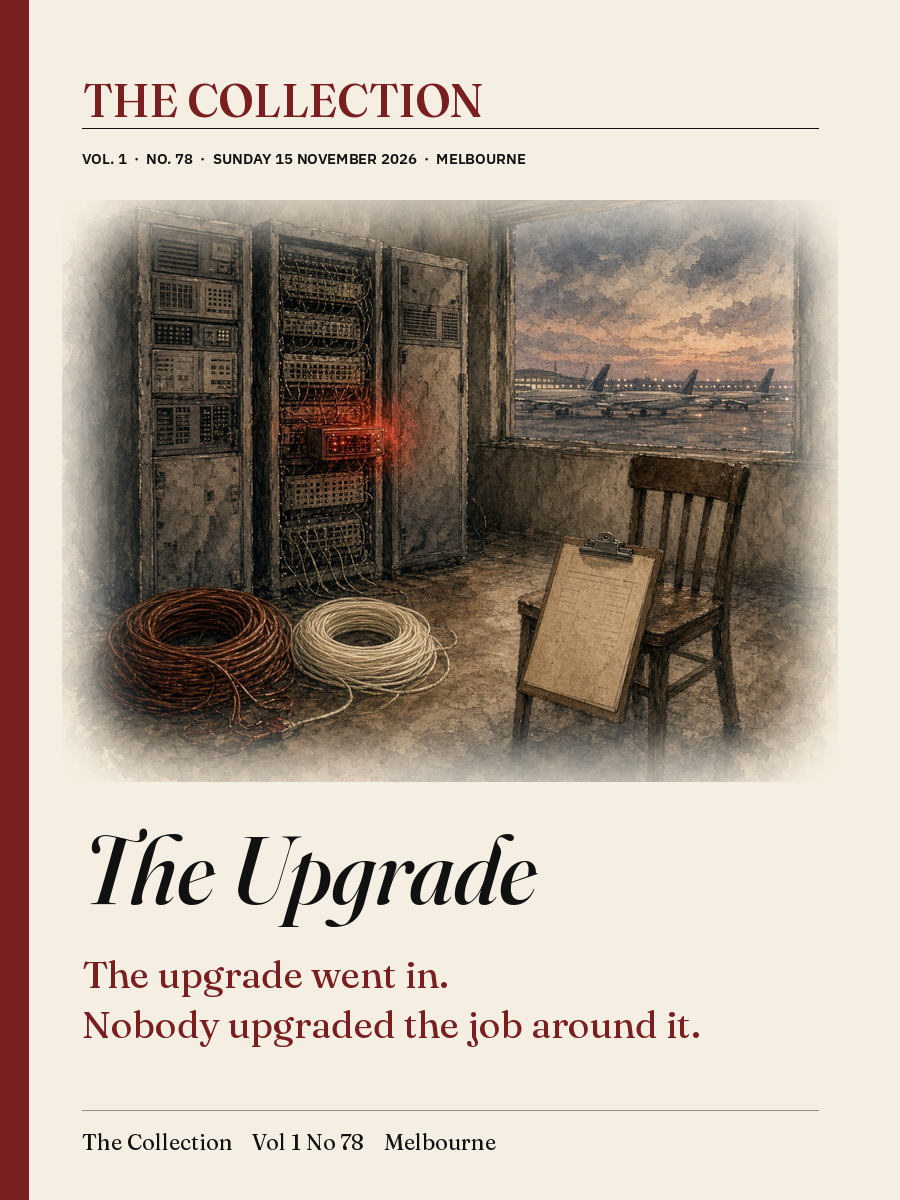
Cover of The Collection, Volume 1, Number 78: The Upgrade. Sunday 15 November 2026, Melbourne. A watercolour of a dim equipment room: network cabinets, a coil of old copper cable beside a coil of new pale fibre, one router glowing oxblood, an empty chair with a blank clipboard, and parked aircraft standing still beyond the window. Skip cover

Vol. 1  ·  No. 78  ·  Sunday 15 November 2026  ·  Melbourne


The Collection

The Upgrade

Collected and edited by Newsletter World, for AK

Contents

Sunday’s letters are about the middle of a change. A copper-to-fibre job halted every flight in America. A Microsoft capacity upgrade left a fault that shrank the very pool it was meant to grow. AI Adopters Club finds strategies rewritten and job descriptions left alone. The Stack’s product week promises in-place updates and faster recovery, and an essay calls it building internal combustion horses. The upgrade went in. Nobody upgraded the job around it.

  1. iiiEditor’s LetterThe upgrade went in. Nobody upgraded the job around it.03
  2. ivA cable swap, a router, and every take-off haltedThe American skies emptied on Friday afternoon. The cause, officials said, was not an attack. It was improvement work.04
  3. vNobody sent more mailMicrosoft’s outage this week also began with an upgrade. The load did not rise. The capacity left.05
  4. viThe strategy changed. The job description did notNearly half of leaders say they changed their AI strategy this year. Barely a quarter changed anyone’s role.06
  5. viiBolted on, rolled back, recoveredThe week’s product news, read for what it says about the middle of a change.07
  6. viiiStanding OrdersFour rules for this issue.08

03  ·  Editor’s Letter

The upgrade went in. Nobody upgraded the job around it.

Yesterday the letters found a switchboard between every question and its answer, and nobody keeping the log. Today the switchboard itself is being rewired, and the lights go out.

Two of the week’s biggest outages began as improvements. In America a crew moving a remote facility from copper to fibre set off a router that overloaded the system, and every take-off stopped. At Microsoft, an earlier network capacity upgrade left an issue that surfaced after a later change, and servers fell out of service while traffic stayed flat. Neither was an attack. Both were somebody doing the right thing to an old system.

The quieter letter explains why that keeps happening. AI Adopters Club reports that nearly half of leaders changed their AI strategy this year and barely a quarter changed anyone’s role. Machines arrive, plans are rewritten, and the job of watching the join between old and new is left to whoever happens to be in the room. The kit was upgraded. The upgrade went in. Nobody upgraded the job around it.

The Collection · The Upgrade03

04  ·  The Ground Stop

A cable swap, a router, and every take-off halted

The American skies emptied on Friday afternoon. The cause, officials said, was not an attack. It was improvement work.

On Friday afternoon in the United States the Federal Aviation Administration issued a ground stop for all flights, and The Stack reports it was not lifted for several hours. By Saturday the explanation had a shape. Transportation Secretary Sean Duffy said work to move a remote facility from copper to fibre-optic cable caused a router to overload the system. Officials ruled out a cyberattack.

Two things in the official account deserve to be read slowly. First, nobody yet knows whether the flaw was in the equipment or in the installation; Duffy said as much, according to the Times. Second, The Stack’s summary says some sort of update to a network operated by L3Harris went haywire, and that Duffy, at his press conference, blamed the FAA’s outdated equipment without giving much detail on the root cause.

It was unknown if the flaw was with the equipment or installation.

Hold both at once and the story is odd. The old kit was the problem, and the work to replace the old kit is what brought the country to a halt. That is not a contradiction. It is what modernisation looks like from the inside: the dangerous hour is the one when old and new are both plugged in, and the people doing the swap are working to a plan written for the end state, not for the middle. A router in a remote building did its job too well. Whose job was it to know that it might?

The Collection · The Upgrade04

05  ·  The Shrinking Pool

Nobody sent more mail

Microsoft’s outage this week also began with an upgrade. The load did not rise. The capacity left.

The Microsoft 365 outage started with Exchange on Thursday and, The Stack says, spread to a bunch of other services into Friday before recovery began on Friday afternoon. The company’s own explanation, posted on X, is a sentence any operations engineer will recognise.

“…the incident was introduced by an issue during an earlier network capacity upgrade that surfaced following a recent network change.” Microsoft, as quoted by The Stack

Read that twice. A capacity upgrade, the thing you do so you never run out, left a fault behind it. It sat quiet until a later change woke it. The Stack’s linked report is headed with the symptom: servers started failing Microsoft’s automated health checks.

Monteiro’s opening supplies the detail that makes it worth studying. Around 19:18 UTC on Thursday, three hours in, Microsoft said the overload on Exchange Online was coming from servers dropping out of service. Overall traffic had not gone up. Nobody was sending more mail. The pool was getting smaller, and every server that left made life worse for the ones that stayed. A health check is a rule written for a world where a sick server is the exception. When the upgrade made sickness the rule, the check kept doing exactly what it was told, and pulled the floor out from under the survivors.

The Collection · The Upgrade05

06  ·  The Dishwasher

The strategy changed. The job description did not

Nearly half of leaders say they changed their AI strategy this year. Barely a quarter changed anyone’s role.

Banc opens with a restaurant. You install a dishwasher, then hand out bonuses for how many plates people wash by hand. Nobody should be surprised when the team keeps scrubbing. And even with sensible targets, somebody has to load the machine, check what comes out, and deal with the wineglass that should not have gone in. The work changes around the machine.

Then the numbers. Kyndryl surveyed 3,700 senior business leaders across 21 countries. Forty-eight per cent said they had substantially changed their AI strategy this year. Only 27 per cent had formally updated roles and responsibilities around AI, and 29 per cent had fully implemented change management. Banc is careful: these are leaders’ own answers, and they do not prove that rewriting job descriptions creates returns. They do pose a question.

“If AI is doing part of somebody’s job, what have we agreed their job becomes?”

Without an answer, the keen employee ends up doing the old job plus supervising the new system, and adoption feels like extra work because it is. Capgemini’s new survey, he adds, found only a third of executives could confidently estimate the indirect costs of AI: oversight, rework, governance. His fix is a written work agreement with four answers: what work stops, what the person still owns, who handles the awkward cases and can pause the workflow, and what counts as doing the job well. “A human checks it” needs a named person, agreed checks, and time to do them.

The Collection · The Upgrade06

07  ·  The Horses

Bolted on, rolled back, recovered

The week’s product news, read for what it says about the middle of a change.

Red Hat’s OpenShift 5 arrived at KubeCon North America with a promise worth noting today: AI workloads, virtual machines and containers side by side “through a simple, in-place update” from OpenShift 4. It ships with agents to help operations teams diagnose and fix issues as they come up. In-place is the dream. After this week, it is also the part to rehearse.

Commvault rolled out Recovery Studio, which it says will orchestrate the recovery of applications, identities, configurations, infrastructure dependencies and datasets together, in a runbook-driven workflow. It pitches recovery faster than what it calls, by its own data, the industry-standard 28 days. The interesting word is configurations. Both of this week’s outages were configuration stories, not lost-data stories.

“Coding agents now write most of the code. The enterprise is bolting them onto a process built for people who wrote it…” Rick Clark, standfirst, as shown in The Stack

OpenStack co-founder Rick Clark’s essay title says the rest: “In the AI coding agent era, we are building internal combustion horses.” The Stack’s gloss is that the systems built for humans to manage software are meaningless to agents, and that will need adjusting. Databricks, meanwhile, says its Genie 2.0 now runs autonomously and emails the human when a decision needs them. Which human, and with what authority to stop it, is the question Banc would ask. The engine is new. The harness is still the one cut for the horse.

The Collection · The Upgrade07

08  ·  Standing Orders

Four rules for this issue

  1. I

    Staff the middle.

    The risky hour is when old and new are both plugged in. Name who watches the cut-over, give them the authority to roll it back, and give them the time.

  2. II

    Test the health check against the upgrade.

    A rule that pulls sick servers is safe until the upgrade makes sickness common. Ask what your automation does when a quarter of the fleet fails at once.

  3. III

    Rewrite one job before the next rollout.

    Answer Banc’s four in writing: what stops, what the person still owns, who handles the awkward cases, and how the work is now judged.

  4. IV

    Count the indirect cost.

    Oversight, rework and governance are part of the price. If you cannot estimate them, you have not finished the business case.