← The stand
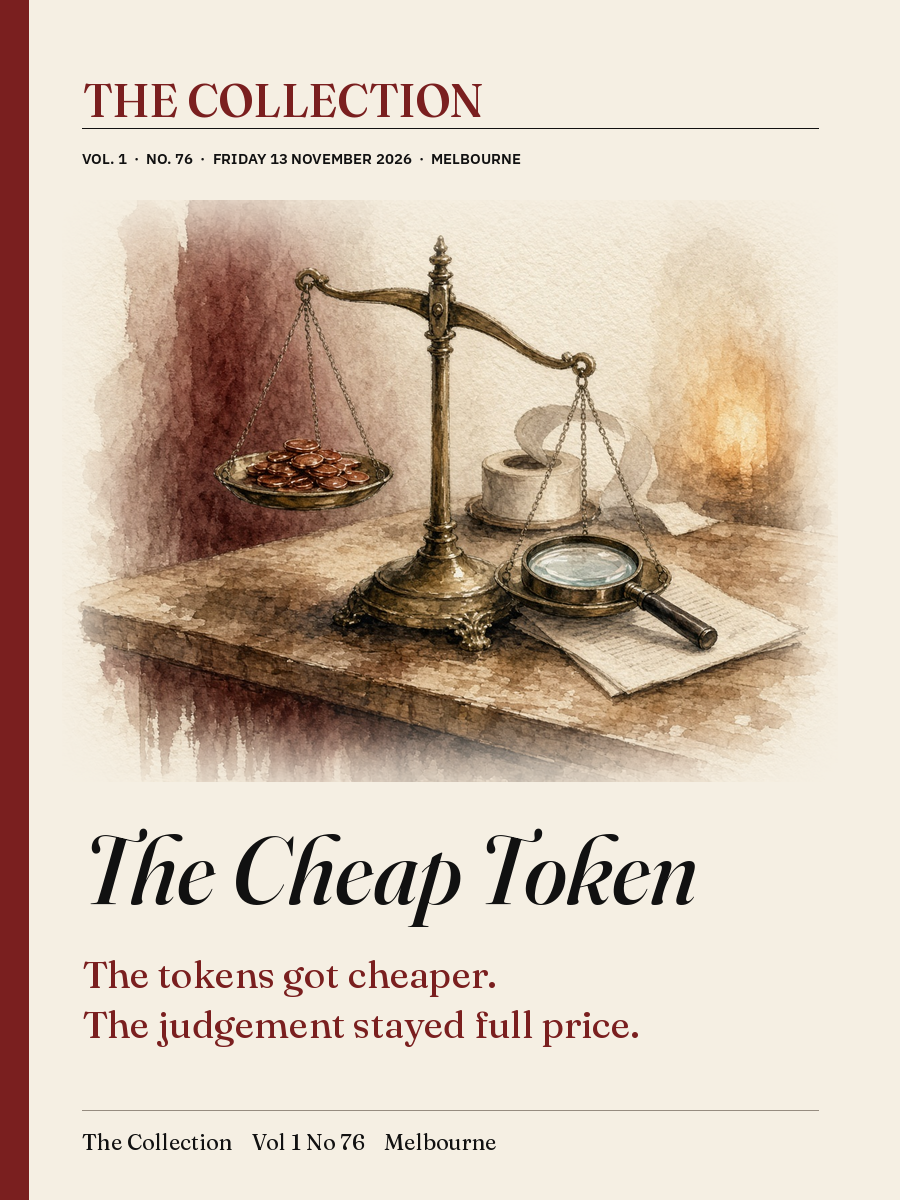
Cover of The Collection, Volume 1, Number 76: The Cheap Token. Friday 13 November 2026, Melbourne. A watercolour of an old brass balance on a wooden counter, a pan of copper coins on one side and a heavy magnifying glass resting on a printed page on the other, the scale tipped toward the glass; a curling receipt roll and lamp light behind. Skip cover

Vol. 1  ·  No. 76  ·  Friday 13 November 2026  ·  Melbourne


The Collection

The Cheap Token

Collected and edited by Newsletter World, for AK

Contents

Friday’s letters are about price. The Pragmatic Engineer opens incident.io’s books: AI spend down from about $4,500 an engineer a month to about $1,600, and the median engineer shipping about 10 per cent more. Devansh explains why Nvidia keeps cutting the cost of inference, and what has to be true for that to pay. Every sketches two new rungs of AI adoption that spend more tokens on choosing a strategy. Mark Cuban lets agents do the grinding and keeps the last word. The tokens got cheaper. The judgement stayed full price.

  1. iiiEditor’s LetterThe tokens got cheaper. The judgement stayed full price.03
  2. ivDown to $1,600 a head, and the median barely movedA reliability startup that measures everything opens its books on AI spend. The price fell fast. The hard part moved somewhere else.04
  3. vSelling the shovels, and cutting their priceNvidia is spending heavily to make inference cheaper. The bet only pays if cheaper work turns into more work worth paying for.05
  4. viTwo more rungs, and a bigger token billEvery’s map of AI adoption ran out at the top. The next levels spend more compute to choose a strategy, not to do the task.06
  5. viiFour models, four answers, one man picksMark Cuban hands the grinding to agents. He keeps the question, and the last word, for himself.07
  6. viiiStanding OrdersFour rules for this issue.08

03  ·  Editor’s Letter

The tokens got cheaper. The judgement stayed full price.

Yesterday the letters were about the one thing nobody kept a spare of. Today they are about the thing everyone now has plenty of: tokens, and what they cost.

The price is falling on every invoice in the mail. incident.io’s bill per engineer dropped by roughly two-thirds when it moved models. Nvidia, by Devansh’s account, is spending to cut inference cost again, up to 45 times on one selected benchmark, betting that cheaper work becomes more work. Every’s next rungs of adoption assume the tokens are cheap enough to burn on rehearsing strategies before reality does.

The other numbers do not move as fast. incident.io’s median engineer ships about ten per cent more than two years ago, and its outages now come from what the agents did not know about production. Mark Cuban lets agents file his records requests, but says the part AI misses is seeing the problem, and he keeps the final call. The claim is short. The tokens got cheaper. The judgement stayed full price.

The Collection · The Cheap Token03

04  ·  The Bill

Down to $1,600 a head, and the median barely moved

A reliability startup that measures everything opens its books on AI spend. The price fell fast. The hard part moved somewhere else.

incident.io was founded in 2021, a year before ChatGPT, and it counts things for a living. So when it shared its AI numbers with Gergely Orosz, it brought a unit: the “effort point”, one medium-sized pull request, whether a person wrote it or an agent did. Nearly 80 per cent of the PRs it ships to production now include agent-written code. Product engineers went from 18 in 2024 to 50. PRs shipped in September were 3.4 times a year earlier, the average PR grew from 22 lines to 111, and the share shipped with no human reviewer went from 12 per cent to 43.

Then the bill. The company is on track to spend about $1.6 million on AI tools this year, around $2,700 an engineer a month. July alone ran past $300,000. Before Opus 5.5 it was paying about $4,500 per engineer per month, mostly on Opus 5; with the new model the figure is near $1,600, about 80 per cent of it on Claude and 20 on Cursor. Cost per effort point peaked over the summer and has come down since.

The median engineer shipped about 10 per cent more PRs: 10.1 a week in October 2024 with no AI, 10.7 in October 2026 with it.

The mean rose about 30 per cent and tenured engineers about 70, from 11.1 to 19 a week. New joiners are told to hold off on AI for their first month, because the ones who leaned on it straight away did worse later. Incidents per 1,000 PRs fell 60 per cent, but there are more incidents overall, because there are more PRs. Most outages used to be wrong code that review could have caught. Now, the team says, most come from information about the production environment that the agent simply did not have. The tokens got cheap. Knowing the floor did not.

The Collection · The Cheap Token04

05  ·  The Price

Selling the shovels, and cutting their price

Nvidia is spending heavily to make inference cheaper. The bet only pays if cheaper work turns into more work worth paying for.

Devansh starts with the puzzle. Nvidia made $89 billion from data centres last quarter, up 117 per cent on a year earlier, at company-wide gross margins of 75 per cent. Yet it keeps building things that let customers need less of its hardware. Its Nemotron Bolt model squeezes 74 billion parameters into 24GB of memory. Its open-source Dynamo inference software promises up to seven times better performance on Blackwell GPUs. Vera Rubin, it says, cuts inference cost up to 45 times against Blackwell Ultra, on a selected benchmark.

His answer is concentration and Jevons. One direct customer was 16 per cent of revenue last quarter, and the biggest buyers are building their own chips. Inference is something almost every business could eventually need, and six inference infrastructure providers have announced more than $7 billion in financing this year, Nvidia in several of the rounds. Make the work cheap enough and new uses appear.

“Jevons Paradox doesn’t guarantee that NVIDIA gets richer.”

For it to work, he writes, customers must spend more on AI, that spending must need more infrastructure, and Nvidia must keep a profitable share. He cites Anthropic’s revenue growing 13 times while its compute expenses grew 4.3 times, and warns that routine workloads drift toward commodity prices while coding, research and agents can justify large reasoning budgets. He notes the piece was largely written before Jensen Huang left Nvidia on 12 November. Alberto Romero’s Algorithmic Bridge reports Huang resigned as president, chief executive and board member; why, and what was behind it, Romero says may never be fully known.

The Collection · The Cheap Token05

06  ·  The Ladder

Two more rungs, and a bigger token bill

Every’s map of AI adoption ran out at the top. The next levels spend more compute to choose a strategy, not to do the task.

In June, Every published eight levels of AI adoption, from Level 1, where you ask a chatbot a question, to Level 8, where a manager agent runs a team of subagents for you. Mike Taylor expected most readers to sit in the bottom half, and most did. What surprised him was how fast the people at the top ran out of map. Most engineers he talks to now run several long-running agents at once and hand the coordination to an orchestrator.

His answer to “what comes next”, from his talk at Thesis: 2027, is simulation: build a model of the world your agents work in, so you can test strategies before reality does. Once agents are managing and doing the work, he writes, the harder question is which strategy to bet on.

Level 9 pits strategies against each other to find the best one. Level 10 runs that competition multiple times to see which win consistently.

He is careful with the caveats. These levels are firmly experimental, they burn many more tokens than the ones below, and working higher up does not guarantee better results today. Read next to incident.io, the shape is plain. The cheap tokens are being spent on deciding, and the simulation is only as good as its picture of the world. That picture is the same thing incident.io’s agents were missing when production broke.

The Collection · The Cheap Token06

07  ·  The Final Call

Four models, four answers, one man picks

Mark Cuban hands the grinding to agents. He keeps the question, and the last word, for himself.

Cuban calls himself “the biggest proponent of AI that there is”, and spends much of the conversation on where it falls short. His first point is variance.

“It’s predictive. It’s not deterministic. Meaning, if you asked 4 different AIs the same question, you’re going to get 4 different answers.”

So any single answer is a draft. His definition of smart is gathering and combining inputs, and the piece he says AI misses is spotting the problem in the first place: the doctor can hold every research report and still has to look at the patient. His working agent is narrow and repeats. For Cost Plus Drugs it tells him when a healthcare conglomerate he calls the problem gets sued or bids on a contract, then drafts the Open Records Act request for the contracts. Before agents, he says, that job meant hiring and managing someone, so it simply stayed undone.

That is the cheap token doing exactly what it is good at: work nobody would pay a person for. What Cuban does not hand over is the framing and the final call. He compares the answers, and he decides.

The Collection · The Cheap Token07

08  ·  Standing Orders

Four rules for this issue

  1. I

    Price the change, not the token.

    Count what a finished, shipped change costs, the way incident.io counts effort points, and expect the number to differ by team. A falling token price tells you nothing about the work.

  2. II

    Watch the median.

    Averages flatter. If the typical engineer moved ten per cent while the bill moved by thousands, find out who is carrying the gain before you scale the spend.

  3. III

    Show the agent the floor.

    When incidents stop coming from bad code and start coming from what the agent could not see in production, the fix is context, not another model.

  4. IV

    Keep the last call.

    Four models give four answers. Let them gather and draft; name the problem yourself, compare what comes back, and sign the decision.