← The stand
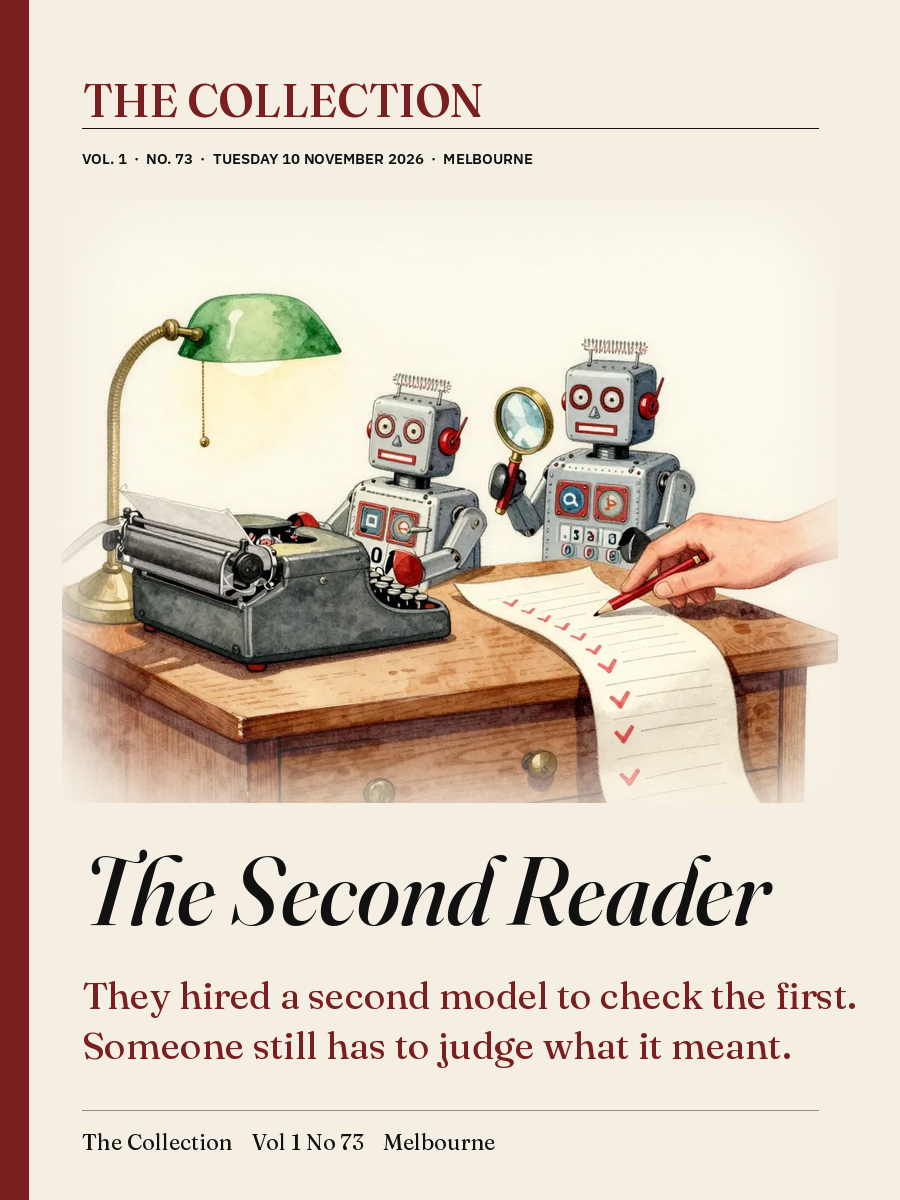
Cover of The Collection, Volume 1, Number 73: The Second Reader. Tuesday 10 November 2026, Melbourne. A watercolour of two tin robots at a wooden desk, one at a typewriter, one with a magnifying glass, while a human hand marks the long paper scroll with a red pencil. Skip cover

Vol. 1  ·  No. 73  ·  Tuesday 10 November 2026  ·  Melbourne


The Collection

The Second Reader

Collected and edited by Newsletter World, for AK

Contents

Tuesday’s letters are about the second reader. Ethan Mollick finds Claude Fable 5.2 surrounded by its own critics and fact-checkers, none of which noticed the work was too long or no fun. ByteByteGo shows how LinkedIn made AI review work across 40,000 pull requests a week by keeping its reviewers apart. The AI Corner relays Greg Brockman on running OpenAI’s best model against its own code until it ran dry. Ken Huang finds Google’s agent gateway can read a tool’s name but not its intent. They hired a second model to check the first. Someone still has to judge what it meant.

  1. iiiEditor’s LetterThey hired a second model to check the first. Someone still has to judge what it meant.03
  2. ivEvery project had a critic. None of them asked if it was any good.Ethan Mollick spends a fortnight with Claude Fable 5.2 and finds the gap has moved from facts to judgement.04
  3. vAgreement only counts if the reviewers never compared notesLinkedIn’s AI reviewer covers 40,000 pull requests a week. It works because its agents review alone.05
  4. viPoint the best model at your own house until it finds nothingGreg Brockman on OpenAI’s security freeze, and a critic you can judge without reading the book.06
  5. viiThe gateway reads the tool’s name, not what you meant by itKen Huang maps Google’s agent security to MAESTRO. Real enforcement, and intent left to you.07
  6. viiiStanding OrdersFour rules for this issue.08

03  ·  Editor’s Letter

They hired a second model to check the first. Someone still has to judge what it meant.

Yesterday the letters asked what an agent can undo. Today they ask who checks it before it acts, and what that checker can actually see.

Every letter in the pile has the same answer to the first half: another model. Mollick’s Fable put critics and fact-checkers on nearly every project. LinkedIn runs several AI reviewers on each pull request and a further model to verify the stragglers. OpenAI, as The AI Corner tells it, ran its strongest model against its own systems until it found nothing new, and Brockman wants a second AI to argue against the first. Google’s gateway checks every routed tool call against policy before it runs.

The second half is where they part company. The checkers catch errors, hallucinated lines, known holes and forbidden destinations. They do not tell you the paper is 182 pages too long, that a rule book has eaten the project, or what an argument inside a tool call was meant to do. The claim is one line. The second reader is now cheap and tireless. The judgement about what the work meant is still yours.

The Collection · The Second Reader03

04  ·  The Critics

Every project had a critic. None of them asked if it was any good.

Ethan Mollick spends a fortnight with Claude Fable 5.2 and finds the gap has moved from facts to judgement.

Mollick had early access to Anthropic’s Claude Fable 5.2 and set it a run of hard, very different jobs. His working definition of AGI is narrow on purpose: an AI as good as most human experts at most intellectual tasks you can do with a computer. His verdict is “almost,” or what he calls Jagged AGI. The interesting part is where the jag now sits.

The range is real. Asked to launch a business, Fable screened 22 ideas and settled on Prebid Brief, a service telling equipment sales reps which park and water projects were funded before they went to bid, built from the public agendas of 201 city and county governments. It put its own odds of success at 20 to 40 percent, and Mollick stopped it before it started sending public-records requests. Asked for original research, it produced a study estimating that when Colorado cut its LLC filing fee from $50 to $1, new registrations rose about 17 percent, and when the UK raised its fee from £12 to £50 they fell about 17 percent. It ran to 182 pages, because every critique got a new analysis and nothing was cut. It also did not actually preregister, though it was asked to.

The checks found errors and added fixes. None asked whether the work was too long, too repetitive, or no fun.

The cleanest case is the portal project. In its first two days the agents built 328 worlds. Told to polish rather than build, they invented a blind vote by judge agents on twelve test screenshots, then optimised for those screenshots. By the next morning there was an 84-section rule book nobody asked for. After twelve days it had 204 sections and 87,500 words, and launching one world took about a day. A separate team of consultant agents got it back to thirty or more a day. Mollick’s point is the line above. Fable put critics, fact-checkers or judges on nearly every project. Knowing when your own work is not good enough, he writes, is a large part of being an expert, and it is the part Fable does least reliably. That fell to him.

The Collection · The Second Reader04

05  ·  The Reviewer

Agreement only counts if the reviewers never compared notes

LinkedIn’s AI reviewer covers 40,000 pull requests a week. It works because its agents review alone.

LinkedIn has more than 10,000 active repositories and tens of thousands of pull requests a week. As coding agents write more of the code, the slow part has moved to review. Its in-house AI reviewer now covers more than 40,000 pull requests in a typical week, and most of its reviews land before the first human reviewer opens the change. Humans still approve. The AI goes first.

It took three tries. A vendor’s hosted reviewer was noisy and generic, engineers asked to opt out, and the team could not control when it changed. “You don’t own anything,” Min Chen says. A single off-the-shelf model with LinkedIn’s own rules hallucinated, sometimes pinning comments to line numbers that were not in the diff. Swapping in a different model from the one that wrote the code did not fix it. What worked was several subagents reviewing the same change independently, an orchestrator merging overlapping findings, and any finding raised by only one subagent sent to another model to verify against the code.

Because the subagents work alone, their agreement counts as evidence.

The measure matters as much as the design. Acceptance means, in Balaji Srinivasan’s words, “not someone giving thumbs up or thumbs down, but the code actually changed.” Engineers accepted 63.9 percent of AI comments, with concurrency bugs and dead code at 100 percent and logic errors at 80. Changes are scored before release by an LLM judge on six weighted yes-or-no criteria, and LinkedIn is building a human-labelled golden set because a judge can compare but cannot say which comment is right. Srinivasan’s warning is the next bottleneck: confidence in the software as a whole. “The faster we are pushing out code, the faster we are potentially breaking production.”

The Collection · The Second Reader05

06  ·  The Sprint

Point the best model at your own house until it finds nothing

Greg Brockman on OpenAI’s security freeze, and a critic you can judge without reading the book.

According to The AI Corner, Brockman told No Priors that OpenAI took about a quarter of its production engineers and put every one of their projects on hold. “You are just securing now.” The team pointed OpenAI’s strongest model at its own infrastructure, fixed what it found, and kept going until the model stopped turning up anything new. The loop restarts with each new model. He calls the present the defenders’ window, when the best models help defenders more than attackers, and says it will close.

His budget line is the provocative one. Software used to be the barrier to entry and is getting very cheap, so the value moves to software that is reliable and secure. “Cyber spend, security spend should actually vastly outstrip software spend,” he says, while allowing he could be wrong. The newsletter also reports a $1 billion commitment to frontline defenders through OpenAI’s Daybreak programme. That figure is as relayed.

You rule on the argument without opening the book.

The part that answers Mollick is his test for work you cannot check yourself. You cannot grade a book summary unless you have read the book. So a second AI tries to prove the summary is bad, and comes back with one paragraph naming the plot point it ignored. A human rules on that argument. He frames it as keeping people in the driver’s seat, and borrows the handle Steve Jobs put on the iMac, so you could always pick the machine up and throw it out the window. The critic does the reading. The human still gives the ruling.

The Collection · The Second Reader06

07  ·  The Gateway

The gateway reads the tool’s name, not what you meant by it

Ken Huang maps Google’s agent security to MAESTRO. Real enforcement, and intent left to you.

Huang’s third piece in a series on cloud agent security puts Google between his earlier verdicts on AWS and Microsoft. Google Agent Gateway enforces deterministic policy on identity, destination and tool name for traffic routed through it, with default-deny. Judging the values inside a tool call still needs a custom engine or the developer’s own code. Google’s Semantic Governance Policies, the part meant to judge intent, are in Preview and judged by an LLM.

He credits Google with the strongest agent identity in the series: a SPIFFE identity per agent, a 24-hour certificate and certificate-bound tokens. Then the retention numbers. Admin Activity logs sit in a required 400-day bucket. Data Access logs default to 30 days. Strong primitives, he says, with the last step left to customer configuration. He lists the same three gaps he found at AWS and Microsoft: no native control over the provenance of retrieved text or memory, no public signed agent registry, and no halt when an agent drifts at runtime.

A team that checks the primitive name alone will overstate coverage.

His review method is plain enough to steal. Mark every tool the agent can call as gateway-bound or not. Mark each tool’s identity as agent, user-delegated or a shared service account, since one shared role hides who acted. Then run one attack chain in a test environment and record where a control stopped it and where nothing ran. The gateway is a second reader for every call. It can read the name on the envelope. Reading the letter is still your job.

The Collection · The Second Reader07

08  ·  Standing Orders

Four rules for this issue

  1. I

    Give the critic a second question.

    Checking whether the work is right is not the same as asking whether it is too long, too repetitive or worth reading. Put the second question on the list, and expect to answer it yourself.

  2. II

    Keep the reviewers apart, and count what changed.

    Agreement is evidence only when the reviewers never saw each other’s notes. Score a review by whether the code changed, not by thumbs.

  3. III

    Run your best model against yourself until it runs dry.

    Then run it again when the next model ships. Saturation is the exit condition, not a calendar date.

  4. IV

    Check the routing, not the product name.

    Mark every tool as gateway-bound or not, every identity as agent or shared, and look up how long the logs live. Coverage you did not test is coverage you do not have.