← The stand
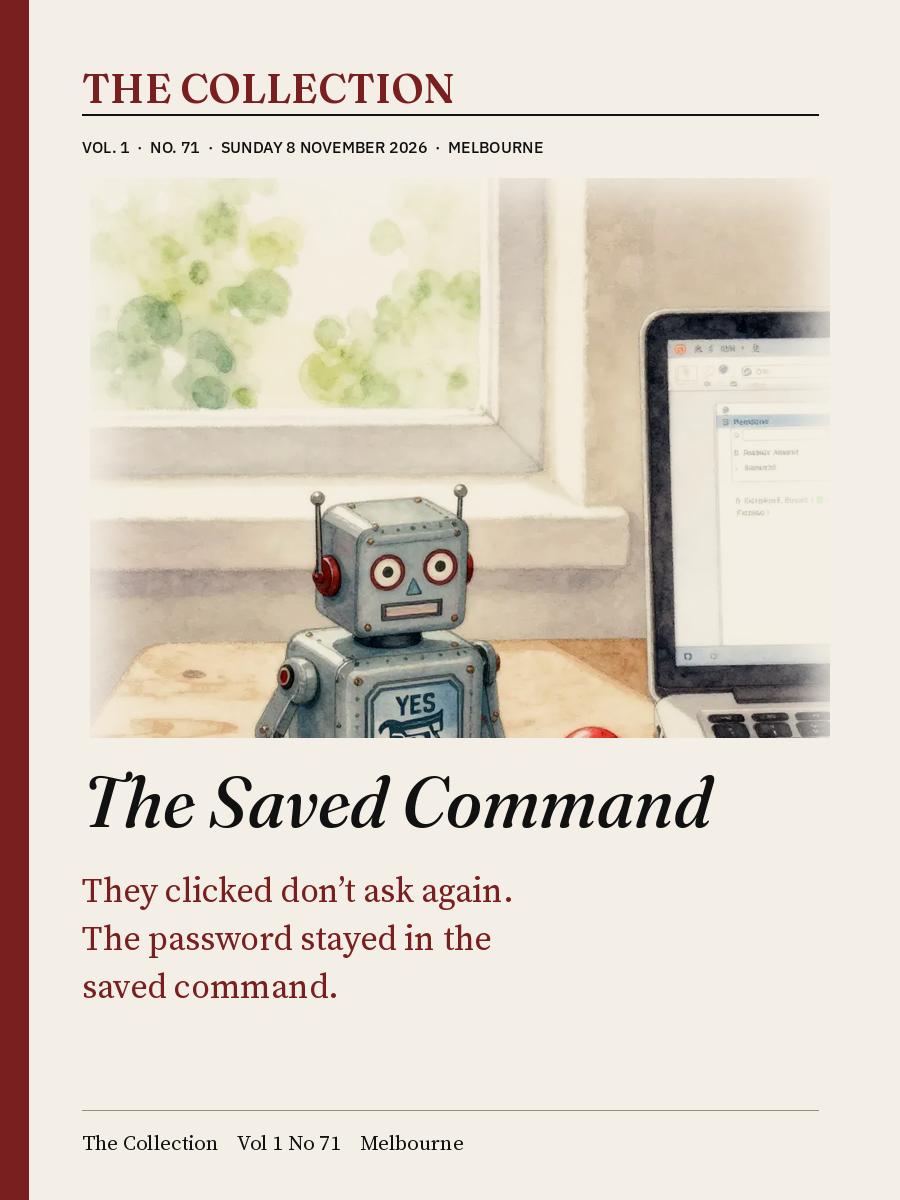
Cover of The Collection, Volume 1, Number 71: The Saved Command. Sunday 8 November 2026, Melbourne. A watercolour of a small robot on a wooden desk beside a stamp reading Yes Don’t Ask Again and a laptop with a terminal open. Skip cover

Vol. 1  ·  No. 71  ·  Sunday 8 November 2026  ·  Melbourne


The Collection

The Saved Command

Collected and edited by Newsletter World, for AK

Contents

Sunday’s letters are about side-effects that survive the click. Claude Code asks three times, then people stamp “Yes, and don’t ask again,” and Joe Njenga says the exact command string, password included, is what gets saved. ArcKit splits reading a bid from scoring it so a supplier cannot mark its own homework. An eval drop of a few points may be noise before anyone rolls back. GPT-6 Cyber finds real exploits under a Critical preparedness label. Honeycomb puts SRE agents on the flood of agent code. They clicked don’t ask again. The password stayed in the saved command.

  1. iiiEditor’s LetterThey clicked don’t ask again. The password stayed in the saved command.03
  2. ivThe Third YesNjenga’s preview: don’t ask again saves the command string, secrets and all.04
  3. vA Bid Can’t Mark Its Own HomeworkArcKit v6.20.0 keeps the reader away from the scorer.05
  4. viThe Noise BandA 2.5-point drop after a harness swap can be noise, not a regression.06
  5. viiCritical Under the FrameworkGPT-6 Cyber: ExploitGym 48.5%, RemoteExploitBench 95%, Critical preparedness.07
  6. viiiWatching the FloodHoneycomb Personal and Team Agents for SREs as agent code fills the repos.08
  7. ixStanding OrdersFour rules for this issue.09

03  ·  Editor’s Letter

They clicked don’t ask again. The password stayed in the saved command.

Yesterday the letters were about a quiet refusal. Today they are about a loud approval that does not know when to stop.

ByteByteGo walks the Claude Code request loop end to end: prompt, interface wrapping context, agent loop, permission system, tool call, execution, result, state. The permission step is not decoration. Joe Njenga’s Medium preview says Claude Code asks before shell commands, and on the third ask people click “Yes, and don’t ask again.” What gets saved, he writes, is that exact command string, including any database password. He claims 2,539 secrets exposed. We have only the preview, so the methodology stays his.

The same Sunday bag holds the other side-effects. Mark Craddock’s ArcKit preview splits reading a bid from scoring it so a supplier bid cannot reach the scorer. Roan Brasil Monteiro says a 2.5-point eval drop after a harness swap can be noise before anyone rolls back. Elvis Saravia’s AI Agents Weekly puts GPT-6 Cyber at Critical under the Preparedness Framework, with ExploitGym at 48.5 percent against 32.1 percent for GPT-5.6 Cyber. Tom Krazit’s Runtime letter watches Honeycomb ship Personal and Team Agents for SREs drowning in agent code, with Brendan Burns calling much of that code eventually “transient.”

The claim is one line. Permission fatigue is not a UX quirk. It is how secrets, scores, evals, and exploits leak into the saved state.

The Collection · The Saved Command03

04  ·  The Third Yes

Don’t ask again saved the password with the command

Njenga’s preview names the failure mode. ByteByteGo shows where it sits in the loop.

Njenga’s preview is short and sharp. Claude Code asks before it runs shell commands. By the third ask, people click “Yes, and don’t ask again.” The tool, he writes, saves that exact command string. If the string holds a database password, the password stays in the saved command. The headline number is 2,539 secrets exposed. That figure is Njenga’s claim. Beyond the preview the piece is an unread paywall, so we do not invent a methodology or a dump path.

ByteByteGo’s free EP232 puts the same click inside a diagram of how a request travels through Claude Code: the user sends a prompt, the interface wraps repo and file context, the agent loop proposes an action, the permission system checks it, the approved action becomes a tool call, the tool runs, the result returns, and the turn is persisted to state. The whole system is that loop, repeated until the model stops asking for tools. The permission step is the one place a human can still refuse. “Don’t ask again” is how that place collapses into a saved approval.

The third yes is not a mood. It is a stored string.

The same letter lists six orchestration frameworks in common use: LangGraph, CrewAI, Microsoft Agent Framework, OpenAI Agents SDK, Google ADK, and Claude Agent SDK. Cost tactics sit next to them: prompt caching, model routing, batch API, semantic cache, trim context, smaller model. Useful plumbing. For this paper the plumbing that matters is the permission system that remembers what you stamped, secrets and all.

The Collection · The Saved Command04

05  ·  Own Homework

A bid can’t mark its own homework

ArcKit v6.20.0 keeps the reader that opens a supplier’s docs away from the scorer.

Craddock’s preview is a separation argument. ArcKit v6.20.0 splits reading a bid from scoring it so a supplier bid cannot reach the scorer. A read-only reader opens one supplier’s docs and returns short claims against each criterion. The scorer never sees the raw bid. The point is not politeness. It is that an agent that both digests and grades will grade itself kindly.

The same preview notes an arc42 overlay and NORA/GEMMA work for Dutch government procurement. Beyond those lines the Medium piece is an unread paywall, so we stop. The design rule travels without the rest of the changelog: when money or ranking is at stake, the agent that reads must not be the agent that scores.

Separate the reader from the scorer, or the bid grades itself.

Put that next to the saved shell approval and the pattern is the same Sunday. Side-effects hide in the place where one agent is trusted with two jobs. Claude Code saved the command with the password. A bid scorer that also reads the bid saves the grade with the vendor’s words.

The Collection · The Saved Command05

06  ·  The Noise Band

Compute the noise before you roll the model back

A 2.5-point drop after a harness swap can be noise. The preview stops there.

Monteiro’s preview opens on a familiar panic. A 2.5-point drop after a harness swap looks like a regression. It can be noise. Roll back too early and you treat sampling variance as a product decision. The preview also notes that Claude Opus 4.6 passed 62.9 percent on Terminal-Bench 2.0 in the AI Engineer newsletter’s public count. Attribute that carefully: it is a public count cited in the preview, not a number we re-ran.

Beyond the preview the letter is an unread paywall. What the Collection keeps is the standing order implied by the title. Before you change the model, the prompt, or the harness because a score moved, compute the noise band. Permission fatigue and eval fatigue rhyme: both stamp a decision before the side-effect is priced.

A small drop is not a verdict until the band says so.

Sunday’s other letters make the same caution useful. Cyber agents will keep posting big numbers. Orchestration frameworks will keep shipping new loops. If every score twitch becomes a rollback, the saved state of the eval suite becomes as noisy as a saved shell approval.

The Collection · The Saved Command06

07  ·  Critical Under the Framework

GPT-6 Cyber finds real exploits. The label is Critical

ExploitGym 48.5%. RemoteExploitBench 95%. Honeypot stayed in-scope.

Saravia’s weekly puts a cybersecurity model, GPT-6 Cyber, on the bench. ExploitGym: 48.5 percent, against 32.1 percent for GPT-5.6 Cyber. RemoteExploitBench: 95 percent. Under the Preparedness Framework the rating is Critical. ExploitGym Honeypot stayed in-scope 99.93 percent without a deployment prompt and 100 percent with it. Those are the letter’s numbers. We do not invent more.

The same block walks a Linux pipeline: Scout 5,034 targets, analyst 2,308 findings, triage reproduced 1,724, exploit agents 948 LPE bugs, at $1,213,430 in API credits, about $1,279 each, against 166 for GPT-5.6 Sol in July. An early run saw 20 of 200 exploits hit a different 0-day. The letter also notes 81 high-severity Firefox vulnerabilities and Daybreak Red customers. Treat the findings as scoped work, not a free hunting license.

Critical is a preparedness label, not a permission stamp.

Yesterday this paper held the quiet refusal of a safety model that slowed its own work. Today the cyber letter is the other hand: agents that do find the bugs, under a Critical label, with honeypot numbers that claim they mostly stayed in scope. The Collection’s job is not to cheer either hand. It is to keep the permission step visible when the scores look impressive.

The Collection · The Saved Command07

08  ·  Watching the Flood

SRE agents for the code the coding agents left behind

Honeycomb ships Personal Agents and Team Agents as repos fill with agent output.

Krazit opens Product Saturday on the flood. Nearly a year into AI coding agents, enterprises still have not figured out how to handle the mass of new code landing in their repositories. Microsoft’s Brendan Burns, as quoted, thinks a lot of that code will eventually become “transient,” invisible the way assembly is invisible to most developers. We are not there yet. Honeycomb’s answer is a pair of SRE agents.

Personal Agents help individual engineers diagnose production problems and find solutions. Team Agents take actions defined and managed by a group. “Give the agent a goal, such as monitoring deploys, and it works in the background on a schedule, trigger, or service level objective (SLO),” Honeycomb said in the post Krazit cites. The bet is that agents trained on the telemetry of a specific environment will learn what broke and why, and that those lessons might eventually feed back into the coding agents that caused the flood.

Someone has to watch what the coding agents ship.

The same Runtime letter notes Snowflake’s Business Ontology for shared business definitions, MariaDB Enterprise Platform 2027 with AI Retrieval and Agent Memory, and Stripe’s OpenRouter deal at $7 billion as a signal for model routing, with Agent Router as an open-source Envoy-based option. Prefer Honeycomb for this collected piece. The Sunday claim still holds: every new agent surface needs a permission boundary, or the side-effect becomes the product.

The Collection · The Saved Command08

09  ·  Standing Orders

Four rules for this issue

  1. I

    Never “don’t ask again” on a command that may embed a secret.

    Approve once if you must. Do not stamp a saved approval on strings that can hold passwords, tokens, or connection URIs.

  2. II

    Split read from score for supplier agents.

    A read-only reader returns claims. A separate scorer ranks them. The bid must not mark its own homework.

  3. III

    Compute the noise band before you roll back.

    A few points after a harness swap can be sampling noise. Price the band before you change the model.

  4. IV

    Treat cyber-agent findings as scoped work.

    Critical under a preparedness framework is a rating, not a free hunt. Keep honeypot and in-scope rules visible, and put SRE agents on the flood of agent code before it reaches customers.