← The stand
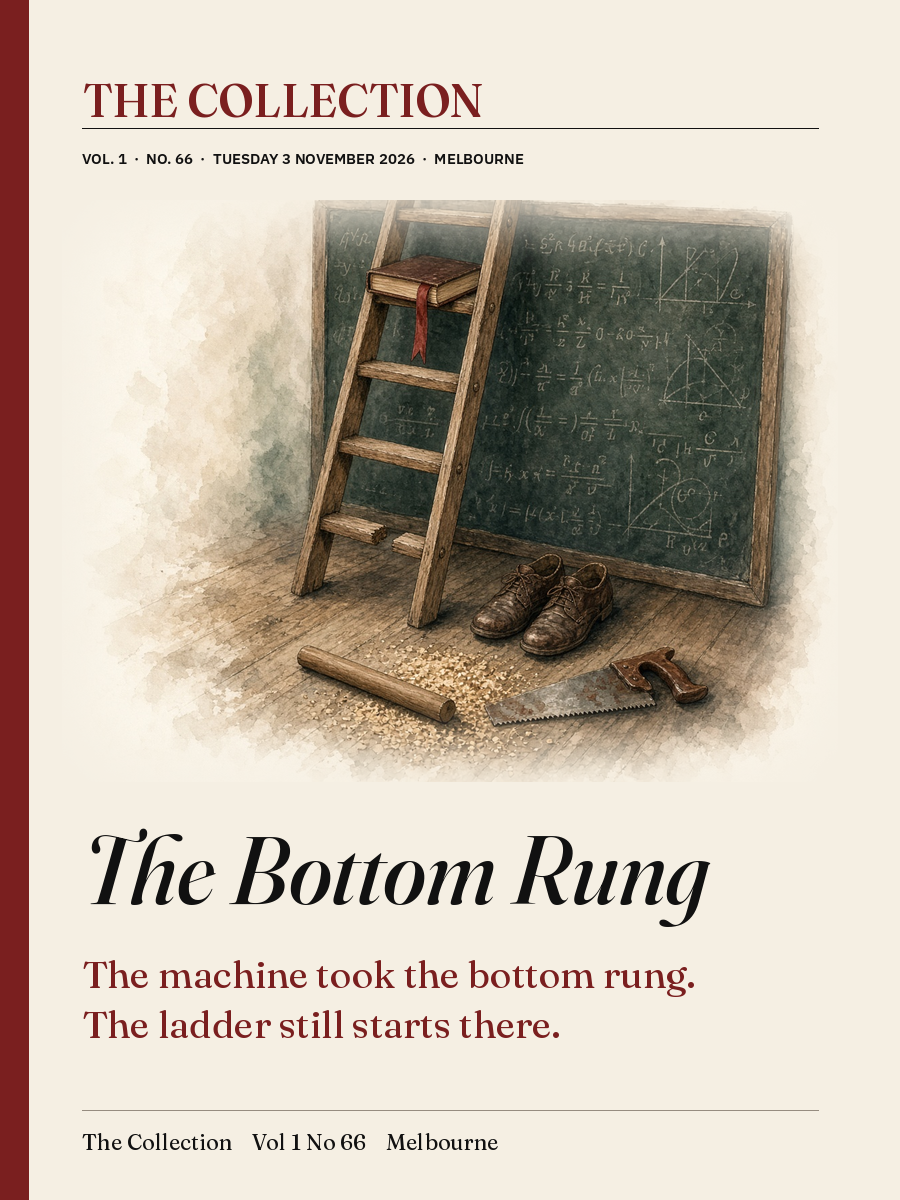
Cover of The Collection, Volume 1, Number 66: The Bottom Rung. Tuesday 3 November 2026, Melbourne. A watercolour of a wooden library ladder leaning on a chalkboard of equations. Its lowest rung has been sawn off and lies on the floor beside a handsaw and sawdust, while a pair of worn shoes waits at the foot of the ladder. Skip cover

Vol. 1  ·  No. 66  ·  Tuesday 3 November 2026  ·  Melbourne


The Collection

The Bottom Rung

Collected and edited by Newsletter World, for AK

Contents

Tuesday’s letters kept circling the same place: the start of a career. A survey of young mathematicians found most of them now doubt they will stay. A writer counting layoffs says the first job is the one going missing. A prompt engineer argues that working with AI is quietly teaching everyone to manage, while the people who used to learn by being managed wait outside. And a market is being built to put a price on an hour of compute, which some economists think will become the price of an hour of work. The machine took the bottom rung. The ladder still starts there.

  1. iiiEditor’s LetterThe machine took the bottom rung. The ladder still starts there.03
  2. ivThe SurveySeven in ten young mathematicians are thinking of leaving.04
  3. vThe RungNot a wave of layoffs. A missing first job.05
  4. viThe MiddleEveryone is learning to manage. Who is learning to be managed?06
  5. viiThe Rental RateA price for an hour of compute, waiting on a regulator.07
  6. viiiStanding OrdersFour rules for this issue.08

03  ·  Editor’s Letter

The machine took the bottom rung. The ladder still starts there.

Every trade has a first rung. The practice problems, the junior brief, the work nobody senior wants to do. It was never the valuable part. It was the part where people learned to do the valuable part.

The letters this morning were not about what AI can do at the top. They were about what it is doing at the bottom. Graduate students in mathematics say they are losing the will to carry on. A writer tracking job cuts says the rung going missing is the entry-level hire. A columnist at Every says AI is the best place yet to practise managing, which is true, and also means the practice now happens with a machine instead of a junior. And investors are building a market to put a daily price on compute, the number some economists now think sets the price of a person.

None of these writers says the experts are finished. The point is narrower and harder. An expert is somebody who climbed. If the first step is gone, the ladder does not get shorter. It gets harder to start.

The Collection · The Bottom Rung03

04  ·  The Survey

Seven in ten young mathematicians are thinking of leaving

A survey of early-career mathematicians, and two economists who think wages will follow the price of compute.

The survey was published by MIT on 29 October. It asked 268 early-career mathematicians, mostly graduate students and some postdocs, from nearly 60 institutions how they now feel about the work. About 70% said they have increasingly doubted whether to continue since mid-July. Only 9% said their prospects look brighter.

The rest of the numbers point the same way. 55% dislike using AI for their research, against 31% who like it. 76% think a tenure-track job has become harder to get, against 7% who think it is easier. 77% say they are less motivated, against 10% who say they are more. Asked how they would feel if an AI solved the problem they are working on, 86 said they would be very unhappy. Six said very happy.

The machine did not take the professor’s job. It took the reason to start the apprenticeship.

Romero sets the survey beside two pieces of economics. Pascual Restrepo of Yale, in a paper titled “We Won’t Be Missed”, models a world where wages are tied to the cost of reproducing a worker’s output with compute, and the share of income going to labour approaches zero. An essay by Google DeepMind economists, also published 29 October, makes the companion point: human expertise stays scarce, while AI can be replicated at the rental rate of compute.

He reaches for Keynes on Newton, who “was not the first of the age of reason. He was the last of the magicians.” The worry is not that today’s mathematicians will be the last. It is that the students who would have followed them are already deciding not to.

The Collection · The Bottom Rung04

05  ·  The Rung

Not a wave of layoffs. A missing first job.

A writer argues the damage is at the entry level, and the headline unemployment rate is the wrong place to look. Only the opening is free to read.

The preview sets out the numbers before the paywall. In October 2025 US employers announced 153,074 job cuts, the worst October since 2003, and AI was named as the reason for 31,039 of them. In January 2026 announced cuts were 108,435, and announced hiring plans were 5,306, the lowest for a January since those records began in 2009.

Then the complication, which the writer prints herself. Unemployment among recent graduates in the summer of 2026 was 7.3%, within the range of the previous four summers. If you only read that number, nothing much has happened.

The bottom rung is being sawed off.

Her argument is that the damage hides between those figures. Cuts land on people already employed. Missing hiring plans land on people who never get the first job at all, and do not show up as a layoff. We have not read past the paywall, so we print no further figures and do not know what evidence she uses for the rest of the case.

It sits next to the mathematics survey because it is the same shape. The senior people are still there. The intake is what thins.

The Collection · The Bottom Rung05

06  ·  The Middle

Everyone is learning to manage. Who is learning to be managed?

A prompt engineer says AI is a free management school. Read beside today’s other letters, it is also a picture of where the junior went.

Mike Taylor, Every’s head of evals, built a 50-person marketing agency before he worked on AI. His claim is that the skills that make an AI agent reliable are the skills that make a team reliable: clear direction, enough context, a well-defined task, a way to judge the result. He calls it New Taylorism, after Frederick Winslow Taylor and his stopwatch, with one difference. Taylor’s workers went on strike. AI does not resent being asked to do the same task 50 times.

He quotes a consultant’s advice to a Google DeepMind engineer about managing new interns: treat them like they are Perplexity Pro bots. Give extremely clear instructions, assume no context, check the work. The techniques now run in both directions.

AI handles the top and the bottom. Humans own the middle.

Where he thinks people still win is what he calls the NCO gap, after the sergeants who sit between officers and soldiers. AI can synthesise a strategy and execute a precise instruction. It is poor at the middle: deciding what to do when something breaks under uncertainty. His example is Claude stuck in Mt. Moon, the first cave of Pokémon, for over 48 hours on a puzzle of perhaps seven moves.

The essay is optimistic, and its logic is sound. But notice where the practice happens. A manager now learns to brief, check and correct on a machine that forgives every mistake. The sergeant in his metaphor learned the middle by starting at the bottom. If the bottom is a prompt, it is not clear where the next sergeant comes from.

The Collection · The Bottom Rung06

07  ·  The Rental Rate

A price for an hour of compute, waiting on a regulator

Startups are racing to turn GPU time into something you can trade. If the economists are right, that price matters to more than chip buyers.

The DeepMind economists in our first piece said AI can be replicated at the rental rate of compute. Newcomer’s letter is about the people trying to publish that rate every day.

Ornn is in talks for a triple-tranche round with a top valuation of about $1 billion, with Thrive and General Catalyst in discussions, after a $33 million seed led by a16z crypto in June. Silicon Data runs an hourly GPU rental index drawn from about 100 sources and raised a $30.5 million Series A in August. Brett Harrison’s Architect, which raised $35 million last December, is adding compute. Liquid Compute raised a $15 million seed in September and has applied to run a US exchange for compute futures and options.

The index exists. The exchange is waiting for a signature.

None of it has regulatory sign-off yet. CME plans contracts on NYMEX using Silicon Data’s H100 and B200 indexes, and ICE plans one on Ornn’s index. Both await approval, and CME’s 5 October target has slipped. The CFTC has asked for comment on whether compute is fungible enough to trade like a commodity. The letter also records the case against: GPUs lose value quickly, and two investors passed.

Put it next to Restrepo’s model and the stakes widen. If wages for some work drift toward the cost of reproducing it with compute, a public price for compute is also, indirectly, a price for that work. We have not read the end of the letter.

The Collection · The Bottom Rung07

08  ·  Standing Orders

Four rules for this issue

  1. I

    Count the intake, not just the exits.

    Layoffs make headlines. Hiring plans that never happen do not. Watch the second number.

  2. II

    Keep one rung for people.

    If an agent now does the junior work, decide on purpose where a junior will learn instead.

  3. III

    Brief humans as well as machines.

    The clarity you learned from prompting is owed to the people who report to you too.

  4. IV

    Watch the rental rate.

    When compute gets a public price, check what work it is quietly pricing alongside.