← The stand
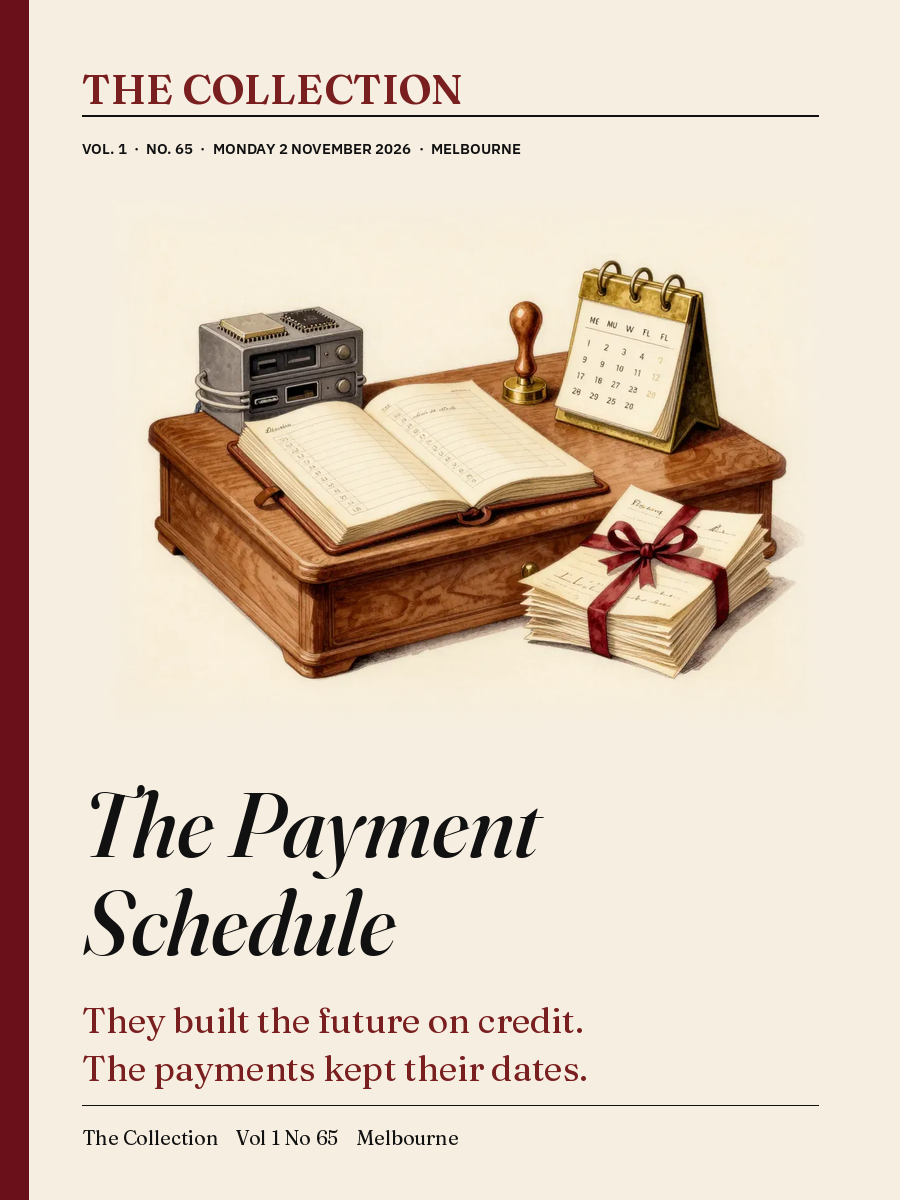
Cover of The Collection, Volume 1, Number 65: The Payment Schedule. Monday 2 November 2026, Melbourne. A watercolour of a polished wooden ledger desk: an open payment ledger with ruled columns, a small grey box of computer chips, a brass-handled stamp, a ring-bound desk calendar and a stack of promissory notes tied with an oxblood ribbon. Skip cover

Vol. 1  ·  No. 65  ·  Monday 2 November 2026  ·  Melbourne


The Collection

The Payment Schedule

Collected and edited by Newsletter World, for AK

Contents

Monday’s letters were written by people reading balance sheets, not demos. Microsoft and Alphabet are now borrowing to build. SpaceX is leasing its chips. Korea learned in a month what happens when one product carries a whole stock market. A finance writer explains why a growth multiple does not shrink so much as disappear. Reddit found out what an AI answer is worth to the site it was taken from. And one writer, behind a paywall, says the first thing to break would be a bond. They built the future on credit. The payments kept their dates.

  1. iiiEditor’s LetterThey built the future on credit. The payments kept their dates.03
  2. ivThe ScheduleThe cash machines started borrowing.04
  3. vThe NodeA trillion dollars of Korea, gone in a month.05
  4. viThe SwitchThe multiple does not compress. It gets replaced.06
  5. viiThe ClickThe answer arrived. The visitor did not.07
  6. viiiThe BondNot a chart. A coupon.08
  7. ixStanding OrdersFour rules for this issue.09

03  ·  Editor’s Letter

They built the future on credit. The payments kept their dates.

A ledger has two columns and no opinions. On one side, what came in. On the other, what is owed and when. It does not care how clever the thing you bought is.

For three years the AI build-out was paid for out of the first column. The biggest companies in the world simply had the cash. This weekend’s letters record the moment that stopped being true. Alphabet spent more on building than its operations brought in. Microsoft sold bonds for the first time since 2017. SpaceX agreed to lease its chips rather than buy them. Each is a sensible decision. Each also writes a date into the second column.

The rest of the issue is about what sits on the other side of those dates. A Korean market that rose on memory chips and fell on them. A valuation rule that flips the day growth slows. A website whose readers now get their answers somewhere else. Nobody here says the machines will stop improving. The point is quieter. Improvement is monthly. Payments are scheduled.

The Collection · The Payment Schedule03

04  ·  The Schedule

The cash machines started borrowing

Microsoft, Alphabet and SpaceX each found a different way to pay for compute. All three end in a repayment date.

Start with the company that can still afford it. In the September quarter Microsoft generated $58 billion in operating cash flow against $39.4 billion of cash capital spending, grew Azure 48%, and repaid $4.9 billion of debt. Total capital spending was $45.2 billion, about three quarters of it on CPUs and GPUs. It expects more than $50 billion next quarter and about $170 billion for the calendar year.

Then, the same week, it priced $25 billion of senior unsecured notes in ten tranches, maturing from 2028 to 2066. It was Microsoft’s first US investment-grade bond sale since 2017, and Bloomberg reported orders peaking at $115 billion. A company with that much cash does not need the money. It wants it on these terms, for this long.

A model can improve every month. Its lender still expects the payment on Tuesday.

Alphabet has already crossed the line. Google Cloud grew 103% to $30.7 billion, and the backlog stands at $561 billion. But capital spending of $51.4 billion exceeded operating cash flow of $42.3 billion, leaving free cash flow at minus $9.1 billion, and the company raised about $29 billion of debt. Guidance for 2026 capital spending is $195 billion to $205 billion.

SpaceX chose a third route: a roughly $40 billion GPU finance lease with an Apollo-managed entity for NVIDIA Vera Rubin systems, expected to close before year-end, with deliveries and lease schedules from the first half of 2027, subject to conditions. Management says the payback is under a year. The letter’s bear case is one sentence long: competition lowers compute prices, hardware becomes less valuable, and fixed payments remain fixed.

The Collection · The Payment Schedule04

05  ·  The Node

A trillion dollars of Korea, gone in a month

Two memory makers carried the KOSPI up. Leverage and concentration carried it down. The next date on the calendar is 2030.

Between March 2025 and June 2026 the KOSPI rose 241%, adding about $3.3 trillion. Then, from 22 June to 16 July, it fell more than 25% and about $1.1 trillion went with it. SK hynix dropped 38%. Samsung dropped 29%.

Those two names are the story. Together they made up more than half of the index’s value. For comparison, the Magnificent Seven are 37.2% of the S&P 500. Between them the two Korean firms hold 83% of the world’s high-bandwidth memory and 63% of its DRAM. Korea had become a single node in the AI supply chain, priced like one.

Trading in two companies and their ETFs peaked at 84% of the market’s volume.

Leverage did the rest. Leveraged single-stock ETFs launched in May, and by June trading in the two firms and their ETFs reached 84% of volume. The Financial Services Commission suspended sales and tripled the minimum deposit to $20,300 from 5 August.

The longer schedule is the worrying one. Korea plans $880 billion of plants and data centres, more than half its GDP, which should come online around 2030. That is roughly when SK hynix’s chief executive, Kwak Noh-Jung, says the memory shortage may end. Gray’s question is two words: what then? Samsung has tied up 70% of its memory output in long-term agreements through 2030, and China’s CXMT has grown its DRAM share from 3% to 10% and is shipping HBM3E.

The Collection · The Payment Schedule05

06  ·  The Switch

The multiple does not compress. It gets replaced.

A finance writer on the day a company stops being valued on revenue and starts being valued on profit.

The rule of thumb is old and still holds. Grow faster than about 30% a year and investors pay you a multiple of revenue. Fall below it and they start asking about profit. CJ Gustafson’s letter is about the awkward ground in between.

He quotes Gokul Rajaram on what the crossing feels like from the inside, and it is the sharpest line of the weekend.

It doesn’t compress. It gets replaced. You cross 30% on the way down and the entire valuation framework switches out from under you.

His worked example is two companies. Company A grows 33% with a margin of minus 5%. Company B grows 23% with a margin of plus 6%. B is the better business on most days. A gets the better multiple. He quotes Rick Smith on the discomfort of 3% to 5% EBITDA margins, too small to impress and big enough to be judged on: with small profits come great expectations.

The AI version sits right on the switch. The letter notes Anthropic’s second-quarter revenue up 1,368% year on year against compute costs up 300%. At that pace nobody asks about margins. The borrowing in our first piece is priced on the assumption that the pace lasts. Gustafson’s point is that when it slows, the question changes overnight, and the debt does not.

The Collection · The Payment Schedule06

07  ·  The Click

The answer arrived. The visitor did not.

Reddit had its worst day as a public company, and its chief executive said plainly where the traffic went.

Reddit missed on revenue and its shares fell 29% on Friday, the worst day since it listed. The briefing puts the cause in one quote from the chief executive, about search engines that answer the question on their own page.

AI Mode does not drive traffic. Not for us, and not to anybody as far as I know.

The numbers behind the response are the interesting part. 59% of Reddit’s daily users are not logged in. Logged-in users make up 80% of the users it actually earns money from. So Reddit will start requiring a login.

It is a payment schedule of a different kind. For years the deal was simple: the site published, the search engine sent the visitor, the visitor saw the ad. The answer engines kept the first half of the deal and dropped the second. Reddit’s response is to stop giving the work away to anonymous readers and ask them to sign in at the door. Every publisher on the web is watching to see whether readers do.

The same briefing carries the other side of the ledger: Ramp says non-engineers there have opened 7,000 pull requests, and Stripe is giving agents a Link balance to spend from. The tools are finding buyers. The question is who pays the sites they read.

The Collection · The Payment Schedule07

08  ·  The Bond

Not a chart. A coupon.

A writer argues that we picture the wrong first domino. Only the opening is free to read.

The preview makes one argument and stops. When people imagine an AI crash, they picture a stock chart falling. That, the writer says, gets the order of events wrong.

The piece is built as a thought experiment: the 24 hours after the market decides that AI spending will not pay for itself. The headline gives the conclusion away. The first thing to break would be a bond.

The crash is usually imagined as a stock chart. That gets the order of events wrong.

We have not read past the paywall, so we print no figures and no names of the bonds she has in mind. We do not know which debt she picks or how she thinks the day unfolds.

It belongs in this issue anyway, because the rest of the issue supplies the bonds. Ten Microsoft tranches out to 2066. About $29 billion of Alphabet debt. A $40 billion lease on chips that may be worth less by the time it is repaid. A share price can fall and recover. A coupon has to be paid on the day.

The Collection · The Payment Schedule08

09  ·  Standing Orders

Four rules for this issue

  1. I

    Read the second column.

    For every AI bet, ask what is owed, to whom, and on what date. Growth is the first column. The schedule is the second.

  2. II

    Price the hardware twice.

    Once at today’s value, and once at what it will be worth when the last payment falls due.

  3. III

    Know which side of 30% you are on.

    The valuation rule does not bend as growth slows. It switches. Plan for the switch before it happens.

  4. IV

    Count the click.

    If an answer engine reads your work, find out whether it sends anyone back. If it does not, change the terms of the door.