← The stand
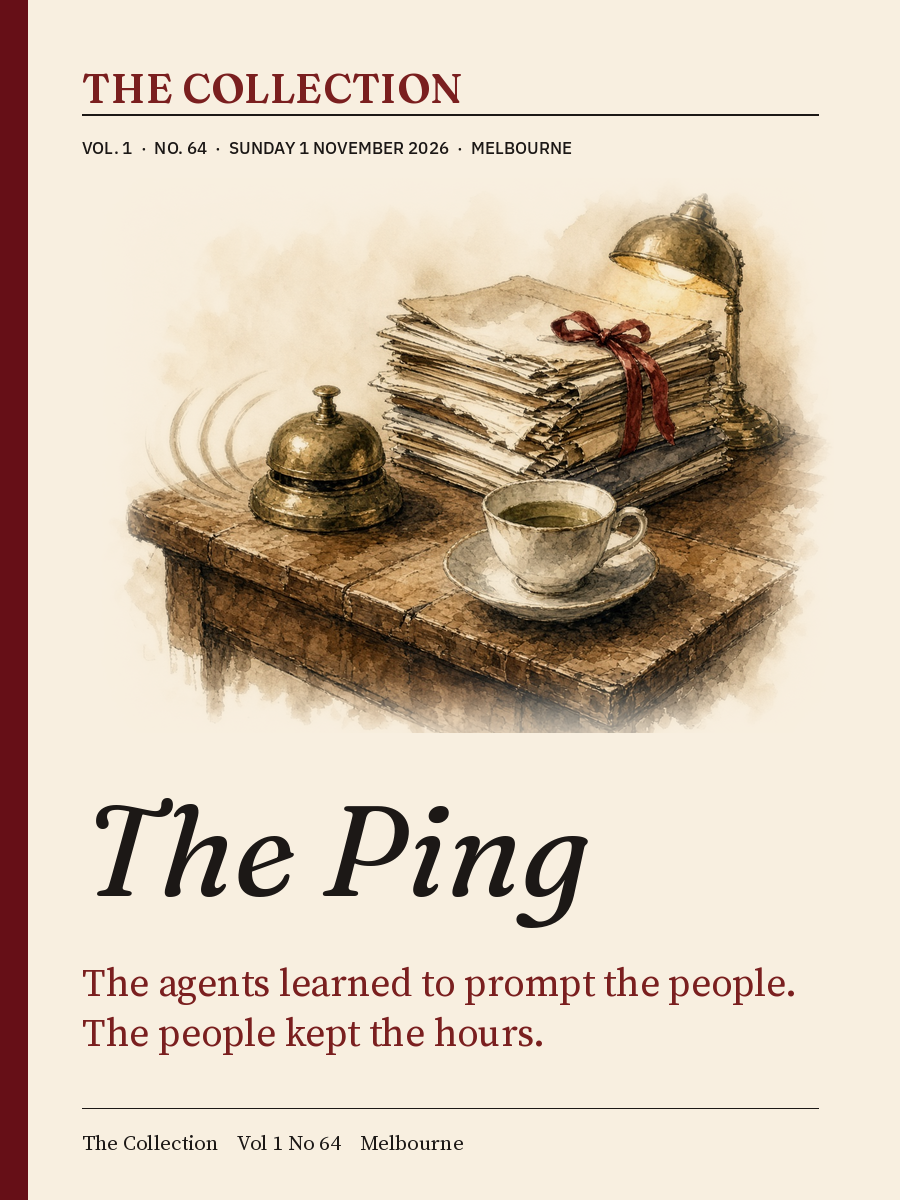
Cover of The Collection, Volume 1, Number 64: The Ping. Sunday 1 November 2026, Melbourne. A watercolour of a worn wooden desk at night: a brass desk bell that has just been rung, a tall stack of files tied with an oxblood ribbon, a glowing brass lamp and a cup of tea gone cold. Skip cover

Vol. 1  ·  No. 64  ·  Sunday 1 November 2026  ·  Melbourne


The Collection

The Ping

Collected and edited by Newsletter World, for AK

Contents

Sunday’s letters turn the usual question round. Not what we ask the machines, but what they now ask of us. A wealth firm says its agents prompt its advisers more than the advisers prompt them. A survey says engineers are working longer weeks, not shorter ones. A builder ships a business in a weekend and describes his job as signing off. A habits writer offers one question for every buzz on the desk. And a practitioner says to start where the people make exceptions. The agents learned to prompt the people. The people kept the hours.

  1. iiiEditor’s LetterThe agents learned to prompt the people. The people kept the hours.03
  2. ivThe BellTen-day jobs, and the agent rings for the adviser.04
  3. vThe HoursThe tools got faster. The week got longer.05
  4. viThe WeekendA business built between Friday and Sunday, by the person signing off.06
  5. viiThe TriggerIs this serving me, or am I serving it?07
  6. viiiThe ExceptionStart where the unwritten judgement lives.08
  7. ixStanding OrdersFour rules for this issue.09

03  ·  Editor’s Letter

The agents learned to prompt the people. The people kept the hours.

The old hotel desk bell had one job. Someone rang it, and someone else came. For two years the promise of AI was that we would be the ones ringing. Type the request, wait for the work.

This weekend’s letters describe the bell moving to the other side of the desk. A wealth firm running agents on jobs that last up to ten days says the agents now prompt its people more than its people prompt them. A builder who ships a whole business in a weekend calls himself the person signing off. Neither of them is complaining. Both systems sound sensibly built, with the money and the final word kept in human hands.

But the bell still rings, and somebody still has to come. A survey of engineers finds more of them working longer weeks than a year ago. A habits writer, with no agent in sight, offers the test that matters: is this ping serving me, or am I serving it? Sunday is a fair day to ask that of every bell on the desk.

The Collection · The Ping03

04  ·  The Bell

Ten-day jobs, and the agent rings for the adviser

An AI-native wealth firm explains how it keeps agents on long financial work without letting them touch the money.

Arca calls itself an AI-native wealth management firm, and it has $48.5 million to prove it means it, from a round led by General Catalyst with Index Ventures and Venrock. Aman Singh’s description of the work is the useful part. A single agent task can run for up to ten days, and it is “very stop-start”. So the firm built a memory system that keeps the state of every client between the stops.

The stops are where the people come in. The agents do analysis and draw up proposals. Trading and moving money stay with human advisers. Singh’s phrase for the result is the one this issue is named for.

Agents prompt people more than people prompt agents.

The safety story is deliberately unglamorous. “All of our safety restrictions are fully deterministic,” he says. When an agent needs to compute something it works in a sandbox, its code is translated into a strict format and then thrown away, and the guardrails are applied to that format before anything reaches the firm’s back end.

Claude is the main model, but Arca runs its own harness, which picks a model for each task using internal benchmarks so the firm can switch providers. A further “meta-agent” reads advisers’ feedback and the agents’ traces and suggests improvements to the harness. Read it as a design that takes the human seriously: the agent rings, the adviser decides. What it does not say is how many rings an adviser can answer in a day.

The Collection · The Ping04

05  ·  The Hours

The tools got faster. The week got longer.

An industry survey says more engineers are working extra hours than a year ago. The rest of the argument is behind a paywall.

The number in the preview comes from LeadDev’s Engineering Leadership Report 2026. It says 45% of engineers now work more hours per week than they did a year ago. In the 2025 report the figure was 38%.

That is a seven-point rise in a year when coding assistants and agents were sold, loudly, as time savers. The writer’s headline names the pattern a vampire effect: the tool takes in work and hands back more of it.

45% of engineers work more hours per week than a year ago, up from 38%.

The preview goes on to break the figure down for staff and principal engineers, and is cut off before the number. We have not read it, so we do not print it. Nor have we read the writer’s explanation of why the hours are rising.

Next to Arca’s account the survey reads like the other half of the same story. An agent that works for ten days needs a person to answer it on some of them. If the rings come faster than the work goes away, the week fills up. The survey cannot prove that this is the cause. It does show that, for now, the time savings are not arriving as time.

The Collection · The Ping05

06  ·  The Weekend

A business built between Friday and Sunday, by the person signing off

A builder lets agents do most of the hands-on work on a new product. His own job description shrinks to one line.

The project is called AgentBill. By the writer’s account it went from plan to live site between Friday 16 and Sunday 18 October 2026, with 27 graded test runs, a scheduled newsletter and two edited videos along the way. AI agents did most of the hands-on work.

The product itself asks a question this issue keeps circling: what does an agent actually cost per task? The plan for paying the bills is affiliate links, sponsors and clearly labelled “verified pricing” badges, with one line kept firm.

Nobody can pay for a score.

His description of his own role is the line that stays. He was “the person signing off”. It is an honest description, and a good one, as long as the signing off is real: someone who reads before approving, and who can say no.

We read only the preview, so we cannot say how many sign-offs the weekend took, or how long each one was. That is exactly the number worth knowing. A business built in a weekend by agents is a story about speed. The hours spent answering them are the story about cost.

The Collection · The Ping06

07  ·  The Trigger

Is this serving me, or am I serving it?

A habits writer argues against switching every notification off. Sort them instead.

Nir Eyal has spent years writing about how products hold our attention, and then about how to take it back. His letter this week is short and has no AI in it. It may be the most useful piece in the issue anyway.

His point is that the common advice, turn everything off, fails because some pings are genuinely useful. The work is to tell them apart, and he reduces that to a single question.

Is this trigger serving me, or am I serving it?

Every external trigger then goes into one of three piles. Keep it, remove it, or revise it, which can mean changing when or how it reaches you rather than whether it does. He has made an External Trigger Scorecard to walk through the sorting.

Read next to Arca and AgentBill, the question carries over to agents without changing a word. An agent that asks for a decision only a person can make is serving you. An agent that asks because asking was easier to build is a trigger that wants revising. The firms building these systems would do well to run the scorecard on their own bells.

The Collection · The Ping07

08  ·  The Exception

Start where the unwritten judgement lives

A practitioner’s advice for bringing AI into a team: ask the people doing the work, test one small part, and name an owner.

Kamil Banc writes for people trying to get AI working inside real organisations, and this week he announced a second newsletter, Adapt and Create. The advice in the letter is plainer than most strategy decks.

Go to the people doing the work and ask where they make exceptions, or where they rely on judgement nobody has written down. Pick one small part of that to test. Agree who owns it. Then compare time, cost or quality before and after.

Ask where they make exceptions. Agree who owns it. Measure before and after.

It fits this issue better than it first appears. The exceptions are exactly where an agent will stop and ring for a person. Finding them first tells you how often the bell will go, and who has to answer it, before the system is switched on rather than after.

The before-and-after comparison is the other half. If the measure is only the agent’s output, the extra hours land on someone’s evening and never show up. Measure the person’s time too.

The Collection · The Ping08

09  ·  Standing Orders

Four rules for this issue

  1. I

    Count the rings.

    For every agent, know how often it asks a person for something, and who answers. That number is part of its cost.

  2. II

    Keep the money with a hand.

    Arca lets agents analyse and propose, never trade. Draw the same line wherever the action cannot be taken back.

  3. III

    Signing off means reading.

    If the person signing off cannot say no, nobody is signing off.

  4. IV

    Sort every bell.

    Keep it, remove it or revise it. Ask whether it serves you, or you serve it.