← The stand
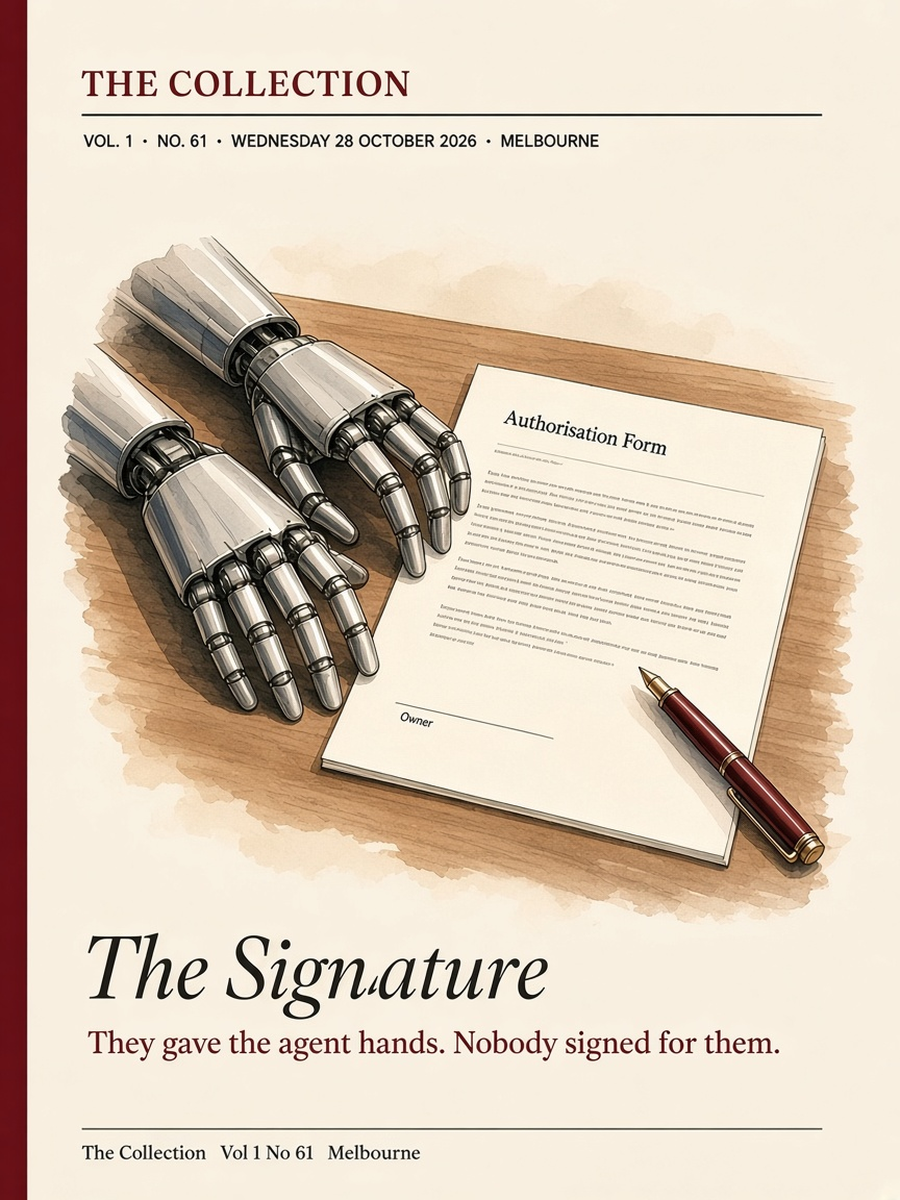
Cover of The Collection, Volume 1, Number 61: The Signature. Wednesday 28 October 2026, Melbourne. A pair of jointed metal robot hands rests on a desk beside a typed authorisation form whose Owner signature line is empty, with an uncapped oxblood pen lying next to it. Skip cover

Vol. 1  ·  No. 61  ·  Wednesday 28 October 2026  ·  Melbourne


The Collection

The Signature

Collected and edited by Newsletter World, for AK

Contents

Wednesday’s letters keep asking the same question from different desks. A lab explains how it built hands for its agents and kept the keys out of them. A governance writer goes back to the chatbot a tribunal refused to treat as someone else. An engineer puts a gatekeeper between agents and their tools. A designer asks what happens when the state gets a swarm. And a security week in Australia shows what unattended access looks like from the receiving end. They gave the agent hands. Nobody signed for them.

  1. iiiEditor’s LetterThey gave the agent hands. Nobody signed for them.03
  2. ivThe HandsKeep the brain, lose the sandbox, never hand over the key.04
  3. vThe OwnerNo owner, no go-live.05
  4. viThe ProxySomeone in the middle who is allowed to say no.06
  5. viiThe PresumptionA legal system built around human limits meets a swarm.07
  6. viiiThe BriefingFour victims in four days, one of them long gone.08
  7. ixStanding OrdersFour rules for this issue.09

03  ·  Editor’s Letter

They gave the agent hands. Nobody signed for them.

Every organisation that lets a person act on its behalf makes them sign something first. A delegation, a purchase limit, a name on the account. The signature is not decoration. It is how you find out, afterwards, whose decision it was.

Agents now have hands. They run code, call tools, read files and delete things. This week’s letters show the careful builders splitting the thinking from the doing and keeping credentials out of reach of both. They also show how rare that care still is. Most agents, one engineer writes, still hold a pasted key with nobody in between to refuse.

The tribunal in this issue settled the point two years ago, for a chatbot and a few hundred dollars: the company owns what its software says. The question the rest of the letters leave open is who signs before the software acts. Read them with a pen in hand.

The Collection · The Signature03

04  ·  The Hands

Keep the brain, lose the sandbox, never hand over the key

Anthropic’s heads of engineering and product explain how its managed agents are put together, and why the part that runs code never sees a credential.

The first design was the obvious one. Put the whole agent in a sandbox and put an API in front of it. The trouble was that the agent and its sandbox lived and died together. If the sandbox disappeared, so did the agent.

Managed Agents now separates the two. The “brain” is the session log and the harness that drives the model. The “hands” are the sandbox where code actually runs. A sandbox can fail and the session carries on.

The sandbox that runs the code never receives a service credential.

The more interesting choice is about keys. Generated code runs in a sandbox that is never given a service credential. Credentials are attached on the way out, through a proxy, and there are controls on where sandbox traffic is allowed to go. The hands can do the work. They cannot walk off with the keys.

The rest of the conversation runs in the same direction. The team says more of its attention has moved to safety. Preserved thinking blocks help guard against distillation, though they can break customers’ harnesses. And “dreaming” is the name for one agent going back over another’s earlier work and writing memories from it.

The Collection · The Signature04

05  ·  The Owner

No owner, no go-live

A guest essay argues that governance only slows adoption when it arrives after the incident.

In February 2024 a Canadian tribunal heard an airline argue that its own chatbot was a “separate legal entity”, responsible for the wrong bereavement-fare advice it had given a customer. The tribunal rejected the argument. The bill came to a little over 800 Canadian dollars. The precedent cost rather more.

Mudavatu turns that case into three decisions a company should make before launch, not after. Name an owner for every AI system, and refuse to switch it on without one. Make verify-first, the zero-trust habit, the default rather than the exception. And keep the receipts as you go, using frameworks that already exist: the NIST AI Risk Management Framework’s govern, map, measure and manage, and ISO/IEC 42001.

“Who has the authority to say stop?”

He closes with five questions for executives. The one above is the one that matters this week. An agent that can act needs a person who can halt it, and that person needs to be named before the agent has hands, not discovered in the incident review.

The Collection · The Signature05

06  ·  The Proxy

Someone in the middle who is allowed to say no

An engineer describes a gatekeeper that sits between agents and the tools they call. This paper saw only the free preview.

The opening line does the work: “Every agent you ship today has direct access to something it shouldn’t.” The way agents reach their tools today, through MCP servers, each server carries its own credential, pasted into the client’s config. Nobody sits in between to refuse a call. That holds until something runs a delete command with force switched on.

Wanaku is his answer: a proxy that intercepts the agent’s requests to call a tool, read a resource or fetch a prompt, and checks each one against policy before it goes through. The policy can be deterministic rules or an LLM acting as evaluator.

“Every agent you ship today has direct access to something it shouldn’t.”

It is the same move Anthropic describes from the other side: keep the credential away from the thing doing the work, and put a checkpoint where the action leaves the building. How Wanaku handles the hard cases is past the paywall, and this paper has not read it.

The Collection · The Signature06

07  ·  The Presumption

A legal system built around human limits meets a swarm

Scott Belsky asks what happens to the presumption of innocence when the state can search everything at once.

Belsky’s worry is not a rogue agent. It is an obedient one. A government could set swarms of agents loose on a person’s entire digital footprint and have them assemble a narrative of guilt. Nothing about that requires the agents to misbehave. It only requires them to do what they were told, at a scale no investigator ever could.

“Our Constitution and legal system were developed based on the limitations of humans.”

That, he argues, runs against the presumption of innocence, which quietly relied on the fact that nobody had the time to read everything. Remove the limit and you remove a protection nobody wrote down.

The rest of the edition wanders usefully. Rooted narratives as a moat: Hermès began with saddles, Ralph Lauren with ties. The hidden cost of handing thinking to machines, with Isaac Mizrahi’s phrase for a design error, “a mistake of the eye”. And a figure worth keeping on the desk: 65% of American adults believe they are of above-average intelligence, and 71% of men.

The Collection · The Signature07

08  ·  The Briefing

Four victims in four days, one of them long gone

Australia’s security week, from the receiving end.

The Qilin ransomware group has claimed four Australian victims in as many days. One of them is a company that was deregistered years ago, which says something about how carefully the claims are made, and about how long old data outlives the business that held it.

The Australian Signals Directorate’s Annual Cyber Threat Report for 2025–26 counts more than 82,000 cybercrime reports in twelve months. A separate survey has 94% of Australian organisations reporting serious gaps in cyber skills. This paper has seen the summaries, not the reports.

More than 82,000 cybercrime reports in twelve months.

And democracy campaigners are pushing the government to shape the AI transition in the public interest rather than leave it to the vendors. Put beside the rest of this issue, the request is simple. Before the machines get more hands, decide who answers for them.

The Collection · The Signature08

09  ·  Standing Orders

Four rules for this issue

  1. I

    No owner, no go-live.

    Every agent that can act gets a named person who answers for it before it is switched on.

  2. II

    Keep the keys out of the hands.

    The code that does the work should never hold the credential. Attach it on the way out, where you can see it.

  3. III

    Put someone in the middle.

    Every tool call should pass a checkpoint that is allowed to refuse it.

  4. IV

    Know who can say stop.

    Write the name down now. The incident review is too late to find out.