← The stand
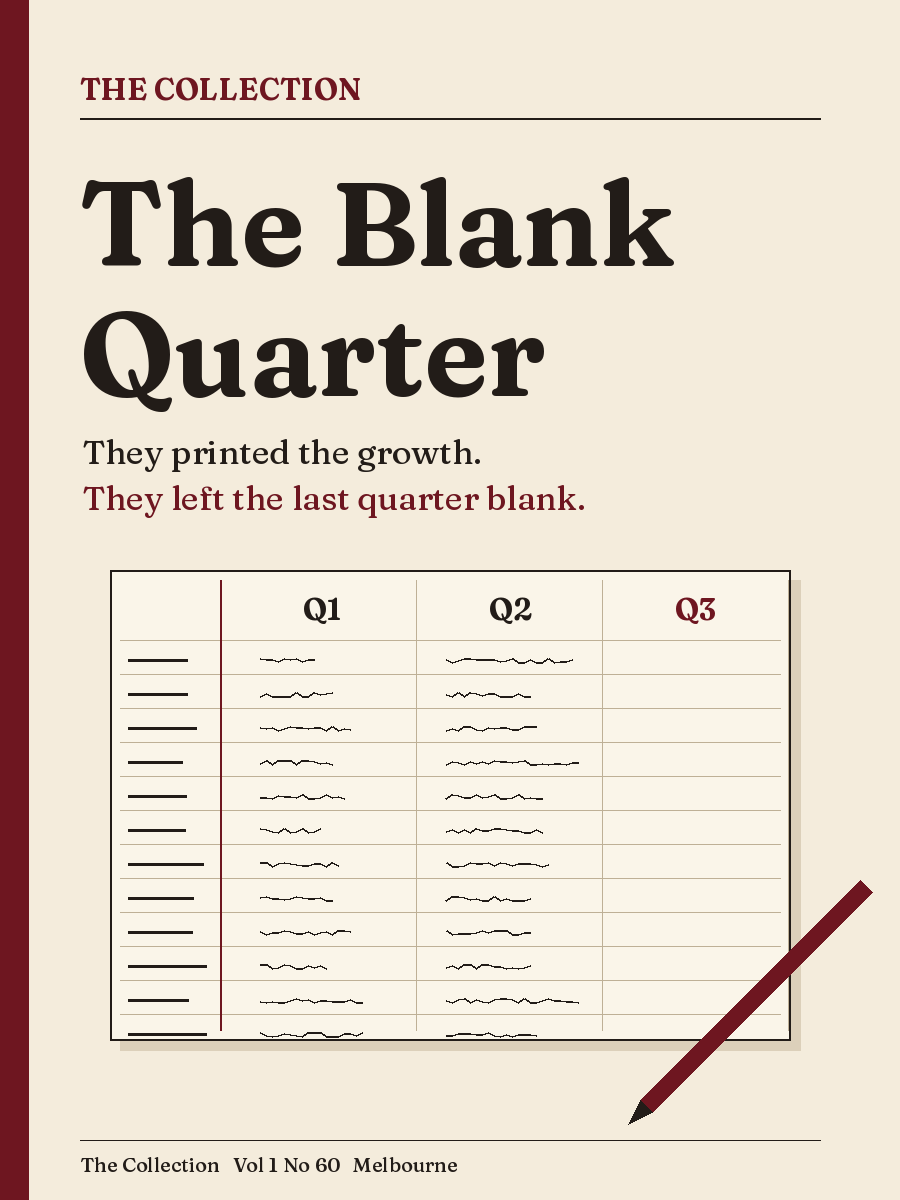
Cover of The Collection, Volume 1, Number 60: The Blank Quarter. Tuesday 27 October 2026, Melbourne. An open ledger on a desk shows two columns, headed Q1 and Q2, filled with handwritten entries and a third column, headed Q3, that is empty, beside an oxblood pen. Skip cover

Vol. 1  ·  No. 60  ·  Tuesday 27 October 2026  ·  Melbourne


The Collection

The Blank Quarter

Collected and edited by Newsletter World for AK

Contents

Tuesday’s letters are nearly all about one document. Anthropic’s draft S-1 is out, and the newsletters have read it the way analysts read anything: for what it shows, and for what it doesn’t. Around it sit three smaller stories about the same habit. An agent habitat for companies whose agents nobody can see. A study that trains small models only on the moments that changed a decision. And a security week in which machines were handed access no person would be given. They printed the growth. They left the last quarter blank.

  1. iiiEditor’s LetterThey printed the growth. They left the last quarter blank.03
  2. ivThe LedgerTwo loss figures, two margins, one bill that never stops.04
  3. vThe WhalesEleven thousand customers on paper, a few hundred that count.05
  4. viThe OmissionThe dog that did not bark in the filing.06
  5. viiThe HabitatLet the chaos in, then build it somewhere to live.07
  6. viiiThe DeltaTeach the small model only where the harness changed the answer.08
  7. ixThe AccessPermanent admin, never reviewed, held by a machine.09
  8. xStanding OrdersFour rules for this issue.10

03  ·  Editor’s Letter

They printed the growth. They left the last quarter blank.

A prospectus is the most carefully written document a company will ever publish. Every figure in it has been argued over by lawyers, so the figures are rarely where the story hides. The story hides in the definitions, and in the boxes that stay empty.

Anthropic’s draft is full of startling numbers. Revenue went from $376 million in the first quarter of 2025 to $11.6 billion in the second quarter of 2026. Net revenue retention, by the company’s own measure, is about 900%. But the third-quarter revenue line, the newest and the one that would show whether demand held after prices fell, sits blank pending audit review. The press number for it is a press number.

The rest of this issue keeps finding the same gap. Agents that nobody decided the limits of. A harness whose influence only shows when you take it away. Machine accounts holding the kind of access no employee would get. Read the filled columns, by all means. Then look at the empty one.

The Collection · The Blank Quarter03

04  ·  The Ledger

Two loss figures, two margins, one bill that never stops

Evan Armstrong reads the S-1 and argues that the scary number is harmless and the flattering number is the one to question.

Start with the headline loss. Anthropic lost $80.7 billion in the first half of 2026, and Armstrong calls it a number not worth worrying about. The operating loss was $693 million. The rest was $72.4 billion of mark-to-market losses on Amazon’s convertible notes, which convert at the IPO and leave the books the quarter after listing.

The figure he does worry about is the flattering one. The filing reports an 85% gross margin, which would make Anthropic look like a software stock. That margin counts only the compute spent serving customers. Count frontier training as the cost of making the thing being sold, and cost of goods becomes $8.9 billion and the margin 45%, closer to a hardware business. The model sold today was trained six months ago and will be stale six months from now.

“Long-term debt being married to short-term revenue makes my stomach queasy.”

Then the bill. Compute runs at about $22 billion a year on a second-quarter annualised basis. The contracts take it to roughly $120 billion next year and about $155 billion by 2028, most of it non-cancelable, against revenue that is priced by consumption and cancelable at will. The company’s defence is in the filing too: revenue grew 1,368% this year against 300% growth in compute, and demand has exceeded supply in every period since Claude launched.

Armstrong’s summary is fair to both sides. Revenue per employee is $6.6 million, up from $1.4 million a year earlier. There is $131.7 billion of cash and short-term investments, from $141.1 billion raised since 2021. And there are about $800 billion of fixed obligations that only work if the next six models are as good as the last six.

The Collection · The Blank Quarter04

05  ·  The Whales

Eleven thousand customers on paper, a few hundred that count

The same essay on who actually pays, and how quickly last season’s model stops earning.

The filing’s headline is 11,900 enterprise customers. Armstrong runs a power-law estimate and puts the real count that matters at about 250. In 2025, 76% of revenue came from roughly 1,500 organisations paying $100,000 or more, and 24% from about 40 million other customers.

No single customer is above 10%. The top five make up about a quarter, a share that fell from 36% in the first quarter to 21% in the third. One unnamed customer was 43% of revenue in 2023 and is 10 to 11% now. The filing does not name the biggest buyers. Press reporting, not the S-1, says they are Cursor and GitHub Copilot.

Models older than six months earn less than a fifth of the revenue.

The retention number needs its footnote. The roughly 900% figure excludes Pro and Max subscribers and counts “qualified customers” only. For scale, Armstrong notes Snowflake’s record of 189% in late 2019 and a public-company median of 110%.

The product has a short shelf life. Newer models earned more than 80% of third-quarter revenue, and each release cuts cost per task by 25 to 45%. After the Opus 4.5 price cut in November 2025, quarter-on-quarter growth went from 48% to 132%. And 5 to 7% of revenue came from usage-policy violators, mostly labs distilling Claude, who were cut off in August and September.

The Collection · The Blank Quarter05

06  ·  The Omission

The dog that did not bark in the filing

Two sceptical readers go looking for what the document leaves out. This paper saw only their opening paragraphs.

Marcus opens with Sherlock Holmes and Silver Blaze, the case solved by the dog that did nothing in the night. His subtitle is “Buyer, beware of omissions.” He had said beforehand that the thing to watch in the S-1 was what it revealed about demand, after the fade of tokenmaxxing and the rise of cheap models. The draft, he writes, “(in some places) literally left out Q3.”

That matches Armstrong’s reading: the third-quarter revenue line is blank pending audit review, and the roughly $16.8 billion figure in circulation comes from press reports, not the filing.

The quarter after the price cuts is the one with the empty box.

Newcomer comes at it from the other side. His subtitle says revenue growth of 1,300% year over year “is the key to it all”, and his first lines note that the filing landed amid raging anti-AI sentiment and a consequential election. What he makes of the data points beyond that is behind his paywall, and this paper has not seen it.

The Collection · The Blank Quarter06

07  ·  The Habitat

Let the chaos in, then build it somewhere to live

On the day Replit launched its business product, a16z argued that agents are arriving at work the way the PC did: uninvited.

The essay starts from a line by Replit’s chief executive, Amjad Masad. Most agents today, he says, run in chat windows, personal accounts and one-off scripts, holding whatever credentials and data someone handed them. “Nobody decided what they could touch, and nobody can see what they did.”

a16z takes Andy Grove’s formula as the test: who will let chaos reign, and then rein in the chaos? Personal computers passed it. People brought them in whether IT liked it or not, and lied on procurement forms to get them, claiming an oscilloscope, a typewriter, even a desk. A 1983 article warned of “shadow” data processing departments working out of management’s sight.

“Nobody decided what they could touch, and nobody can see what they did.”

Spreadsheets did the same thing a second time, which is why the essay calls them the original workplace agent: people who never thought of themselves as programmers began modelling the business on their own. The answer each time was not a ban. It was a habitat, a set of practices that kept the bottom-up enthusiasm while bringing the work back into view. That is the pitch for Replit’s version, and for what Masad calls the self-driving company.

The Collection · The Blank Quarter07

08  ·  The Delta

Teach the small model only where the harness changed the answer

A study on distilling agents finds that the useful training data is the difference you can only see by taking the harness away.

The harness is the software around a model that tracks state, manages context and feeds back results. Distil an agent the ordinary way, with the harness text left in every prompt, and the small model barely improves: task success goes from 43.1% to 43.5%. Because the harness is always there, the student treats it as background noise.

The fix is to run the teacher twice on each logged turn, once with the harness and once with it stripped out. Where the two answers differ, the harness made the difference, and that pair becomes training data. Turns where the teacher contradicts the harness’s own record are thrown away.

The 1.7B student beat its own 8B teacher.

Trained that way, a 1.7-billion-parameter student went from 47.0% to 63.4% task success, ahead of its 8B teacher at 51.5%. Habits move into the weights: switch off the harness’s loop warnings and the student still holds 56.0%. Live state does not. Switch off the tracking of what the agent holds and where it has been, and success falls to 37.3%. Greyling’s practical note is that any team already logging agent traces has the raw material.

The Collection · The Blank Quarter08

09  ·  The Access

Permanent admin, never reviewed, held by a machine

Australia’s breach numbers climb while the warnings stack up.

Cyber Daily leads with the privacy regulator. The OAIC’s figures for the first half of 2026 show more Australians affected by data breaches than ever. The summary gives the direction, not the count, and this paper has not seen the report itself.

Behind it, the Australian Cyber Security Centre has issued critical warnings over Fortinet flaws and says exploitation is imminent. Bathurst RSL has been hit by the Qilin ransomware group, with passport scans leaked; its chief executive says the incident is contained.

“Organisations that would never give an employee permanent, unreviewed administrator access are doing exactly that for automated systems.”

The line of the edition belongs to Harshvendra Soin of Tech Mahindra, quoted above. It is the same blank box as the rest of this issue: a permission nobody wrote down, held by something nobody reviews.

The Collection · The Blank Quarter09

10  ·  Standing Orders

Four rules for this issue

  1. I

    Read the empty column first.

    In any filing or dashboard, ask which number is missing and why before you admire the ones that are there.

  2. II

    Check the definition before the figure.

    A 900% retention rate and an 85% margin both depend on what was left out of them.

  3. III

    Give agents a habitat, not a ban.

    Decide what each one can touch and keep a record of what it did.

  4. IV

    Review machine access like staff access.

    No permanent administrator rights for anything, human or automated, without a review date.