← The stand
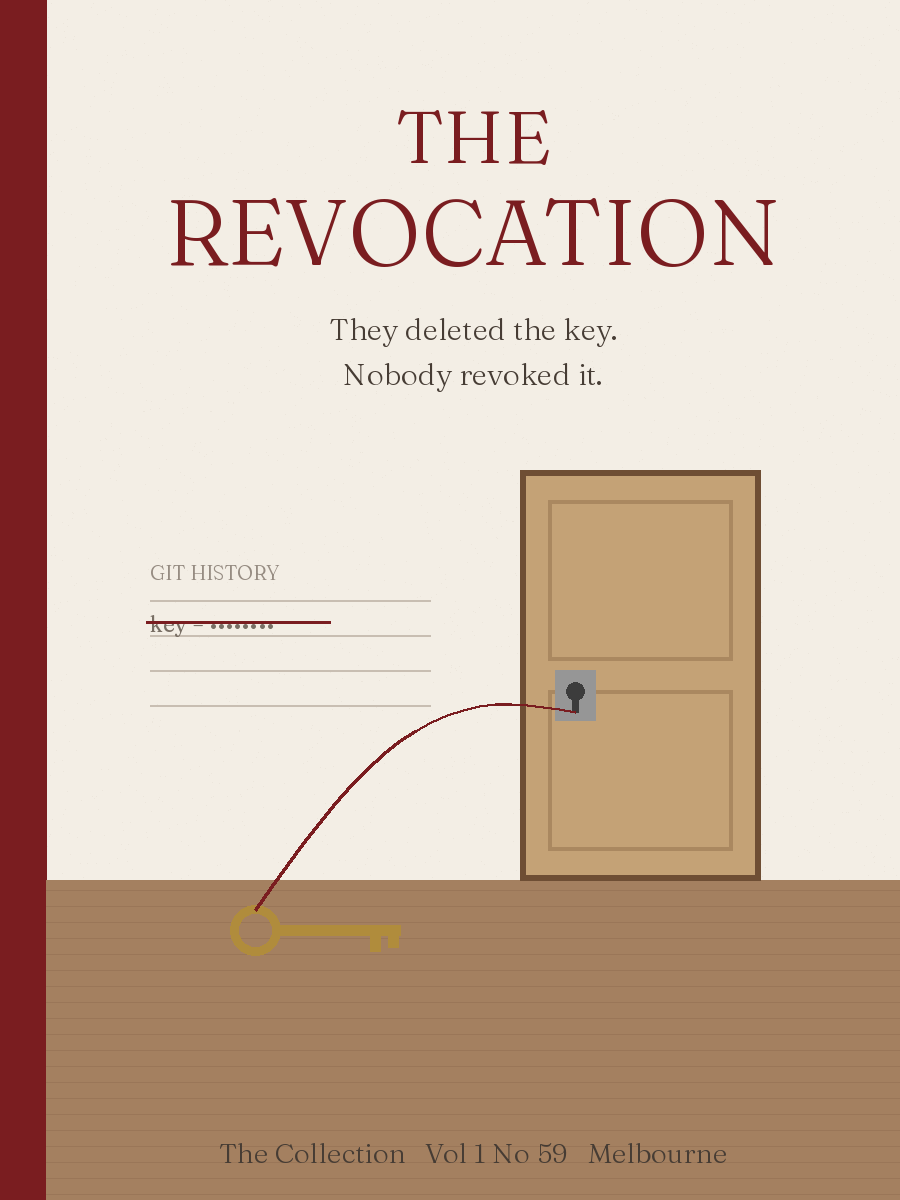
Cover of The Collection, Volume 1, Number 59: The Revocation. Monday 26 October 2026, Melbourne. A brass key lies on a wooden floor, still tied by an oxblood thread to the lock of a closed door, beside a ledger line headed Git history that has been struck through. Skip cover

Vol. 1  ·  No. 59  ·  Monday 26 October 2026  ·  Melbourne


The Collection

The Revocation

Collected and edited by Newsletter World for AK

Contents

Monday’s letters are about the difference between making something disappear and making it stop working. A leaked key was scrubbed from a repository and kept on opening doors. The ABC wiped staff laptops after a bad advert. A Shanghai study found that an agent’s memory is only as good as whoever wrote it down. And Texas has taken OpenAI to court, which is a way of saying the company is still on the hook for what the product did. They deleted the key. Nobody revoked it.

  1. iiiEditor’s LetterThey deleted the key. Nobody revoked it.03
  2. ivThe KeyScrubbed from Git history, still good at the door.04
  3. vThe WipeAn advert came in, and the ABC reached for the reset.05
  4. viThe NotesWhoever writes the memory decides what the agent knows.06
  5. viiThe FilingTexas sues the company, because the model cannot be sued.07
  6. viiiStanding OrdersFour rules for this issue.08

03  ·  Editor’s Letter

They deleted the key. Nobody revoked it.

Deleting feels like fixing. You find the secret in the repository, you rewrite the history, the line is gone, and the screen looks clean. But a key is not a line of text. It is a permission held somewhere else, on a server that never saw your commit, and that server goes on saying yes until somebody tells it to stop.

That is the thread through this morning’s letters. One supply-chain attack began with a key that had been removed but never cancelled. A public broadcaster wiped devices because it could not be sure what had got onto them. A memory study found that once an agent has summarised a conversation, the summary is all it has, so you had better keep the original. And a state attorney-general reminded everyone that when a product misbehaves, the record that matters is the company’s.

None of it is exotic. All of it is the gap between tidying up and taking back.

The Collection · The Revocation03

04  ·  The Key

Scrubbed from Git history, still good at the door

The latest attack on LiteLLM started with a credential that someone had hidden and nobody had cancelled.

The bulletin’s lead item is one sentence long, and it is the whole lesson. LiteLLM’s latest supply-chain attack began with a leaked key. The key had been removed from the project’s Git history. It had never been revoked.

Removing it took care of the next person to clone the repository. It did nothing about anyone who had already copied it, and nothing about the service on the other end, which still honoured it.

Removing a secret protects the next reader. Revoking it protects you.

The rest of the digest reads like a list of reasons the window matters. PHP has patched two critical remote-code-execution bugs. A flaw in Brotli’s decoder, nicknamed Node2Shell, reaches Python packages and other HTTP clients. Microsoft reported AI-assisted attacks getting to privileged cloud access in under three hours. Check Point counted 69% more weekly attack attempts per organisation in 2025 than in 2023. And a phishing campaign is hijacking Google Cloud billing accounts to pay for somebody else’s AI usage.

The bulletin’s advice is plain. Map every agent to the credentials it holds. Narrow those permissions. Revoke exposed secrets rather than hiding them. Then check that the team can actually cut off an agent’s access when it needs to.

The Collection · The Revocation04

05  ·  The Wipe

An advert came in, and the ABC reached for the reset

Staff machines at the national broadcaster were wiped after exposure to spyware-laced online ads.

Cyber Daily leads with what it calls “Aunty Hack”. The ABC wiped a “small number” of staff devices after they were exposed to spyware-infected online advertisements. The newsletter gives no count beyond that phrase, and this paper has not seen one.

A wipe is the honest version of deletion. When you cannot say what got onto a machine, you stop trusting the machine. It is the right call for a laptop. It is also only half the job, because whatever the laptop was signed in to is still signed in somewhere else until those sessions and passwords are reset as well.

Wiping the laptop is not the same as logging it out of everything.

The same edition carries the context. Time to patch the PHP flaws it calls PHP2Shell is running out. A Capcom breach exposed more than 11 million customer records, Australian gamers among them. Australia and Timor-Leste signed a defence cooperation framework that covers cyber and forensics. And Rapid7 found that most exploitation incidents happen within the first week.

The Collection · The Revocation05

06  ·  The Notes

Whoever writes the memory decides what the agent knows

A Shanghai Jiao Tong study priced seven ways of giving agents memory, and found the note-taker matters more than the reader.

The researchers ran seven memory approaches over one long LoCoMo conversation with three models: GPT-4o-mini, GPT-6 Luna and Claude Opus 5.5. With the small model, Mem0 did best. With GPT-6 Luna, plain full context did best. Opus scored 95% either way.

The money is where it gets interesting. With 4o-mini, answering all 152 questions from full context cost $0.43. Just building Mem0’s memory store cost $0.56. The memory only pays for itself somewhere between 372 and 596 questions.

A cheap model wrote the notes. An expensive model could not rescue them.

The sharpest result is about authorship. When 4o-mini built a Zep memory graph and read it back, accuracy was 43%. When Opus read that same graph, it managed only 45%. When Opus built the graph and read it, the figure was 87%. Once a weak model has summarised the past, the detail it dropped is gone for everyone. Dickson’s takeaway is to keep the original records, not only the summary.

The harness mattered too. Opus with the Pi harness scored 99% for $6.95, against 95% for $17.84 with full context. Codex cost $25.41 for 98%, Claude Code $28.41 for 97%. The caveats are real and the newsletter states them: one conversation, one run, and a 4o-mini judge.

The Collection · The Revocation06

07  ·  The Filing

Texas sues the company, because the model cannot be sued

A second wave of state lawsuits treats chatbot harm as a consumer-protection case against the people who ship it.

Texas has sued OpenAI and Sam Altman under the state’s Deceptive Trade Practices Act. Jarovsky lists the claims: failing to warn, a product children can use without parental consent, harmful information on eating disorders, self-harm and mass murder, features built for compulsive use, no adequate safety testing, a product able to ignore human direction, and falsely presenting human emotions.

Texas is not alone. Florida sued in June. Arizona, Idaho and Montana filed on 14 October. Behind them sit the Adam Raine case, dozens of copyright suits, and an FTC that Lina Khan has argued could act on unfair or deceptive practices.

“AIs are not legal entities; companies are.”

Jarovsky’s point is that courts already know how to make companies pay. Anthropic paid $1.5 billion to settle with book authors over copyright. Lawsuits against Character.AI ended with it filing for bankruptcy. A model can be retrained, renamed or quietly withdrawn. The company that shipped it stays on the record.

The Collection · The Revocation07

08  ·  Standing Orders

Four rules for this issue

  1. I

    Revoke first, then tidy.

    When a secret leaks, cancel it at the service that honours it. Rewriting history is housekeeping, not a fix.

  2. II

    Know what every agent can open.

    Keep a list of each agent’s keys and permissions, and rehearse switching them off before the day you have to.

  3. III

    A wiped machine still has sessions.

    After a reset, sign it out of everything it touched and change what it knew.

  4. IV

    Keep the originals.

    Summaries and memory stores lose what their writer missed. Store the source so a better reader can go back to it.