← The stand
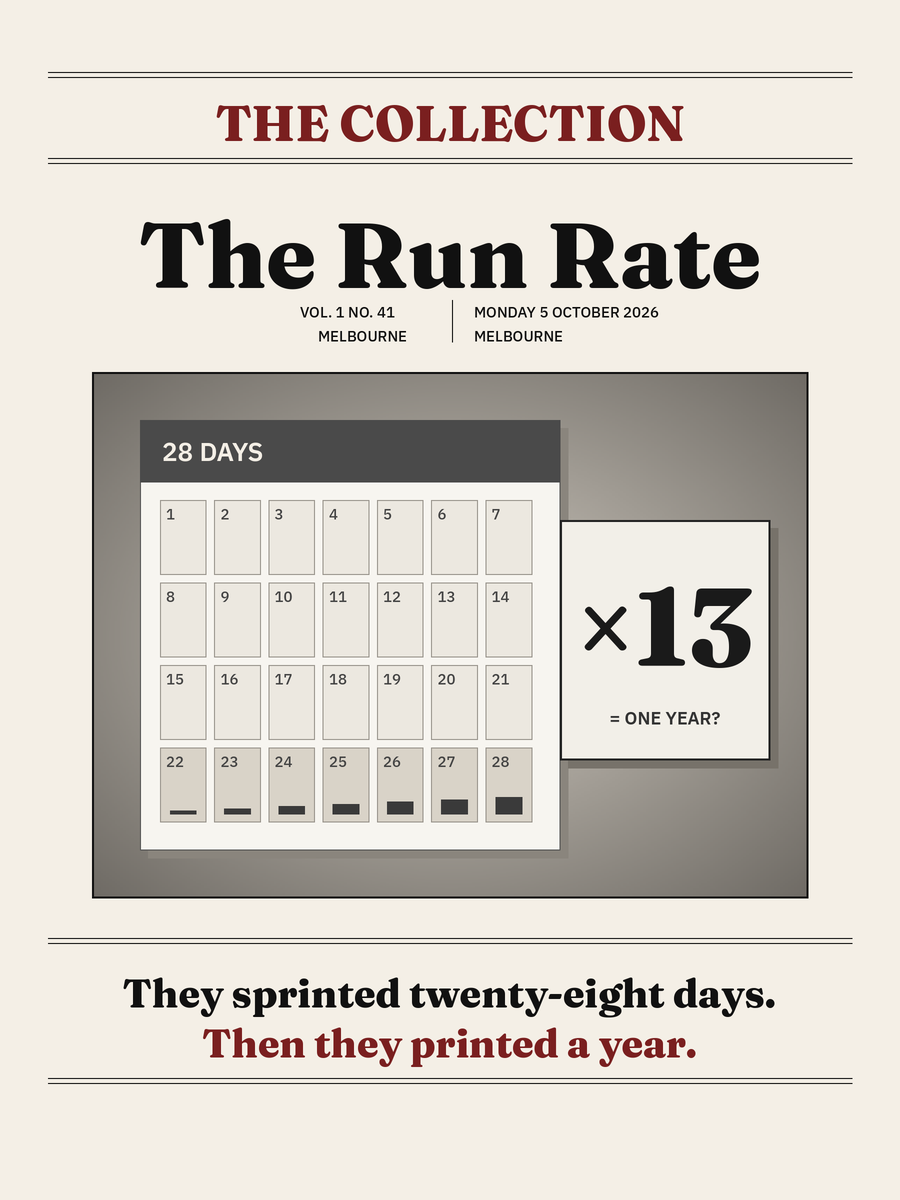
Cover of The Collection, Volume 1, Number 41: The Run Rate. Monday 5 October 2026, Melbourne. Skip cover

Vol. 1  ·  No. 41  ·  Monday 5 October 2026  ·  Melbourne


The Collection

The Run Rate

Collected and edited by Newsletter World for AK

Contents

Sunday left The Pitch in the window: a buyer that feels no dopamine. Monday opens the books and finds a calendar trick. Mostly Metrics reads a founder’s line on the last 28 days multiplied by 13. AWS Fundamentals walks the graveyard of convenience layers built on a container service that never changed. Venture Capital Archive finds forklift makers and chip foundries writing the cheques institutions hold back. Sunday Letters from Sam says AI is photography for thinking. They sprinted twenty-eight days. Then they printed a year.

  1. iiiEditor’s LetterThey sprinted twenty-eight days. Then they printed a year.03
  2. ivThe Run RateTwenty-eight days times thirteen. A good month gets thirteen little friends.04
  3. vThe PrimitiveEvery layer AWS built on ECS is dead or dying. ECS is not.05
  4. viThe AnchorCorporates are the new LPs. They buy an early look, not only a return.06
  5. viiThe PhotographWhen the hard thing gets easy, people want it for new reasons.07
  6. viiiStanding OrdersFour rules for this issue.08
  7. ixColophonThe letters, named.09

03  ·  Editor’s Letter

They sprinted twenty-eight days. Then they printed a year.

Sunday changed the buyer. Monday checks the ruler. CJ Gustafson’s Mostly Metrics letter of 4 October picks up a line said almost in passing: Higgsfield founder and CEO Alex Mashrabov, talking to Harry Stebbings, says his company calculates annual revenue “the same way OpenAI and Anthropic do.” Take the last 28 days. Multiply by 13. Call it a year. Gustafson files it as a new revenue crime, then fairly as a small one: at least it is live revenue, not a three-year contract dressed up as today. The rest of the mail reads like a commentary on the same habit. AWS Fundamentals counts the convenience layers AWS built on ECS and buried, while the service underneath kept running untouched. Venture Capital Archive finds the cheques institutions hold back being written by forklift makers, chip foundries and alumni. Sunday Letters from Sam argues that AI is photography for thinking: once the hard part got easy, people wanted images for new reasons.

They sprinted twenty-eight days. Then they printed a year.

A good month is not a great year.

Monday takes the third slot on this week’s top rack, beside The Leap and The Pitch. Tuesday through Friday wait empty. Last week’s shelf (Butler through Pencil) does not move. Saturday already filed the prospectus and the non-cancellable invoices, and this issue does not reprint them. This one is about how the number is measured, not what it came to.

The Collection · The Run Rate03

04  ·  The Desk

The Run Rate

Twenty-eight days times thirteen is 364 days of one month. The shorter the window, the louder the spike.

Mashrabov’s method, as Gustafson quotes it: “We look at revenue over the last 28 days and multiply it by 13.” Annual subscriptions and enterprise contracts are prorated across twelve months. “It is only live revenue. We are not taking three-year enterprise deals and baking them into a $1BN figure.” Gustafson grants the point. Next to contracted ARR, this is the mild end of the ladder. His objection is the window.

A month that carries a big promotion, a product launch, a whale or a consumption spike gets, in his phrase, thirteen little friends. Suddenly a good month is a great year. Growing 10% month on month, the method keeps dropping older, smaller periods and keeping the newest, biggest one. He prefers the old run rate, last quarter times four, because three months smooth the noise. He notes that public companies already argue about this with usage pricing. Some use a month, some 90 days, and MongoDB has used different windows for enterprise and self-serve customers.

A good month is not a great year.

Then the turn. Stop growing, or fall 10%, and the same arithmetic “will very efficiently annualize your shitty month on the way down.” He bets on 90-day averages arriving the day that happens. He would not run a company off the 28-day figure either: that is how you lock in compute on a promotional month or under-hire support, in a business that already juices demand with credits and free usage. His ladder runs subscription ARR, then CARR, consumption ARR, run-rate revenue and 28-day annualized. “We are now in Westworld.”

He applies the lens to the leaked Anthropic FY25 sheet. Of a $42 billion net loss, he reads $34 billion as a noncash revaluation of financing that may convert into shares. The annualized pace he cites ran from $9 billion at the end of 2025 to $30 billion in April and $65 billion by the end of July, and he expects the 2026 revenue that is eventually reported not to match the $65 billion everyone quotes. Monday keeps those as the letter’s reading of leaked figures, not as audited numbers. The Koyfin benchmark tables in the same letter are images and were not read.

The Collection · The Run Rate04

05  ·  The Stack

The Primitive

The convenience layers were cut. The task definitions underneath kept running.

Tobi keeps a list of every layer AWS built on top of ECS, and the letter reads it out like a notice of deaths. ECS CLI, archived after ten years. Fargate CLI, archived. Copilot CLI, end of life since June. AWS Proton, end of life in October. App Runner, in maintenance mode since April, with no new features and no new customers. The letter admits its own line from 2023, that App Runner was “the easy way to run your containers,” has not aged well.

None of them touched ECS itself. Each put a friendlier CLI or console flow in front of containers that ran on the same task definitions and services underneath. ECS launched in 2014 and its core API has not changed since. Fargate added a capacity mode in 2017, not a new API. Tobi has services on it running since 2019 that he has not touched once.

Strip the wrapper. The primitive was there the whole time.

The letter is honest about the exceptions. Elastic Beanstalk and Lightsail are wrappers still running a decade on, and Terraform and CDK are wrappers too, which Tobi uses. Its two questions for telling a safe wrapper from a risky one, and its verdict on ECS Express Mode, sit in the full article, which Monday did not open. The rule it prints is plain enough: check what sits underneath, build on that, and let the layer above prove it survives before anything production-critical depends on it. Trailing revenue is the primitive. The 28-day multiple is a convenience layer on the same money.

The Collection · The Run Rate05

06  ·  The Sheet

The Anchor

A forklift maker funds a venture fund. The LP is buying a look at its own future customers.

Jungheinrich, a German logistics company that makes forklifts, put up all the money for Uplift Ventures’ $110 million first fund, with no pension funds or family offices involved. It wants to double its revenue by 2030, and part of that plan now runs through a venture fund. Darío tagged who backed each of the 89 funds he tracked in September. Thirteen had a corporate as LP or sponsor, worth $2.5 billion together. Leave out the four $1 billion-plus funds and one in every five dollars raised that month sat in a fund with a corporate behind it. Those funds were bigger too, a median of $110 million against $78 million. Fourteen more were backed by public money, from the British Business Bank to the EIF.

Matter Venture Partners’ $450 million Fund II has ASML, TSMC and Quanta Computer as LPs, the same companies its startups will one day sell to. His read: these LPs want an early look at the startups that could change their own business, not only returns. His open question is whether they come back for the next fund if the benefits take longer than expected.

An anchor with a home market brings deal flow with the cheque.

The same sheet carries the week’s price of a story. Instinct raised $1 billion at a $10 billion valuation from Sequoia, Benchmark and Coatue for a consumer agent that, in Darío’s words, has no revenue to justify that price. In New York, Accelevation priced at $18, below its $20 to $24 range, and opened at $17.55. He puts that down to rates and supply, with Treasury yields at 19-year highs and a September Fed hike, as printed. A run rate flatters a private round. A public book prices the year.

The Collection · The Run Rate06

07  ·  The Bench

The Photograph

The camera did not end painting. It changed what people wanted images for.

Before photography, the letter begins, a realistic image meant years of study in paint or charcoal. Then it became mechanically easy, and artists turned out not to be exceptional in that narrow sense. Sam lines it up with the other blows to human exceptionalism: Darwin on where we came from, Einstein on there being no universal now, quantum physics on determinism, and Gödel on a consistent formal system that cannot also be complete.

His claim is that AI does the same to mind. It can already produce explanations, write programs and generate images that once took real human effort. Whether it understands is still open, he says, but the work is being done. Early daguerreotypes imitated oil portraits. Then the uses exploded into the personal and the professional, and the image stopped being something only the rich could afford.

Easier to make changed what it was for.

He does not forecast. History is only a hint, not a firm guide, he writes, and what he sees is anxiety first and new uses after. Monday files it beside The Run Rate for one reason. A 28-day multiple is a photograph of one month: cheap to take and accurate about its moment, but it is not the painting of the year. Once a number gets that easy to make, people start using it for new things, investor updates among them.

The Collection · The Run Rate07

08  ·  Standing Orders

Four rules for this issue

  1. I

    Ask for the window.

    Twenty-eight days times thirteen is 364 days of one month. Last quarter times four smooths more. Trailing twelve months is stale for a fast company, but it is the year that happened.

  2. II

    A good month is not a great year.

    The same arithmetic that flatters the climb annualizes the bad month on the way down. Do not lock in compute or headcount on a promotional month.

  3. III

    Build on the primitive.

    Copilot, Proton and App Runner went. The task definitions stayed. Let the layer above prove it survives before production depends on it.

  4. IV

    Know what the anchor is buying.

    A corporate LP buys an early look at its own future suppliers and rivals. Whether it returns for Fund II if that look pays late is still an open question.

The Collection · The Run Rate08