← The stand
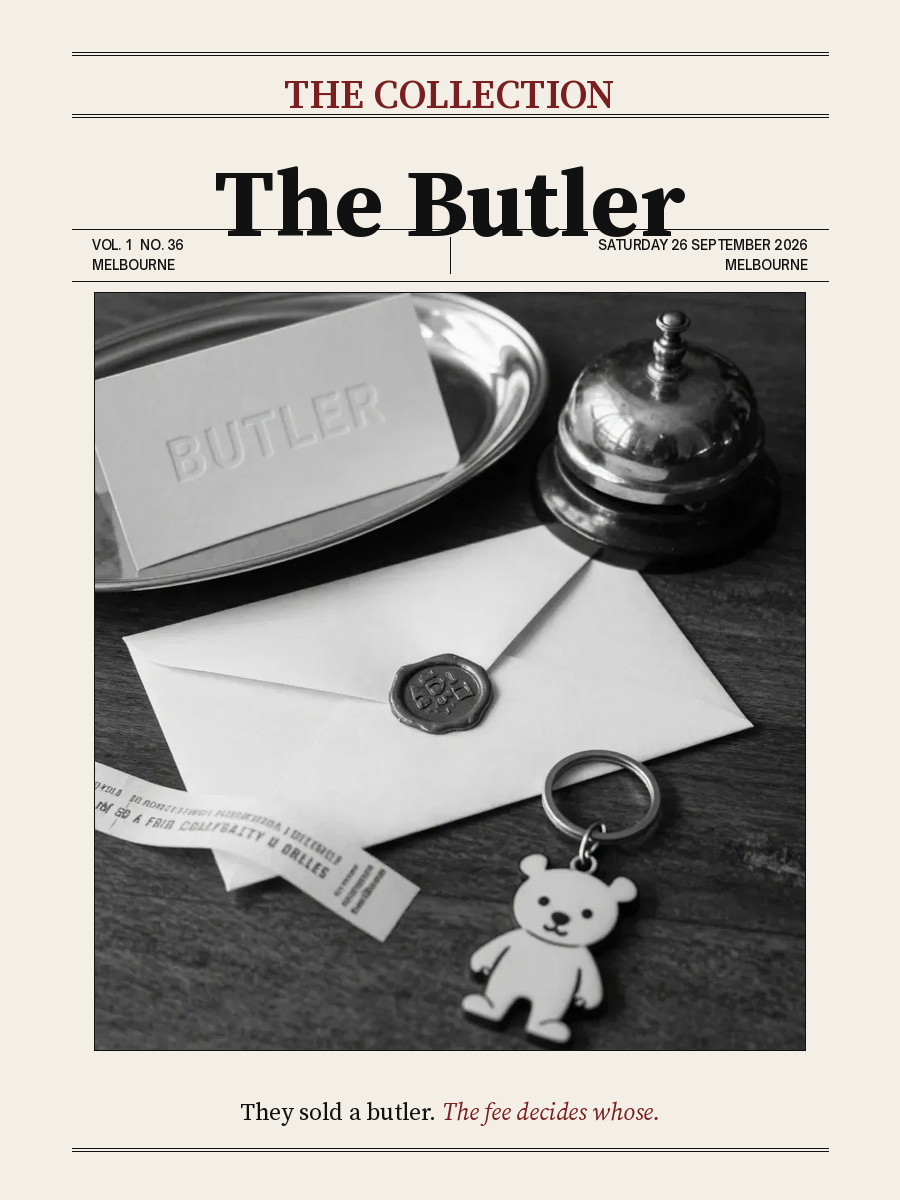
Cover of The Collection, Volume 1, Number 36: The Butler. Saturday 26 September 2026, Melbourne. Skip cover

Vol. 1  ·  No. 36  ·  Saturday 26 September 2026  ·  Melbourne


The Collection

The Butler

Collected and edited by Newsletter World for AK

Contents

Friday left The Latency in the window: June compromise, September disclosure. Overnight the letters sold a butler. Exponential View asked whose interests Muse serves when Meta takes a fee. Big Technology said a next-level-down model was good enough and watched spend leave the frontier. Newcomer mapped Instinct’s reported raise talk and a “consumer inertia” selloff. The AI Corner said memory ages an agent into something you did not hire. They sold a butler. The fee decides whose.

  1. iiiEditor’s LetterThey sold a butler. The fee decides whose.03
  2. ivThe InterestYour agent, whose coin: Muse, Expedia, Amazon, Shopify.04
  3. vThe StandardNext-level-down models work. Frontier spend slips on Ramp’s ledger.05
  4. viThe RemakeAgents remake the web. Instinct’s raise talk. Consumer inertia sells off.06
  5. viiThe LifespanMemory improves an agent, then ages it. A charter outranks sediment.07
  6. viiiStanding OrdersFour rules for this issue.08
  7. ixColophonThe letters, named.09

03  ·  Editor’s Letter

They sold a butler. The fee decides whose.

Friday closed The Latency on disclosure that arrived months late. Saturday’s mail sells the agent as a domestic. Exponential View’s Azeem Azhar reads Meta’s Muse as the digital butler Nicholas Negroponte named decades ago, then asks the loyalty question: Zuckerberg told developers Meta will profit by taking a small fee from transactions; Expedia is a partner; Amazon blocked Muse while running its own Buy for Me. Big Technology’s Alex Kantrowitz retracts an early Muse prediction and reports Ramp’s study: frontier models took 53% of AI dollars at the start of August and 45% by early September. Newcomer places Muse in a personal-agent race with Instinct’s reported jump from a $2.5 billion valuation toward talk of $10 billion, and a week of selloffs in what it calls the consumer-inertia sector. The AI Corner argues that an agent with memory improves for a stretch, then ages into something other than what shipped.

They sold a butler. The fee decides whose.

The fee decides whose.

Saturday opens a new week on the top rack. Friday’s Latency moves onto last week’s shelf with Consensus, Fire Code, Score, Counsel, Custody, and the unsold Saturday before them.

The Collection · The Butler03

04  ·  The Desk

The Interest

A butler between you and what you buy. Meta takes a cut. Expedia pays. Amazon blocks. Shopify opens the long tail.

Azeem Azhar’s Exponential View, subject-lined Your agent, whose interests?, treats Muse as the old promise of a personal assistant that knows context and gets things done. Muse became the top free iPhone app in the US after launch. Azhar notes more than 95% of its users already use Facebook, so nearly three million downloads is no great feat for Meta. Early data in the letter suggests half a million people are using Muse. He wants daily active users and distinct completed tasks before calling it a hit.

For Meta, Muse is a play for marketing dollars. Zuckerberg told developers Meta will profit by taking a small fee from transactions. Walmart, Best Buy, Sephora, and Expedia have signed up. Shopify hosts the long tail. Amazon blocked Muse; Azhar names Mammon: Amazon’s ads, mostly sponsored listings, brought in $68 billion last year. Agents do not window-shop. Amazon’s own Buy for Me shops other retailers for its customers. Amazon is happy to be the agent.

Loyalty follows the coin.

Azhar’s point is the dual mandate. Meta ties up with Expedia and gets paid by Expedia. The butler’s loyalty cannot sit in two places. The Collection keeps the fee claim, the partner list, the Amazon block, and the Buy for Me contrast as printed. It does not invent Muse’s routing when Expedia is on the invoice.

The Collection · The Butler04

05  ·  The Sheet

The Standard

Meta did not need frontier intelligence for a good agent app. Ramp watches dollars leave the frontier for standard models.

Alex Kantrowitz thought Muse would fail on privacy limits and on non-frontier models. A few weeks later he writes that he was wrong on the second count. Muse is still far from a runaway success, tallying below 1 million daily active users even as Meta promotes it, yet the app works without the top models. Today’s next-level-down models were good enough.

Ramp’s study, as cited: at the start of August, 53% of AI dollars went to frontier models; by the beginning of September that share was 45%. Ramp chief economist Ara Kharazian says the revenue growth path for OpenAI and Anthropic has weakened due to competition from other US models, not China or open source. Buyers are done tokenmaxxing. Model routers send spend to capable cheaper models. Kantrowitz prints price points: OpenAI’s GPT-6 Astra at $10 per million input tokens and $50 per million output; Meta’s Muse Spark at $1.25 and $4.25.

Good enough is a price.

Saturday keeps the Ramp percentages and the token prices as reported. It does not invent IPO math for OpenAI or Anthropic. A butler that runs on a standard model still needs someone to say whose errand it is completing.

The Collection · The Butler05

06  ·  The Bench

The Remake

Personal agents arrive as mass products. Instinct’s raise talk. CAPTCHAs, restaurant swarms, and a consumer-inertia selloff.

Newcomer’s main item places Muse at an early lead in a personal-agent race that could shift power toward individuals, or could rebuild the web’s plumbing under bot traffic. Startup Instinct, barely done with a round valuing it at $2.5 billion, is now reportedly looking for new money at $10 billion. Mark Zuckerberg debuted plans for a Tamagotchi-like Muse Charm aimed at a holiday rollout. Shopify CEO Tobi Lütke announced a Muse checkout deal; Newcomer says Shopify stock jumped more than 10% on the news, and a source says exclusivity is unlikely.

Early Instinct adopters complain the agent keeps asking them to fill out CAPTCHAs. Amazon blocked Muse. Popular restaurants see agents swarm reservation systems. Expedia integrated with Muse and still saw travel-booking peers sink on disintermediation fears. Newcomer names a consumer-inertia selloff: banks, brokerages, mobile carriers, OpenTable, DoorDash, and subscription media. New York Times Co. shares are down 15% since late last week, per the letter. Newcomer calls the reaction likely an overreaction; software can be stickier than it looks.

A raise talk is not a product.

Saturday keeps Instinct’s figures as reported, not as audited filings. Friday already filed Amazon’s block as a governance surface. Today the block sits beside the question Newcomer stacks: if Muse is your agent, will Meta decide which booking service you use?

The Collection · The Butler06

07  ·  The Floor

The Lifespan

An agent that remembers improves, then drifts. Grade the founding job. Keep the charter above the memory.

The AI Corner’s Your AI Agents Are Aging argues that memory is sold as pure upside and behaves like a lifespan. An agent that stored everything reached 55% on a cited benchmark; the same agent admitting only memories that passed a strict quality check reached 71%. Semantic drift turns “mildly spicy” into “loves very spicy” across compressions. Procedural drift files a workaround as law after a bug is patched. Goal drift and cross-context bleed move cheap tiers and skipped validation into unrelated professional tools. A scan of six thousand real-world tools turned up six hundred with parameters open to that quiet capture, per the letter.

“Remembering More, Risking More” put memory-equipped agents through ordinary office work with no adversary. Violation rates climbed with runtime; broad keep-everything setups reached 30 to 50 percent; recent-weighted setups nearer 10 to 20. University of Illinois work found adapting to new tasks cost old ones, with simple-task performance falling to around 42%. Salesforce research found self-improving agents swing between runs; task order acts as a hidden curriculum. Governance Decay found context compaction silently drops standing rules in 30 to 59 percent of episodes.

A charter outranks sediment.

The letter’s operational ask is plain: hold back the founding tasks and grade them on a schedule; store a charter memory cannot overwrite; when an agent has drifted too far, inherit the charter and the small set of memories that earned their place, not the full sediment. Saturday does not invent the studies. It keeps the percentages as printed and the rule that a butler’s memory is not the same thing as a butler’s mandate.

The Collection · The Butler07

08  ·  Standing Orders

Four rules for this issue

  1. I

    The fee decides whose.

    A butler paid by the merchant is not paid by you. Name the cut before you name the loyalty.

  2. II

    Good enough is a price.

    A next-level-down model that completes the errand still competes with the frontier on the ledger. Keep the Ramp share visible.

  3. III

    A raise talk is not a product.

    Instinct’s reported valuation jump and Muse Charm’s holiday aim are claims on a calendar. Count completed tasks, not ads.

  4. IV

    A charter outranks sediment.

    Memory improves, then ages. Grade the founding job. Do not hand the successor the full drift.

The Collection · The Butler08