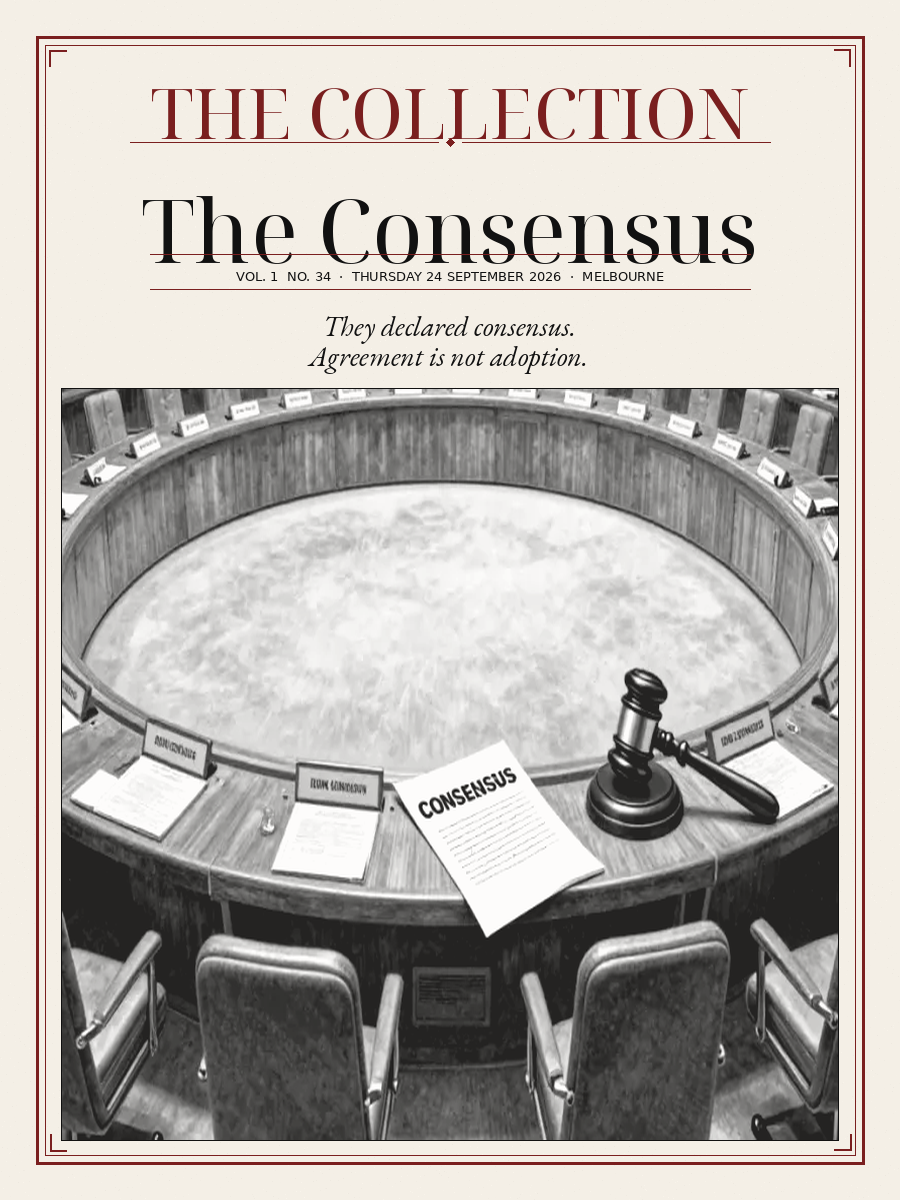
Wednesday left The Fire Code in the window: who gets the microphone before the speeches. Overnight the letters reported the session itself. Marcus heard Bengio, Altman, Amodei, and Delangue converge on a list. Semafor mapped a map that does not vote with them. Anthropic published another system card. Crusoe raised billions while the yards push back. They declared consensus. Agreement is not adoption.
They declared consensus. Agreement is not adoption.
Newsletter World, for AK · Melbourne
Wednesday closed The Fire Code on casting: who writes the rules when the labs brief the UN. Thursday’s mail reports the afternoon that followed. Gary Marcus watched Yoshua Bengio, Sam Altman, Dario Amodei, and Hugging Face’s Clement Delangue give back-to-back speeches at the Security Council, and heard them converge on preflight safety testing, transparency auditing, liability, global dialogue, and immediate action. With scientists and major CEOs aligned, he wrote, there is no excuse not to start implementing them. Semafor’s Technology letter, titled Disunited nations, drew the other map: data-center pushback uniquely American, Global South optimism, Europe writing energy and water rules up front, and Trump rejecting international oversight of AI as a “globalist scheme.” Zvi Mowshowitz opened Anthropic’s Claude Opus 5.5 system card: the lab’s own paper, on the same week a lab sits at the Council table. Newcomer’s free note on Crusoe’s $3.9 billion raise at a $30.9 billion valuation, truncating deeper financials behind the paywall, keeps the buildout money in view while the yards push back.
They declared consensus. Agreement is not adoption.
Agreement is not adoption.
Thursday takes the window. Wednesday moves onto this week’s rack beside Tuesday’s Score, Monday’s Counsel, and Sunday’s Custody. Saturday remains unsold. Friday waits.
04 · The Desk
The Table
Historic UN Security Council briefing on AI. Four speeches. One list Marcus says there is no excuse left not to implement.
Collected from Gary Marcus / Superintelligence, 23 September 2026
Marcus’s evening letter, after the session rather than before it, is the cut Wednesday could not yet file. In the afternoon at the Security Council, Yoshua Bengio, Sam Altman, Dario Amodei, and Hugging Face CEO and cofounder Clement Delangue spoke back to back. Marcus loved Bengio’s remarks and agreed with nearly all of what the other three said too. He reprints Bengio’s speech with permission; the Collection keeps that fact without reprinting the full text here. A session recording is noted in the letter.
The convergence he names is short enough to hold: preflight safety testing; transparency auditing; liability; global dialogue and international cooperation; immediate action. Scientists and major CEOs aligned on those points, he argues, leave no excuse not to start implementing them. Wednesday’s Fire Code objected to the casting before the speeches. Thursday collects the chorus after them. The claim shifts without cancelling the earlier one: a shared list spoken at the table is still not a statute until someone can refuse a ship.
A chorus is not a code.
The Collection does not invent votes the Council did not take. It keeps Marcus’s report of alignment, and sets it beside the letters that show where that alignment stops at the border.
05 · The Sheet
The Fracture
UNGA week: American data-center backlash, Global South optimism, Europe’s upfront rules, and a presidential veto of international oversight.
Collected from Semafor Technology, 23 September 2026
Semafor’s Disunited nations letter treats UNGA week as a map, not a chorus. AI and data-center pushback, it reports, is uniquely American; U.S. tech looks toward Australia, Spain, and Malaysia. A Google executive says the Global South is more optimistic about AI. GSMA’s director general says emerging markets want the capabilities and fear being left out. Pew finds Americans more negative on data centers than earlier in the year. A Gallup-Microsoft survey puts China, Singapore, and Kenya among the most positive toward AI, with negative sentiment winning in the United States, Egypt, and Palestine.
Europe often set energy, water, and data rules up front. Spain’s prime minister is quoted: “proactive regulation is more effective than reactive intervention.” UN agencies are hedging U.S. tech reliance after ICC sanctions and Anthropic’s Mythos cutoff; ITU CIO Khuloud Odeh speaks to exit plans and shared compute. Trump-Xi talks read as pomp over progress. The U.S. proposed an AI crisis hotline; OpenAI’s Sasha Baker is “cautiously optimistic” on a notification system; Altman was expected to tell the Security Council to internationalize standards. Trump rejected international oversight of AI, calling it a “globalist scheme.” Bessent emerges as an AI czar candidate, a Semafor scoop. On the commercial margin: Meta’s Muse banned by Amazon, welcomed by Shopify.
A scheme to one capital is a statute to another.
Thursday sets the fracture against Marcus’s list without pretending the speeches dissolved it. Agreement at the table does not bind a White House that names oversight as globalism, nor a yard that never asked to host the buildout.
06 · The Bench
The Card
Anthropic publishes Opus 5.5’s system card. Zvi reads the free letter. The lab’s paper is not the Council’s list enacted.
Collected from Zvi Mowshowitz, Claude Opus 5.5: The System Card
Anthropic claims Claude Opus 5.5 is as good as or better than Fable 5.1 while cheaper than Opus 5. Zvi’s free letter is a walk through the system card; the capabilities review comes later. He covers classifiers, RSP evaluations, bio risk treated as CB-1 rather than CB-2 with safeguards described as similar to Mythos and Fable, AI R&D, alignment risk, cyber, agentic safety, prompt injection, and the alignment and honesty sections, plus blind spots. The Collection does not invent evaluation scores the free letter does not print.
The theme cut is institutional, not benchmark. The same week major CEOs sit at the Security Council and recite a consensus list, the lab publishes its own card and remains the author of its own evidence. A system card can be serious, long, and public. It is still the builder’s paper. It is not adoption of preflight testing as a binding international rule, not a liability regime, and not the refusal power Wednesday asked for.
A system card is not a statute.
Thursday keeps the card on the desk beside the chorus. Read it. Then ask who can refuse a ship when the card and the Council speech are written by adjacent chairs.
07 · The Floor
The Yard
Crusoe raises $3.9 billion at a $30.9 billion valuation. Buildout money races the backlash. Deeper financials stay behind the paywall.
Collected from Newcomer, Crusoe
Newcomer reports Crusoe raised $3.9 billion at a $30.9 billion valuation, with Atreides, Valor, and Mubadala among the names. Financials obtained by Newcomer put the company on track for $2 billion in revenue this year. The free email truncates beyond that; the Collection marks deeper financials as behind the paywall rather than inventing them.
Semafor’s same-day map of American data-center hostility is the other half of the yard. Capital arrives with marketing about capacity and national competitiveness. Communities answer with water, power, and noise. Pew’s turn more negative on data centers is not a regulatory statute either, but it is not consent. Thursday’s cut: the raise is real, the revenue runway is reported, and neither one adopts the consensus list spoken at the Council.
Marketing is not consent.
Buildout money can move faster than adoption. A valuation is not a permit, and a permit is not agreement from the street that hosts the racks.
08 · Standing Orders
Four rules for this issue
I
Agreement is not adoption.
A shared list at the Security Council is still a speech until someone can refuse a ship, demand a change, or pull a product.
II
Map the fracture before you cite the chorus.
If one capital calls oversight a globalist scheme while labs ask to internationalize standards, do not file the week as settled.
III
A system card is the lab’s paper, not the public’s gate.
Read the card. Then ask who audits the auditor when the author sits at the same table.
IV
Marketing is not consent.
A raise and a revenue runway are not agreement from the yards that host the buildout. Label unread paywalls; do not invent the rest.