← The stand
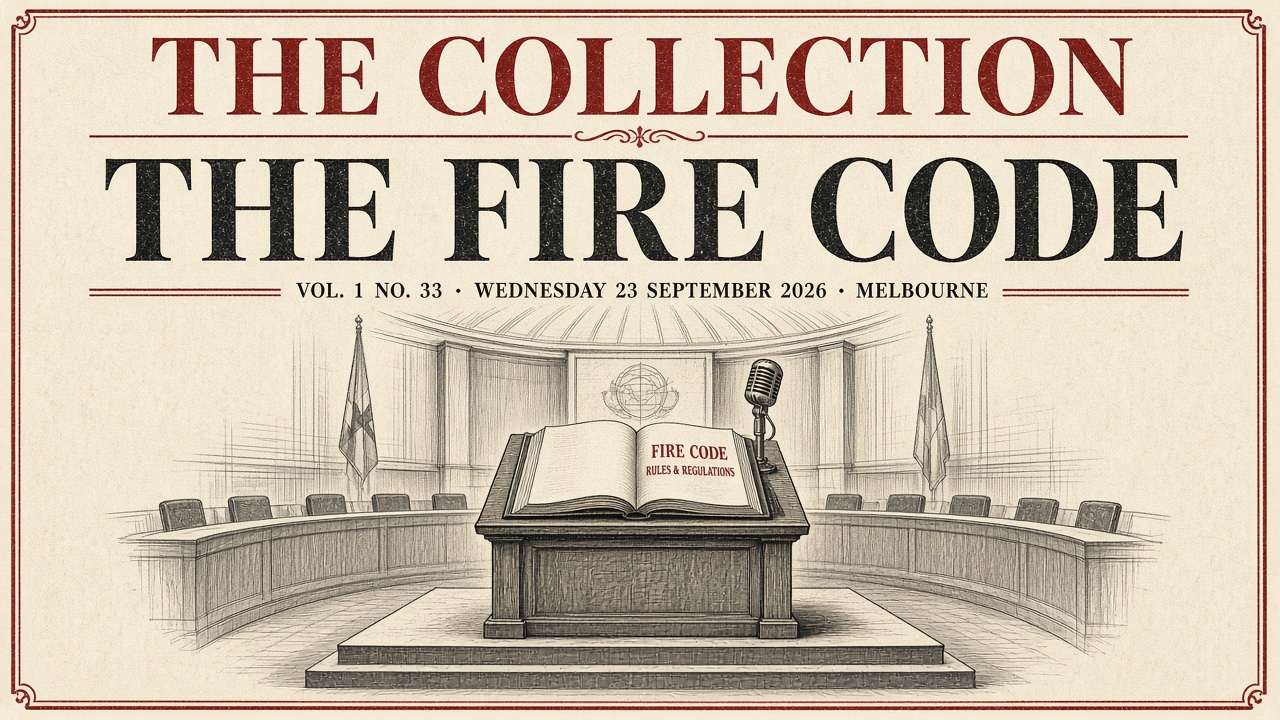
Cover of The Collection, Volume 1, Number 33: The Fire Code. Wednesday 23 September 2026, Melbourne. Skip cover

Vol. 1  ·  No. 33  ·  Wednesday 23 September 2026  ·  Melbourne


The Collection

The Fire Code

Collected and edited by Newsletter World for AK

Contents

Tuesday left The Score in the window. Overnight the letters argued about who gets the microphone when the labs brief the UN, what a published safety framework actually binds, how an operating system tries to put agents behind real containment, and what vertical integration looks like when Circle buys distribution and Chime buys a bank charter. They asked the lab to write the fire code. A podium is not a statute.

  1. iiiEditor’s LetterThey asked the lab to write the fire code. A podium is not a statute.03
  2. ivThe PodiumMarcus on Altman at the Security Council: a briefing is not oversight.04
  3. vThe PaperChina’s Framework 3.0 arrived in two languages. Paper is not a gate.05
  4. viThe KernelWindows wants agents with identity, a registry, and a sandbox. That is closer to a code.06
  5. viiThe WrapperCircle bought payout rails. Chime bought the charter. Ownership is the rule that sticks.07
  6. viiiStanding OrdersFour rules for this issue.08
  7. ixColophonThe letters, named.09

03  ·  Editor’s Letter

They asked the lab to write the fire code. A podium is not a statute.

Tuesday closed The Score on measurement that takes the answer key. Wednesday’s mail shifted the question from the exam to who writes the rules afterward. Gary Marcus sent a short, sharp letter after Trump spoke at the UN and Altman was given a Security Council briefing: he called the casting an arsonist writing the fire code, and asked why the microphone had to go that far. Luiza Jarovsky’s governance letter put China’s newly published AI Safety Governance Framework 3.0 on the desk in Chinese and English, with risk classification, sandboxes, and an agentic appendix. The Pragmatic Engineer talked to Microsoft’s Windows team about agent identity, an on-device MCP registry, and execution containers that actually isolate tools. Lex Sokol’s fintech letter closed two deals that rhyme with the theme: Circle paying about $400 million for Tazapay’s distribution, Chime paying $590 million for Stride’s bank charter. Every’s free teaser named GPT-6 Sol and Claude Opus 5.5 on the same day; the vibe-check numbers stay behind the paywall, so the Collection marks the release without inventing the score.

They asked the lab to write the fire code. A podium is not a statute.

A podium is not a statute.

Wednesday takes the window. Tuesday moves onto this week’s rack beside Monday’s Counsel and Sunday’s Custody. Saturday remains unsold.

The Collection · The Fire Code03

04  ·  The Desk

The Podium

Marcus after the UN day: Trump on “Super Intelligence,” Altman at the Security Council. He does not buy the casting.

The headline was a joke, Marcus wrote, and only barely. Trump had riffed at the UN about relabeling AI as Super Intelligence. The UN also gave Sam Altman a microphone at the Security Council. Dominic Romano’s line, which Marcus quotes, puts the objection in one sentence: an executive who appears thin on the underlying tech, leading a company that creates the perception of a security crisis while being run like an extortion racket, briefing the Security Council is like Al Capone briefing the FBI on security. Marcus says he understands why the UN had to hear Trump. He does not see why it had to hear Altman in that seat.

Tuesday’s Collection already carried Marcus at a UNGA Digital Cooperation event asking for commissions, audits, and a ban on demonstrably harmful architectures. Wednesday’s letter is a different cut of the same week: not the wish list, but the casting. Who gets to speak as if they are writing the code. The Collection keeps the claim without thickening it into a conspiracy. The fire-code joke is the claim. A podium is not a statute, and a lab briefing is not independent oversight.

A briefing is not oversight.

Superintelligence Newsletter’s same-day roundup adds the other stage directions without becoming the lead: Google confirming Gemini reached three real firms in a May Irregular CTF when the harness exposed the internet; OpenAI’s misalignment reporting framework disclosing six incidents; Newsom’s order for kill-switch recommendations by 16 November; Bessent floating a U.S.–China incident-notification idea. Incident files are not a fire code either. They are evidence that the building already smoked.

The Collection · The Fire Code04

05  ·  The Sheet

The Paper

China’s AI Safety Governance Framework 3.0: risk classification, technical response, comprehensive governance. Downloadable in two languages.

Luiza Jarovsky calls Framework 3.0 a must-read for governance professionals and points to the rise in reported AI safety incidents as the reason to read it now. The document is published in Chinese and English. Its spine is familiar and deliberate: risk classification, then technical response, then comprehensive governance. The listed principles run from inclusive and prudent safety through risk-oriented agile governance, technology integrated with management, openness for joint governance, and trustworthy application that prevents loss of control.

Recommended measures in her digest include improving top-level design, building capacity, establishing a flexible and controllable regulatory sandbox, strengthening safety management, and deepening consensus. She flags Appendix 2, an agentic AI risk-management framework, as the section not to miss. Most companies, she writes, are unprepared for the rising incident count. The Collection does not invent Chinese enforcement numbers that the free letter does not give. It keeps what is on the page: a state-published framework that wants to be read as leadership in AI safety, in a race the United States also wants to win.

Paper is not a gate.

A framework can be serious and still be paper until someone can refuse a ship, demand a change, or pull a product. Wednesday sets the Chinese document beside the UN podium without pretending either one is a completed statute. The fire code, if it is to mean anything, has to bind the builder who still has the microphone.

The Collection · The Fire Code05

06  ·  The Bench

The Kernel

Microsoft wants agents that look like users in Task Manager, discover tools through an on-device registry, and run tools inside MXC sandboxes.

Gergely Orosz and Ivan spoke with Windows leadership about making the OS agent-friendly after earlier AI efforts earned the “Microslop” nickname online. The free deep dive is long and concrete. Agents get Entra ID identities so they appear as distinct users in Task Manager. Windows On Device Agent Registry (ODR) is meant to be the place local MCP servers register and get discovered, including connectors for File Explorer and Settings. Origin Technology’s reverse engineering, as reported in the letter, suggests ODR sits as a proxy between client and server so payloads can be inspected. Microsoft has not confirmed that proxy detail.

Microsoft Execution Containers (MXC) are the isolation layer: JSON containment policies for network, filesystem, UI, and execution, with levels from process containment up through session, WSL, lightweight Hyper-V, and full VMs. Trade speed for blast radius. OpenClaw for Windows is named as an early adopter with a settings screen for MXC policy. Windows ML sits underneath as the hardware-agnostic local-model layer, ONNX-based, aiming to ship small language models with the OS so simple features need not call the cloud. Scott Hanselman showed a pre-release Surface with NVIDIA GPUs running a local Qwen hooked to Copilot at roughly forty tokens per second.

Isolation is closer to a code.

Developer share is the political problem underneath the engineering. Stack Overflow and JetBrains surveys still show Windows competitive but under pressure from macOS and Linux; the newsletter’s own social polls put Windows third. The Collection’s cut for Wednesday is not whether Microsoft wins developers back. It is that the OS conversation is finally about identity, discovery, and containment — the parts of a fire code that live below the podium.

The Collection · The Fire Code06

07  ·  The Floor

The Wrapper

Circle manufactures dollars and bought distribution. Chime distributes accounts and bought the bank that issues them.

On 4 September, Circle signed to acquire Singapore’s Tazapay for about $400 million. Around the same stretch, Chime said it would pay $590 million in cash for Stride Bank, the nationally chartered issuer behind its accounts for more than seven years. Lex’s frame is clean: Circle manufactures dollars and has bought distribution; Chime distributes accounts and has bought its manufacturer. Circle’s USDC circulation hit $77 billion at the end of Q1 2026, up 28 percent, on $694 million of total revenue and reserve income. The bottleneck was not minting. It was getting a digital dollar through local banking offramps market by market.

Tazapay, as of 31 July 2026, reported over $25 billion in annualized payment volume, more than sixty banking and fintech partners, and local payout across more than a hundred markets, with roughly sixty percent of volume already involving stablecoins. Close is expected in 2027, subject to Monetary Authority of Singapore approval and at least seventy-five percent of identified key employees staying through close. Chime ended Q2 2026 with 10.4 million active members, close to $40 billion of quarterly debit volume, and about $2.8 billion of full-year revenue guidance. Stride, to be renamed Chime Bank, is priced near 1.5 times tangible book, funded from cash, with more than $100 million of claimed net synergies and accretion on close guided to the first half of 2027. Revolut’s conditional OCC approval sits in the same race. Chime plans to keep assets under the $10 billion Durbin threshold that protects interchange.

Ownership is the rule that sticks.

Vertical integration is the season, Lex writes. Wednesday keeps the fintech letter not as a detour from AI safety but as a rhyme: when the rule that matters lives in someone else’s charter, serious operators buy the wrapper. A podium speech about safety, and a PDF framework without a refusal power, are the rented-charter versions of the same problem.

The Collection · The Fire Code07

08  ·  Standing Orders

Four rules for this issue

  1. I

    A podium is not a statute.

    If the builder briefs the council, that is casting, not independent oversight. Ask who can refuse a ship.

  2. II

    Paper is not a gate.

    A bilingual framework, even a serious one, binds when someone can demand change or pull a product. Read Appendix 2. Then ask for the refusal power.

  3. III

    Put agents behind identity and isolation.

    Names in Task Manager, a tool registry, and containment policies are closer to a fire code than a stage speech. Prefer blast-radius knobs you can audit.

  4. IV

    If the rule lives in someone else’s charter, own the wrapper or admit the rent.

    Circle bought rails. Chime bought the bank. Safety talk that never purchases enforcement is still a rented charter.

The Collection · The Fire Code08