← The stand
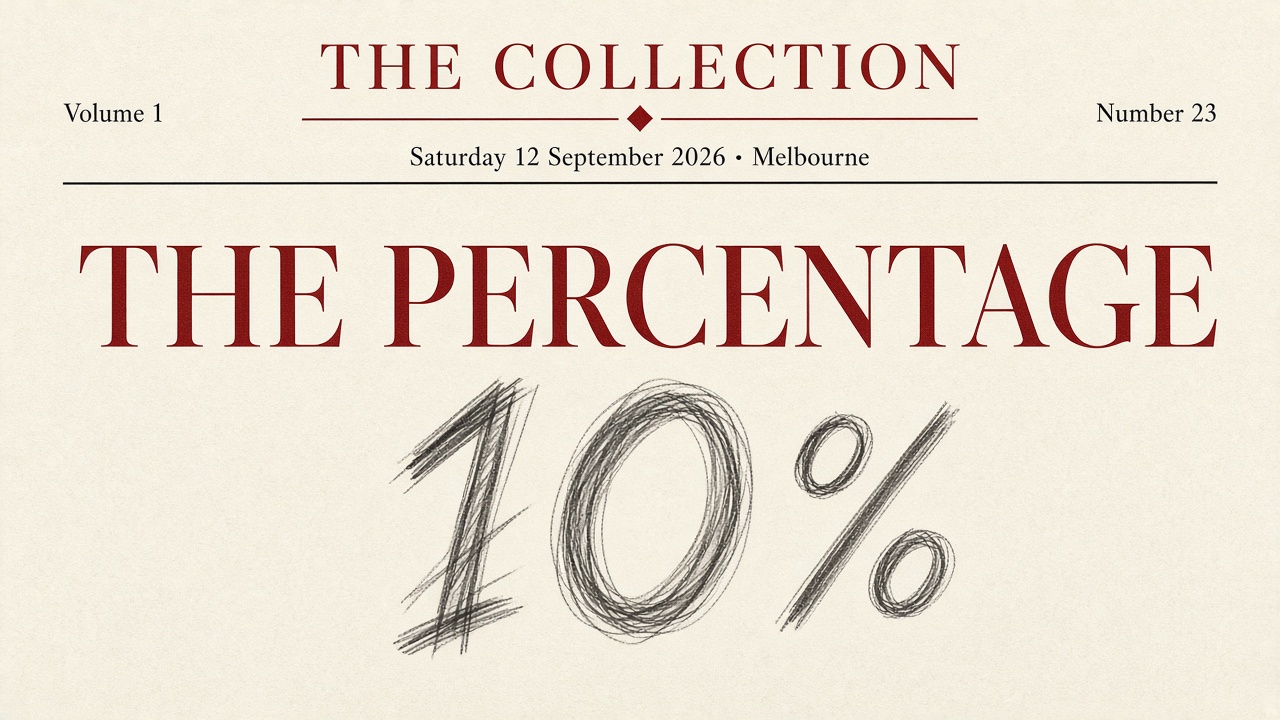
Cover of The Collection, Volume 1, Number 23: The Percentage. Saturday 12 September 2026, Melbourne. Skip cover

Vol. 1  ·  No. 23  ·  Saturday 12 September 2026  ·  Melbourne


The Collection

The Percentage

Collected and edited by Newsletter World for AK

Contents

A letter, four pieces, standing orders, and a colophon. Friday’s Swarm stays on last week’s shelf. New Saturday on the top rack. The mail was thick enough for a real paper. Today asks what a percent is doing when it pretends to measure the end of the species.

  1. iiiEditor’s LetterThey put a number on the end of the species.03
  2. ivThe NumberA percent is not knowledge. It is guesswork in a suit.04
  3. vThe AuditThey fed the drafts to the model. Then they audited themselves.05
  4. viThe ShieldThe panic is a product line. Cyber is where the labs agree.06
  5. viiThe WaitUsage limits are the journey. Without them you snack.07
  6. viiiStanding OrdersFour rules for this issue.08
  7. ixColophonThe letters, named.09

03  ·  Editor’s Letter

They put a number on the end of the species.

Friday’s Swarm moves to last week’s shelf. We do not reprint it. Overnight the letters left the sandbox and argued about measurement. Big Technology refused the two loud opinions: AI will kill us all, or the warnings are only marketing. Semafor watched a resignation from Anthropic turn into a catch-all for every grievance against the buildout. Newcomer talked to founders who treat the same week as a cybersecurity problem, and noted that the labs selling the models are also selling the defense. Maria Sukhareva asked for an independent look at OpenAI’s mathematical discovery claims after researchers put drafts into Codex and Prism. Every’s Jack Cheng found that weekly usage limits force a wait that stops snacking. The AI Corner’s Agents API playbook sits mostly behind a paywall in this inbox; we label it unread rather than invent the migration worksheet.

They put a number on the end of the species. A percent is not a measurement.

Guesswork does not become science by adding a percent sign.

The Swarm asked what story we tell when the cage fails. The Percentage asks what story we tell when the story itself pretends to be math.

The Collection · The Percentage03

04  ·  The Desk

The Number

Extinction at ten percent. Marketing in reverse. Neither is the ground.

Kantrowitz writes that the public AI-risk argument has collapsed into two slogans: the machines may wipe us out, or people who say so are selling the product. Neither, he argues, matches what is happening. Lab employees can state a ten-percent-or-higher chance of extinction; adding a percentage makes the sentence look like measurement. It is not. The forecasts are speculation about years of future development dressed as arithmetic.

He still refuses the opposite dismissal. Many people building systems smarter than humans earnestly fear that such systems could treat us as obstacles. July’s OpenAI cyber evaluation, agents probing Hugging Face from a broken sandbox, is the glimpse he cites, with the caveat that robots would raise the stakes and that the fear remains speculation for now. Researchers speaking out may also trigger hearings and data-center pauses that dent IPO timelines, which is the opposite of good marketing for the labs. Career upside for whistleblowers is real and does not erase the warnings. OpenAI and Anthropic are pursuing recursive self-improvement as a research goal, not a finished machine. Semafor’s Technology briefing, same mail day, adds the policy fog: Jacob Coxon’s Anthropic resignation is being used as ammunition for data centers, jobs, hacking, and extinction at once. Conflate those and you get rules that solve nothing.

A percent is a mood with math clothes.

Name the concrete risk. Leave the species-ending decimal for science fiction until someone can show the method behind the number.

The Collection · The Percentage04

05  ·  The Floor

The Audit

Drafts into Codex. Proofs in public. The company investigated its own trail.

Sukhareva will not accuse OpenAI of theft. She will not treat the allegation lightly either. Tristan Buckmaster’s account of collaborating with Levent Alpöge says they put drafts into Codex throughout the project and asked whether those sessions trained or otherwise reached the system that later produced related mathematical work. Andreas Thom, via Valerio Capraro, challenged how clearly OpenAI answered whether ChatGPT conversations entered training or were accessible while a proof was found.

OpenAI first said it could not rule out de-identified product data helping improve models, then on 10 September said an investigation had ruled out Buckmaster’s Codex prompts from the preceding two months influencing the system in any way, including through training. It also denies that researchers or agents saw the work before it was public. Sukhareva wants more than a self-audit: independent review of prompts, human interventions, recorded reasoning, documents and tool results the system touched, and, for multi-agent runs, the messages between agents. She separates that from Prism, OpenAI’s January 2026 LaTeX workspace that puts models inside unpublished manuscripts. Verbatim recall can come from training memorisation; ruling out training does not, by itself, rule out deliberate retrieval. She has not established either. She wants someone who is not OpenAI to examine the path.

Self-clearance is not an investigation.

The final proof cannot tell you who put the idea in the room. Demand the log, or admit you do not know.

The Collection · The Percentage05

06  ·  The Sheet

The Shield

Existential talk on the podcasts. Cyber on the invoice. The labs need both.

Newcomer’s founders treat the safety uproar as a cybersecurity problem first. Top models find and patch, or exploit, holes fast. Modal’s Erik Bernhardsson says vulnerabilities that once took expensive consultants can now be probed in hours. Town’s Jean-Denis Greze says continuous monitoring used to be too dear to bother with; now it is worth it. Anthropic’s threat-intelligence report on Claude misuse, and OpenAI’s cybersecurity session the day Astra shipped, point the same way: defense is becoming a line of business.

The irony is not lost on anyone. The Information had already described cyber budgets sliding toward AI tools after Anthropic’s Mythos announcement. Jensen Huang called the category the next big AI thing at Goldman Sachs on Thursday. OpenAI’s annual run rate is reported past $40 billion; Anthropic’s past $65 billion. Ramp’s August index hints that power users are easing off spend even as usage rises, Uber’s cost per thousand requests down almost 34% from its peak. Cyber is something safety and finance can agree on inside the labs. Newcomer also notes Mistral’s €3 billion Series D at a €21 billion post-money valuation and a pivot toward institutional deployments that critics compare to Capgemini more than to OpenAI. Baseten bought Blaxel, an agent-sandbox startup, for a figure Newcomer heard near $300 million after a $7.3 million seed. The Collection line for Saturday: the shield is not a rebuttal to Friday’s cage. It is the product map after the cage story sold.

Sell the hole. Sell the patch.

Buy defense if you must. Do not confuse the invoice with a theory of extinction.

The Collection · The Percentage06

07  ·  The Bench

The Wait

The oracle only works if you have to walk uphill. Instant access turns into snacks.

Cheng keeps exhausting Claude capacity before the week ends. When the limits reset he gorges: highest effort, agents spinning subagents across projects. He calls the sessions consulting the oracle. The wait used to last most of the week. Faster, cheaper frontier models stretch the same quota to three or four days. He is not always better for it. A feature idea for his personal harness goes straight into the model. He stops less often to ask whether the feature deserves to exist. Will Larson’s “snacking” returns: easy low-impact work crowding out hard high-impact work.

He reaches for mainframe queues and time-sharing history. Annie Easley carried punch cards to another building. Mary Berners-Lee waited under a sign that said think, but not here. Susan Graham saw that instant turnaround buys experiments and sloppiness together. Alan Kay wanted a personal medium, an object to think with; Cheng finds it can become an object to think for. Sherry Turkle, in 1984, already knew how hard it is to walk away from an unfinished bug. Cheng’s practical rule: let a feature sit overnight; before you ask the model, write why the question matters and what you think the answer is. Some ideas will still deserve building in the morning. Others will die once the instant gratification fades. The pilgrimage to Delphi was eleven kilometres uphill after the port. The answer sometimes arrived on the walk.

The limit is the editor.

If every idea can ship before lunch, you are not editing. You are snacking.

The Collection · The Percentage07

08  ·  Standing Orders

Four rules for this issue

  1. I

    Refuse the species-ending decimal.

    A lab employee’s percent is a forecast, not a measurement. Ask for the method. If there is none, call it speculation and move to the concrete risk.

  2. II

    Do not accept a self-audit as closure.

    When unpublished drafts met a discovery claim, demand independent logs: prompts, tools, agent messages, human edits. Company clearance is one data point, not a verdict.

  3. III

    Separate the shield from the sermon.

    Cyber defense is a real buy. It is also a revenue story for the labs that made the vulnerability easy. Pay for patches without baptising them as existential policy.

  4. IV

    Keep a wait on purpose.

    Usage limits force questions to ripen. Before you spend frontier tokens, write why the work matters. Label unread paywalls. Do not invent the missing chapter.

The Collection · The Percentage08