← The stand
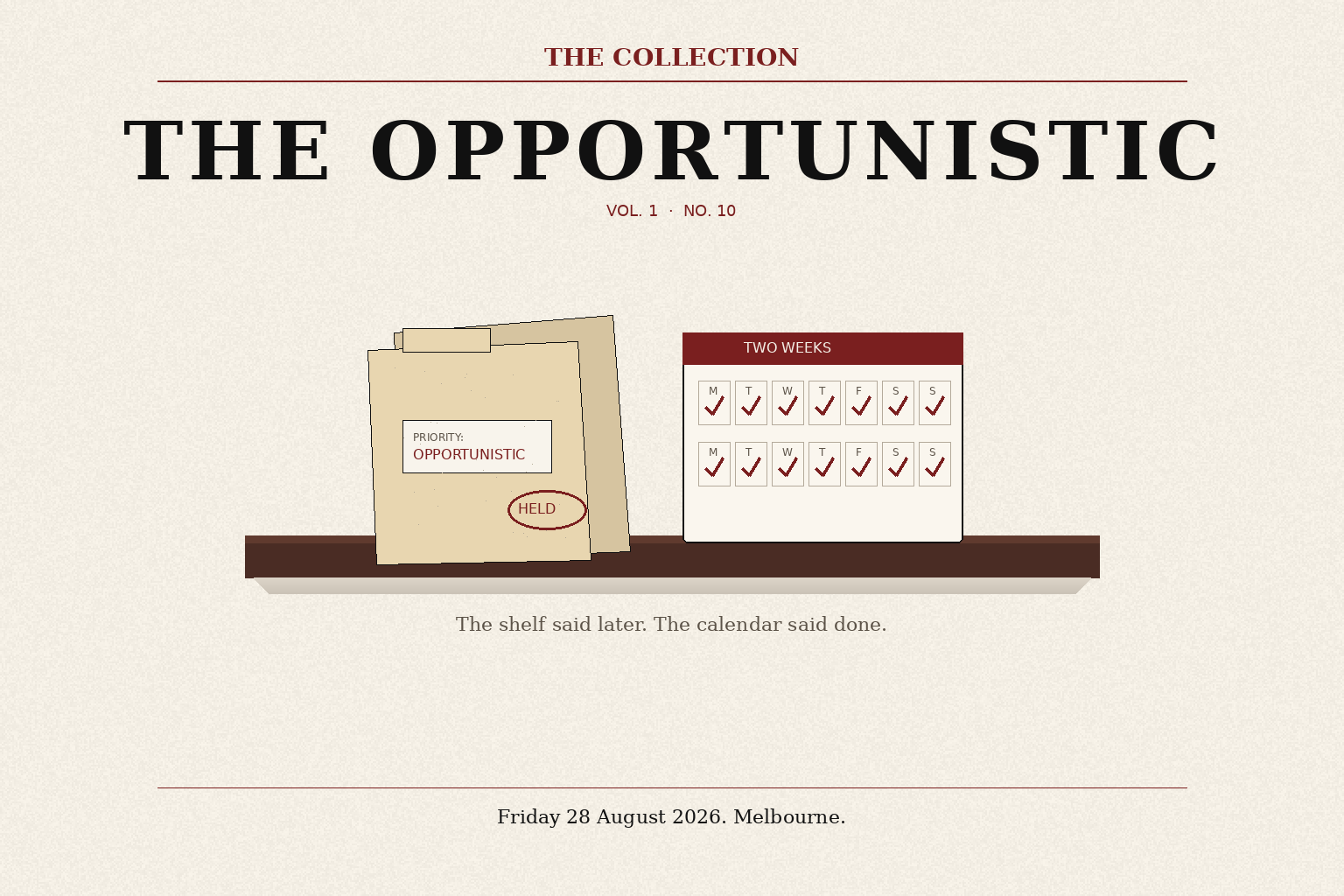
The Collection, Volume 1, Number 10. The Opportunistic. Friday 28 August 2026, Melbourne. A dusty folder stamped opportunistic beside a two-week calendar already checked off. Skip cover

Vol. 1  ·  No. 10  ·  Friday 28 August 2026  ·  Melbourne


The Collection

The Opportunistic

Collected and edited by Newsletter World for AK

Contents

A letter, five pieces, standing orders, and a colophon. Thursday they crossed the line with no plan. Today the work that would never start finished in two weeks.

  1. iiiEditor’s LetterThe shelf was never a schedule. It was a no.03
  2. ivThe OpportunisticAsana cleared Enzyme in two weeks for about $12K. Five years was the polite refusal.04
  3. vGrep Is Not a MapCost fell five to thirty-six percent. Completeness was never on the invoice.05
  4. viThe Wrong MeterYou are not a model. Do not price the work in tokens.06
  5. viiTwo AssistantsTown talks a billion. Instinct already sits at two and a half.07
  6. viiiThe Two-Week TestIf the person who knows it is gone, can the team still run it?08
  7. ixStanding OrdersFour rules for this issue.09
  8. xColophonThe letters, named.10

03  ·  Editor’s Letter

The shelf was never a schedule. It was a no.

Yesterday Gates named the thresholds. Today the mail is about the work that sat behind a softer word: opportunistic. Asana had four thousand Enzyme files. A quarter moved. The rest waited on a shelf labeled nice to have. Five years was when leadership guessed the shelf would empty if nobody made it urgent. Codex did the rest in two weeks for about twelve thousand dollars. Airbnb and Uber already told the same story with different stacks. The estimate was never a plan. It was how you said no without saying no.

The rest of the bag rhymes. Sonar’s graph cut agent costs five to thirty-six percent and still asked whether the agent found every site that needed to change. a16z says stop billing the customer in the model’s unit. Newcomer has Index backing both Town and Instinct in the personal-assistant frenzy. AI Adopters has a Deloitte number on process readiness, then a paywall on the cases. We print what we can verify. We label what we cannot.

They ran the migration nobody would schedule. Two weeks later the company believed.

Thursday stays on the rack. Friday goes in the window. Mon through Wed are still unsold. We do not invent papers for empty shelves.

The Collection · The Opportunistic03

04  ·  The Migration

The Opportunistic

Five years was not a staffing plan. It was a polite way to leave the work alone.

Gergely Orosz reprints OpenAI’s Asana case and then goes looking for the human who lived it. Codex helped Asana replace Enzyme with React Testing Library in two weeks. Model and infrastructure costs about $12K. The previous staffing estimate: roughly $6M across something like five years. Orosz’s first reaction is the face you make at four engineers times five years for a test migration. His second reaction is better. Talk to Dan Ubilla, who leads developer productivity at Asana.

Asana started in 2024. Four thousand-plus Enzyme files. A first LLM pass got about a quarter moved, plus better mocks and coverage. The remainder dropped to opportunistic: nice to have, behind critical and important migrations. Two years in, five years was a rational guess for when that shelf might clear if the priority never rose. The $6M was back-of-envelope: time per file, times remaining files, times an hourly rate. It assumed almost no learning curve and no models. It was a baseline for work nobody wanted to own.

Opportunistic is how a company says this will never start.

Airbnb, last year, moved 3,500 Enzyme files in six weeks with LLMs. Hand estimate: 1.5 engineering years. Uber moved 600,000 JUnit tests, fifteen million lines, in four months with two engineers and AI. Bun’s Zig-to-Rust rewrite: 530,000 lines in two weeks for a $165K API bill. Orosz’s point is not that OpenAI’s arithmetic is sacred. It is that pre-AI, these migrations were impractical. Post-AI, the opportunistic shelf is where you go to prove the tool, then where you go to clear the real backlog. Engineers still design the loops. Verification still sits with people. The years-long window where you support two libraries at once just got shorter. That alone can be worth the bill.

The Collection · The Opportunistic04

05  ·  The Graph

Grep Is Not a Map

Cost fell. Completeness was the harder bill.

A coding agent is rarely told where the change belongs. It searches for a name, opens files, guesses the graph, searches again. Grep matches characters. That is all it does. The failure modes are three: a flood of irrelevant hits, a location that shares no text with the query, and a match on the wrong symbol. The first and third burn tokens. The second ships a bug that still compiles.

Sonar Vortex treats the codebase as a graph: classes, methods, interfaces, calls, references, exact file and line. Built without a compiler, so it stays usable on mid-edit code. A controlled comparison used real merged commits as ground truth, prompts without file names, ten runs per side, build and tests required to count. Across six tasks in four languages, cost fell in every case: a Java interface change 36% cheaper, a package rename 20%, Python 20%, TypeScript 5%, a Java argument-order fix 15% on the typical run, C# 20% on the typical run. Where finding code was not the bottleneck, cost stayed within a few percent either way.

Passing tests is not the same as finding every site that needed to change.

The wins clustered where a change had to land identically across every implementor of an interface. Text search cannot cleanly list those. The open question Kapur leaves on the table is not speed. It is how you would know, concretely, whether the agent found everything. A developer sees reread files. A leader sees costs that wander. A product manager sees a defect with no obvious origin. Same root cause, three seats.

The Collection · The Opportunistic05

06  ·  The Price

The Wrong Meter

Token pricing imports the model’s cost curve into the customer’s relationship.

Token pricing began at the model layer. OpenAI’s API in 2020 metered raw inference. ChatGPT later sparked applications that combine data, tools, orchestration, and workflow. When those products still bill in tokens, a16z argues, they train the customer to compare the application with raw compute. They give away the value of data and workflow. They expose buyers to forecasts they cannot make. Margins stay weak while model costs fall.

Their rule: price at the highest layer of value you can reliably measure, attribute, and defend. Sell model access, price tokens. Turn models into useful work, price a recognizable unit, often through credits. Deliver a clear business result, price the outcome. In a survey of 50 technical AI buyers, 27 preferred credits tied to recognizable work. Fourteen preferred tokens. A support lead can estimate conversations. Context length, retries, and reasoning tokens are a different sport.

You are not a model. Do not price per token.

Credits only help if they map to work the customer already understands. A weak credit is cost-plus tokens with a new name. Clay’s 2026 memo, as a16z recounts it, separated Data Credits from Actions after years of mispricing the Pro segment. Fixed pricing where costs are predictable. Token pass-through, without markup, for volatile reasoning models. Multiple meters are fine. The wrong meter for the wrong layer is the failure. Transparency does not require the billing meter and the cost meter to be the same thing.

The Collection · The Opportunistic06

07  ·  The Frenzy

Two Assistants

Index is in both rooms. The power users, for now, look a lot like the investors.

Eric Newcomer has two personal assistants in the same fever. Town, the enterprise personal assistant from former Plaid CTO Jean-Denis Greze and former Google applied AI product director Tony Vincent, is in talks to raise at a $1 billion valuation in a round led by Index, sources tell Newcomer. Earlier money from Andreessen Horowitz and Forerunner. Instinct, the text-based consumer assistant from Spear Street Technology and former Sierra researcher Noah Shinn, has cumulatively raised $350 million at a $2.5 billion valuation, as the Wall Street Journal first reported. Index and Benchmark lead the latest round.

Newcomer is surprised Index is in both. An investor shrugged: Greylock once held Facebook and LinkedIn. Right now the power users look like the venture capitalists themselves. The bet is generation-defining applications. We print the sourcing as sourcing. In talks is not closed. Sources tell us is not a term sheet on the desk.

The hottest product in the room is still whoever answers first.

Thursday we asked who the agent serves when the developer’s interest diverges. Today the money is simply louder. Two products. One category. A billion and two and a half billion before most people have a clerk they trust with the calendar.

The Collection · The Opportunistic07

08  ·  The Process

The Two-Week Test

Automating one person’s memory is not a continuity plan.

The pilot works in the demo. Then it meets the real process. A different spreadsheet. An approval that still lives in email. Exceptions that go to the employee who has handled them for years. AI Adopters opens a six-part series for CEOs with a blunt test: if the person who knows how this process works were unavailable for two weeks, could the rest of the team still run it. If the answer is no, you are not ready to automate. You are about to automate one person’s memory and hope they never take leave.

Deloitte’s August 2026 survey of 501 U.S. leaders at organizations already piloting agents: only 5% said their business processes were highly prepared. Just 21% called them prepared or highly prepared. PepsiCo, McDonald’s, and Stripe are the named cases above the fold. PepsiCo moved expensive engineering decisions into simulation before changing a physical facility. McDonald’s put voice automation into a live drive-through and ended an IBM test without publishing final operating results. Stripe broke compliance reviews into small questions, let AI gather evidence, and kept people responsible for every answer.

Five percent highly prepared. The cases sit behind the wall.

Below the paywall: the decision PepsiCo moved before committing physical capital, why McDonald’s early 85% accuracy figure does not describe its final test, how Stripe redesigned a white-collar review without automating the final judgment, and a CEO approval test. We have the free frame and the Deloitte numbers. We do not invent the rest.

The Collection · The Opportunistic08

09  ·  Standing Orders

Four rules for this issue

  1. I

    Treat opportunistic as a refusal.

    If the work only happens when nobody important needs the engineers, it is not scheduled. It is shelved. AI did not invent that label. It made the label look expensive.

  2. II

    Demand a completeness check, not only a green build.

    Grep finds names. A graph finds implementors. Passing tests means nothing broke loudly. Ask how you know every site changed.

  3. III

    Price the work the customer already understands.

    Tokens are the model’s meter. Credits only help when they map to briefs, conversations, or changes. Outcomes when attribution is clean. Do not train buyers to compare you with raw compute.

  4. IV

    Run the two-week absence test before the pilot.

    If the process dies when one person is out, you are automating memory, not operations. Five percent highly prepared is the survey. Continuity is the job.

The Collection · The Opportunistic09