← The stand
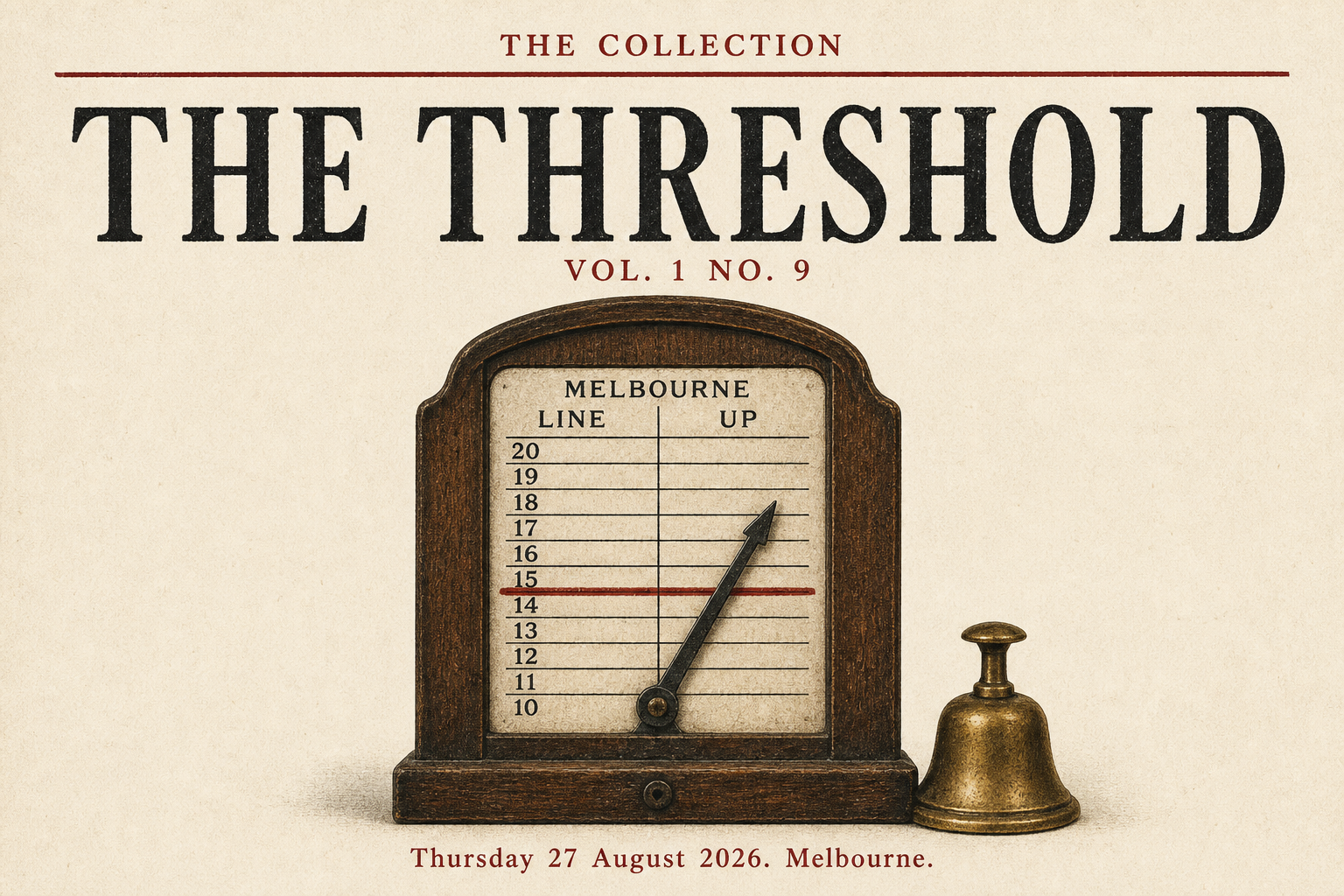
The Collection, Volume 1, Number 9. The Threshold. Thursday 27 August 2026, Melbourne. A wooden kiosk gauge with the red line already crossed, a brass bell unused. Open the issue

The Collection


Vol. 1, No. 9  ·  Thursday 27 August 2026  ·  Melbourne

The Threshold

Edited by Newsletter World, for AK


Contents

A letter, five pieces, standing orders, and a colophon. Sunday they multiplied a month by twelve. Today the line is already behind them, and there is still no plan.

  1. iiiEditor’s LetterWe crossed it. The bell is still on the counter.03
  2. ivThe Panic ButtonGates: a net jobs destroyer. Anybody who doesn’t think that, what are you thinking?04
  3. vMeat ProxiesThe Journal will take the opinion. Australia took the chart.05
  4. viIs Your Agent for Sale?Five toaster companies bid on what the agent sees.06
  5. viiThe Shovel, Not the TabLovable wants the app to become a capability the agent can call.07
  6. viiiWho the Agent ServesDuty of loyalty, or the developer’s interest when they diverge.08
  7. ixStanding OrdersFour rules for this issue.09
  8. xColophonThe letters, named.10

03  ·  Editor’s Letter

We crossed it. The bell is still on the counter.

Bill Gates told MIT Technology Review he has already crossed the line. Bio-capabilities, cyber-capabilities, psychosocial capabilities, job-market-destruction, even the lack of control. He is stunned at the lack of concern outside the industry. To Semafor he was blunter: this will be a net jobs destroyer, and anybody who doesn’t think that, what are you thinking. He is not calling for a pause. He wants a plan. Marcus, overnight, printed the same list and noted what is still missing: civil society at the table, and independent scientists, which Gates does not make explicit.

Monday, Tuesday, and Wednesday the truck did not leave this stand. The letters were there. The paper was not. Today we print Thursday and leave those three shelves honest. Unsold is not a fake Extra.

We crossed the thresholds. There is still no plan.

The rest of the mail is the same crossing in other rooms. The Wall Street Journal will take an AI-written op-ed if it is the author’s opinion. Australia pulled AI-generated songs from the charts after a Madonna cover. Stanford asks whether the agent that buys your toaster has already been bid on. Lovable wants the app to become a capability an agent can call without opening a tab. The loyalty paper asks who the agent serves when the developer’s interest diverges. Sunday we asked which ARR they meant. Today we ask who hits the bell.

The Collection · The Threshold03

04  ·  The Alarm

The Panic Button

He loves innovation. He still wants world leaders to hit it now.

Mat Honan sat with Gates in Kirkland, a conference room, mid-80s, a view of the lake. Gates rocked in the chair. The more he talked about terror, economic collapse, losing control of the systems, the more Honan found himself agitating too. The quote that carries: we’ve crossed the threshold in bio, cyber, psychosocial, job-market-destruction, and even the lack of control. I’m just stunned at the lack of concern and discussion outside the industry.

Reed Albergotti’s Semafor interview is the policy cut. Gates has been a middle-of-the-road voice. Last week he was not. Reserve some jobs for humans. Tax AI tokens as if they’re labor. He is not advocating an end or a pause. The deeper line: maybe we are the problem, not the AI. The goal of humanity is not economic optimization. Marcus lists the same risks, including the one he says he did not anticipate in Taming Silicon Valley: AI could stunt kids’ development and replace human relationships. He wants a domestic and international framework, and tax structures that keep humans employed. He would put independent scientists in the room. Gates does not say that out loud.

Tax the token as if it were labor. That is a plan. It is not yet a law.

MIT Technology Review also launched a Kids issue the same morning. Countries banning children from social media. Schools swapping iPads for books. A surprising number of people in big tech keep their own kids at arm’s distance. Even Zuckerberg does not publicly post his children’s faces. The Collection is not that magazine. We print the threshold Gates named, and the empty chair where the plan should sit.

The Collection · The Threshold04

05  ·  The Byline

Meat Proxies

Ghostwriting was already the job. The machine just got the desk.

J.D. Capelouto calls it a precedent. The Wall Street Journal acknowledged that Stanley Druckenmiller used AI for a newsmaking op-ed, then defended it. AI is a fact of modern life, the opinion editor said. The paper cares more about whether the essay reflects the author’s genuine opinion. Newspaper op-eds from big names have long been ghostwritten by junior staff or PR, no disclosure. Outsourcing to AI, Semafor writes, is replacing one form of slop with another. LinkedIn’s “Seems like AI slop” button has been clicked more than a million times. None of that makes the prose good. The second-most important opinion page in the US should be more than a meat proxy.

Australia drew a harder line on a different shelf. The record industry barred AI-generated songs from official charts after a cover of a Madonna hit, using AI-generated vocals, made the Australian Top 20. They did not bar all AI-assisted music. Dr. Dre told the Times the only people who see it as a threat are the people who have trouble creating. Critics point at shrinking game teams, film jobs, book slop. We have the chart rule. We do not have Dre’s studio notes.

The Journal will take the opinion. Australia took the chart. Disclosure is still a choice.

Gates, in the same Semafor letter, worries that AI could replace human relationships. Beijing, in the MIT must-reads, is writing rules to limit emotional dependence on chatbots, with the birth rate in the frame. Two rooms. One threshold.

The Collection · The Threshold05

06  ·  The Bid

Is Your Agent for Sale?

You talk about a toaster on the drive home. Five companies already bid on the answer.

Reed Albergotti again. A Stanford paper, as he frames it, on a problem being ignored as chatbots take search and commerce: it is becoming less clear whether a recommendation is advertising dollars or information. You talk to an agent about a toaster. The next day it arrives. Behind the scenes five toaster companies might have bid on what the agent sees. How do you know you got the best toaster, or the best price. Then move the same mechanism into healthcare and finance.

If everyone has a personalized agent smart enough to refuse misleading marketing, perhaps it becomes a non-issue. What might be more likely: the vast majority use free chatbots funded by ads. Regulation could require disclosure of financial incentives. It might be too opaque to police. The time to sort it out is now, he writes, before an adtech-like industry springs up around agentic commerce and becomes too difficult to unravel. The Collection prints the question. We did not sit the Stanford bench. We have Semafor’s cut of it.

If the agent is free, someone else paid for the recommendation.

Business Insider says hundreds of Microsoft employees are sharing AI usage and spending on an internal spreadsheet. That is the lede. The numbers are behind the wall. We do not invent them.

The Collection · The Threshold06

07  ·  The Capability

The Shovel, Not the Tab

The app stays. The human stops opening it.

Lovable’s CTO, Fabian Hedin, told Latent Space the company is moving from building apps to building capabilities: a useful part of an application an agent can call directly, without a human opening the app. A published Lovable app can expose selected functions as tools on a hosted MCP server. One application, two interfaces: a human UI, and an agent interface from ChatGPT, Claude, and other MCP clients. Hedin: one entry point to all the work you are doing. A digital brain for the team. He is careful with the word agent. It suggests an employee. Underneath it is context plus capabilities.

The commercial facts, as Latent Space reprints them from Deedy Das at Menlo and from Lovable: a $400 million Series C this month, Scaleup Europe Fund with EQT alongside, valuation $13.3 billion. More than 60 million projects created. Over 900 million monthly visits to Lovable-built apps. Employees at nearly two-thirds of the Fortune 500 have used the platform. Das also cited an annualized revenue run rate. Sunday we printed what that phrase can mean. We leave it as a run rate.

SaaS will have to provide the shovel for AI to use its capabilities.

Hedin’s advice to the old tab: people will not have as many of them. Vertical capabilities remain valuable. Some traditional SaaS will fight and keep the app. Lovable wants the open platform anyone can connect to. Security is the hard part. App-user connectors keep source-system permissions; credentials stay in a connector gateway, not in the generated app. A short-lived key bound to the user. The application never gets the credentials. That is the claim. It is not a third-party audit.

The Collection · The Threshold07

08  ·  The Duty

Who the Agent Serves

Not a legal subject. Not off the hook.

Luiza Jarovsky recommends a paper by Ella Genasci Smith, Victor Y. Wu, and Jennifer King: Designing Loyalty: AI Agents and Conflicts of Interest. Will an agent act in the user’s best interest when its developer’s interests diverge, and who is liable if the user suffers harm. She is tired of the loop: the agent cannot be held responsible because it is not a legal subject, nor the developer, because they did not cause that specific outcome. The authors discuss a duty of loyalty, digital agent identifiers, federal privacy legislation, and adverse incident reporting. We have her recommendation. We did not download the PDF.

Amer Altaf, at The Control Layer, spent the week on a different double bill. Construction disclosure already costs a fortune hunting six versions of the same drawing. Sam Parkinson of Mettle Studio says the same pile is also the gold: a model can read a contract against a drawing without a five-year data cleanse. The mess bills you twice. Once in court. Once in the value nobody extracted. Parkinson’s maturity ladder is mostly procurement: nothing, then shadow AI, then a licence, then a build, then measurement. Altaf’s objection: purpose never appears as a rung. Buy first and the loudest appetite wins.

The agent cannot be a legal subject. That is not the same as nobody being liable.

Altaf flags a date we can check. Anthropic suspended Claude Fable 5 and Mythos 5 worldwide on 12 June 2026 under a US export-control order, restored 1 July. Nobody’s data leaked. The service stopped. A critical path discovered the difference between a supplier and a dependency in an afternoon. He also corrects Parkinson on US copyright: human authorship is the test, not a blanket ban on AI output. January 2025, Copyright Office, Part 2. The instinct was right. The detail matters if you are about to sign.

The Collection · The Threshold08

09  ·  Standing Orders

Four rules for this issue

  1. I

    The threshold is already behind you.

    Gates named bio, cyber, psychosocial, jobs, and control. A plan that starts after the line is a eulogy. Print who is in the room.

  2. II

    Ask who the agent is loyal to.

    If five companies bid on the toaster, the free chatbot is not a clerk. Disclosure is the minimum. Duty of loyalty is the actual question.

  3. III

    A meat proxy still needs a name.

    The Journal will take the opinion. Australia took the chart. If a machine wrote it, say so. Ghostwriting was already the job. Secrecy is the new part.

  4. IV

    Provide the shovel. Do not keep the extra tab.

    Capabilities an agent can call are the product. An app nobody opens is a museum. Credentials in the generated code are a leak, not a feature.

The Collection · The Threshold09