← The stand
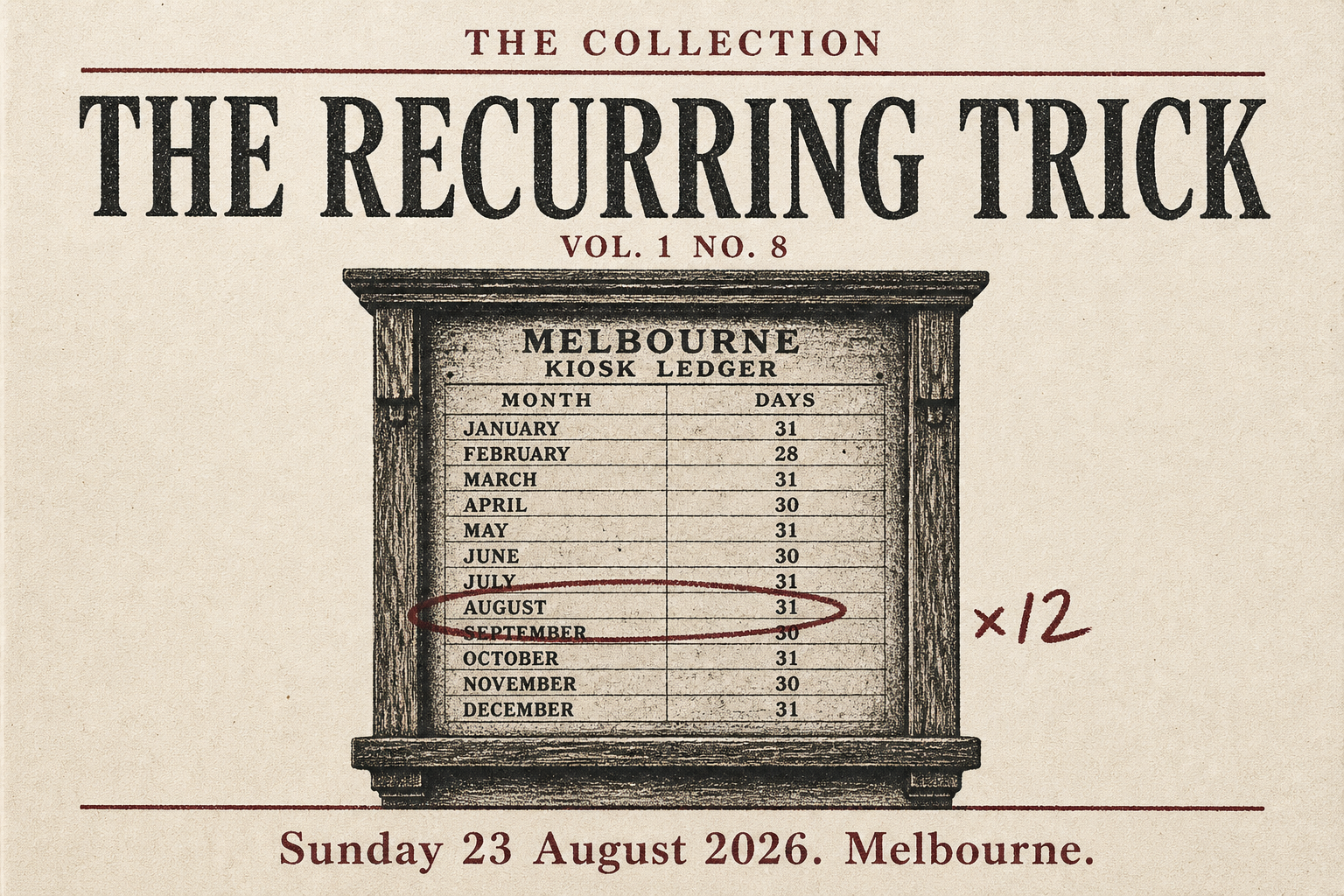
The Collection, Volume 1, Number 8. The Recurring Trick. Sunday 23 August 2026, Melbourne. A wooden kiosk ledger with August circled and times twelve written beside it. Open the issue

The Collection


Vol. 1, No. 8  ·  Sunday 23 August 2026  ·  Melbourne

The Recurring Trick

Edited by Newsletter World, for AK


Contents

A letter, five pieces, standing orders, and a colophon. Yesterday the hangar was in someone else’s field. Today the number on the cover is twelve times a month, and they called it a year.

  1. iiiEditor’s LetterThey took the best month and multiplied by twelve.03
  2. ivARR vs ARROne acronym. Two books. They mean the worse one.04
  3. vThe ForgeAgents broke the 2008 git. Cursor built another one.05
  4. viThe Score Is the LoopOpus 5 at about 30 percent. The same model, wrapped, at 100.06
  5. viiWho Holds the RecordThe controls are thorough. The operator keeps the log.07
  6. viiiA Channel for the AgentAnyone can @-mention Claude Code. Slack opens a room.08
  7. ixStanding OrdersFour rules for this issue.09
  8. xColophonThe letters, named.10

03  ·  Editor’s Letter

They took the best month and multiplied by twelve.

Gary Marcus wrote overnight about an acronym the boosters will not unpack. ARR, as they say it, is supposed to sound like Annual Recurring Revenue: subscriptions that will be there next year. What they mean is Annualized Run Rate. Take a good month. Multiply by twelve. Call it a year. You might never have a year that is twelve times your best month.

He does not give a dollar figure. Saturday we printed one, as a run rate, from other people’s mail. Today the letter is the definition. After the collapse of what he calls tokenmaxxing, companies like ATT are moving to open-source models to save costs. The second-quarter kind of revenue, he writes, may well not recur at the same scale. Netscape had a meteoric 1995. Then Microsoft gave the browser away.

They took the best month, multiplied by twelve, and called it recurring.

The rest of the mail is the same trick in other rooms. Cursor launched Origin, a git forge, because agents broke the 2008 one. NVIDIA’s AVO scored 100 on ARC-AGI-3; Claude Opus 5 on the same set is about 30 percent. The model did not jump. The loop did. Ken Huang mapped MCP against Proof-of-Control and found the controls already thorough. The operator still holds the record. That is not a year either. That is a month, attested by the person who ran it.

Yesterday the backyard. Today the recurring trick.

The Collection · The Recurring Trick03

04  ·  The Acronym

ARR vs ARR

The boosters want you to hear subscriptions. They are selling a projection.

Marcus’s Sunday letter is short on purpose. Annual Recurring Revenue is the thing you want: subscriptions, next year likely the same or better. It recurs. Annualized Run Rate can mean as little as the best month times twelve, then a hope that this month becomes next year’s average. That could happen. Or the best month is not typical, and you never print a year that matches the cover.

When people tell you Anthropic had this or that ARR, he writes, you need to know which meaning they are talking about. They rarely tell you. They really mean the latter. He names the pressure: the kind of revenue they were making in the second quarter of this year may well not recur, at the same scale, now that companies like ATT are turning to open-source models from other vendors. He dates that turn to the aftermath of tokenmaxxing’s collapse. He does not invent ATT’s bill. He does not invent Anthropic’s.

Annual Recurring Revenue recurs. Annualized Run Rate does not have to.

Then 1995. Netscape had revenue, doubling every quarter, a public company worth billions without a profit. Later that year Microsoft offered a competitor for free. Netscape was never the same, all but out of the game a decade later. Caveat emptor, he closes. The Collection’s job is smaller: when someone boasts about ARR, print the question. Which one.

The Collection · The Recurring Trick04

05  ·  The Store

The Forge

GitHub is straining. Cursor shipped a git that assumes agents.

Tom Krazit’s Saturday Runtime opened on a Product Saturday: Cursor unveiled a version-control host in the same week GitHub kept struggling to stay online. Origin, in Cursor’s own docs as he quotes them, is a git forge for storing and sharing code. Host repositories. Sync projects from GitHub. Browse the team’s Origin repos in the browser. Git is the second-most famous open-source project Linus Torvalds ever developed. GitHub has been the most widely used host around it since 2008.

2008 was a long time ago. Anyone shipping in 2026, Krazit writes, knows GitHub is straining under AI-driven software from agents. Vicent Marti, in the launch post, walked the early GitHub architecture. Most of those decisions made sense then. They are coming back under a load you cannot throw compute at. Continuity is Cursor’s Git storage: learn what Spokes did well, fix what years of production now show as problems. Agents made the situation worse. Origin is built around AWS S3 and write-ahead logging.

The 2008 git assumed people. The 2026 git has to assume agents.

GitHub’s own receipt arrived in the same pile. Krazit flags a 17 August outage post from GitHub CTO Vlad Federov, thoughtful and contrite, promising to do better, and a note from Airbnb’s Lorin Hochstein on autoscaling and the component-substitution fallacy in the cascade. We have those titles. We do not reprint the post-mortems as if we sat the incident. The Collection prints the fork: a forge built because the old one is breaking, in public, on a Monday.

The Collection · The Recurring Trick05

06  ·  The Loop

The Score Is the Loop

A perfect public set. The same model, unwrapped, is not close.

NVIDIA’s general-purpose coding agent AVO scored a perfect 100.00 RHAE on the ARC-AGI-3 public set. It cleared all 183 levels across all 25 environments with no instructions, rules, or stated goals. The weekly is careful with the next line. Claude Opus 5 alone scores roughly 30 percent on the same benchmark. Wrap it in AVO and it goes to 100 percent. NVIDIA frames that as system design, not model capability alone, unlocking long-horizon work.

The loop is named. Inspect context, plan the next change, implement, evaluate with a scoring function, diagnose and repair from failed attempts, commit accepted candidates into a growing solution lineage. Persistent memory keeps prior implementations, evaluation results, compiler output, and reasoning, so the agent resumes from current state. A separate monitor watches for stagnation and redirects. The same architecture was built for CUDA GPU kernel optimization and moved to interactive reasoning unchanged, using about 12 percent fewer environment actions than the prior VISTA baseline.

The model at 30 percent. The harness at 100. Do not confuse them.

TrueFoundry, the same issue, open-sourced TrueForge under an MIT license: a vendor-neutral harness, MCP tools, a skills registry, sandboxed execution, approval gates, subagents, durable state, step-level tracing. It runs on your iron against any model. The TrueFoundry AI Gateway is optional. On DevRev’s Enterprise-Bench, evaluated blind, they report roughly 30 percent lower cost on identical tasks with the same model, and up to 75 percent savings when routing to open-source models with accuracy matched. The repo has cleared 2,800 stars since the 19 August launch. We have their numbers. We did not sit the bench.

The Collection · The Recurring Trick06

07  ·  The Log

Who Holds the Record

MCP already has the controls. Proof is who can check them without asking.

Ken Huang’s Saturday letter is a crosswalk, not a rant. He maps the Model Context Protocol against the six domains of Proof-of-Control. MCP is hosted by the Linux Foundation, JSON-RPC 2.0, the place an agent reads data it did not author, calls a tool it does not own, and takes an action outside its own process. Every such crossing is a place evidence goes missing. His finding is not that the protocol is sloppy. It is that the controls are thorough and the record is held by the party being checked.

Revision 2026-07-28 is stateless. No initialize handshake, no session. Every request carries version, capabilities, client identity, authorization in its _meta field. That is good for a per-action evidence record. It is still Tier 2: attestation. Token validation, scope enforcement, consent, schema: all real, all normative, all attested by the operator who runs the server. Moving a spec-conformant deployment from Tier 2 to Tier 3, he writes, requires no new controls. It requires changing who produces and holds the record.

A careful log written by the operator is still a month. It is not a year you can audit.

He works an example. A support agent running Opus 5 issues a $42.50 refund on a billing MCP server. Six weeks later an insurer’s adjuster asks whether the agent was authorized and stayed inside the limit. The Tier 2 row is not weak: audience-bound tokens, PKCE, scope, schema, per-client consent. The adjuster still has nothing they can rely on without trusting the company that wrote the log. That is the binary threshold. We print the threshold. We do not print a refund that did not happen.

The Collection · The Recurring Trick07

08  ·  The Room

A Channel for the Agent

The session is no longer a private terminal. It is a Slack room.

Salesforce shipped Slack Code in the same Runtime. Anyone with access, not just developers, can @-mention coding agents like Claude Code or Codex inside Slack. Slack Code opens a new channel for that project. The team can see it and comment as the work unfolds. The company’s line, as Krazit quotes it: a dedicated place to work with an agent on a specific coding session or project, together, right in Slack.

That is the forge’s other half. Origin stores the repo under a load git was not built for. Slack Code makes the agent session a room other people can walk into. Neither one is a year of recurring revenue. Both are infrastructure for a month that is suddenly very busy. If the run is a projection, the channel is where you watch whether it actually ships.

The agent used to work in a private terminal. Now it has a channel.

Krazit also notes Snowflake adding dynamic model routing in Cortex AI Gateway, and Cerebras announcing CS-4: a claimed 30 times performance, up to 10 times more throughput per watt than CS-3. Stripe and OpenRouter we already printed on Wednesday. The hangar we printed yesterday. Those numbers stay on those shelves. Today’s paper is the trick, the forge, the harness, and the log.

The Collection · The Recurring Trick08

09  ·  Standing Orders

Four rules for this issue

  1. I

    Ask which ARR they mean.

    Annual Recurring Revenue is a subscription. Annualized Run Rate can be a good month times twelve. If they will not say which, assume the worse one.

  2. II

    The harness is the score.

    Opus 5 at about 30 percent. The same model in AVO at 100. Print the loop. Do not credit the weights for the supervisor.

  3. III

    The operator holding the log is not proof.

    MCP already has the controls. Tier 2 is a signed record by the party being checked. Independent evidence is a different shelf.

  4. IV

    Git for people is not git for agents.

    Origin exists because Spokes is showing its age under agent traffic. A 17 August outage is not a personality. It is a load.

The Collection · The Recurring Trick09