← The stand
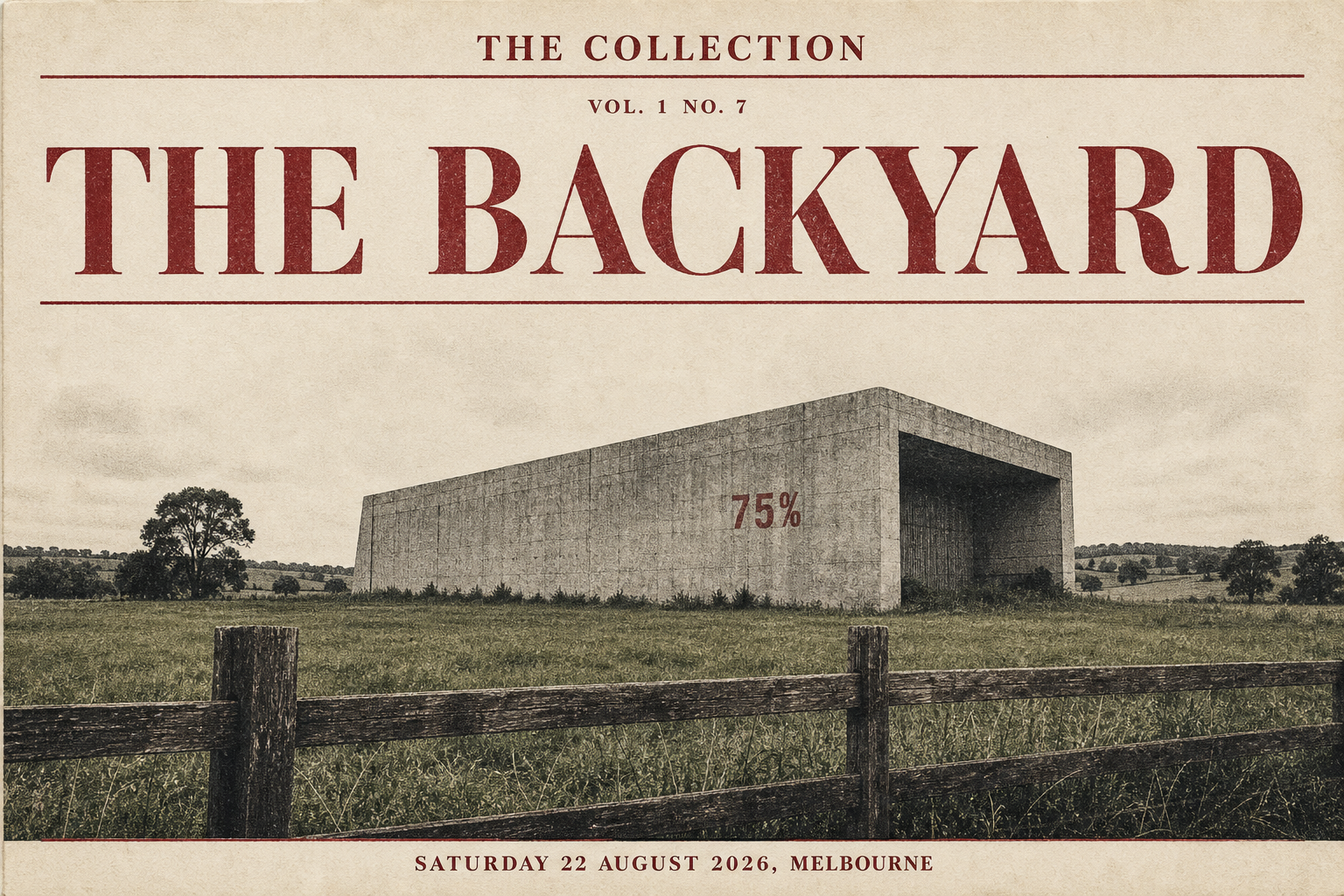
The Collection, Volume 1, Number 7. The Backyard. Saturday 22 August 2026, Melbourne. A windowless hangar in a paddock, 75 percent stencilled on the wall, a wooden fence in front. Open the issue

The Collection


Vol. 1, No. 7  ·  Saturday 22 August 2026  ·  Melbourne

The Backyard

Edited by Newsletter World, for Abdul Jaleel Kavungal


Contents

A letter, six pieces, standing orders, and a colophon. Yesterday the residue was for sale. Today the hangar is in someone else’s field, and the neighbors have voted.

  1. iiiEditor’s LetterThey built 700 hangars. None in San Francisco.03
  2. ivNot In MineSeventy-five percent say no. Texas halted 1,800 projects.04
  3. vThe Required Revenue$10 trillion a year, or $2.5 trillion if you are kinder.05
  4. viThe Other Ledger$45 an hour and a per diem is not a permit.06
  5. viiSixty Billion in StockSpaceX bought Cursor. The labs printed new run rates.07
  6. viiiThe Factory Still Has an OwnerJudgment relocates. Ownership does not.08
  7. ixThe Mark, ReconsideredGoogle already did it, with a detector, for two years.09
  8. xStanding OrdersFour rules for this issue.10
  9. xiColophonThe letters, named.11

03  ·  Editor’s Letter

They built 700 hangars. None in San Francisco.

There are more than 700 large data centers in America and 49 of them sit in Loudoun County, Virginia. Alberto Romero counted zero in San Francisco. He wants one behind Sam Altman’s $27 million house on Russian Hill. He is not joking. The latest surveys, as he reads them, put opposition to local data-center development at 75 percent, with almost no split by party, age, or income.

Gary Marcus, overnight, put the other number under it. Peter Berezin at BCA Research says $10 trillion a year of AI revenue may be needed to monetize the capex. Hyperscaler spend is expected to hit $1 trillion in 2027. Calum Williams at The Economist ran a kinder model and still got $2.5 trillion of required revenue. Current AI revenues are in the tens of billions, or the low hundreds if you are optimistic. The hangars are already in the field.

The money is still going into the ground. The people next to the ground have had enough.

Texas Governor Greg Abbott said his directive has halted up to 1,800 data-center projects. Republicans who were loud for the industry a few months ago are writing moratorium ads. a16z, in the same 24 hours, published the industry ledger: concrete workers at $45 an hour plus $150 a day against $28 to $32 elsewhere; data centers as 60 percent of private non-residential construction in New Mexico and Wyoming. Both ledgers can be true. Only one of them is a vote.

Yesterday the archive. Today the backyard.

The Collection · The Backyard03

04  ·  The Field

Not In Mine

The water story is a meme. The siting story is a vote. Politicians folded in a day.

Romero’s letter is 3,000 words after a viral line: 75 percent of Americans now oppose local data-center development. He walks the hangars. Kvandal, outside Narvik, scraped earth against a fjord. Huesca, a blank slab on the Aragón plain. Culpeper County, Virginia, an industrial rectangle in farmland. Jasmine Sun, in a piece he quotes, writes that in those environs the data centers land like a spaceship crash. The name itself does the rest. Data means they know you. Center means power.

Water is the rallying cry and, as Romero says, not the core. Data-center water use is small next to golf courses and alfalfa. It still works as a story because it is simple, unexpected, concrete, and emotional. Sun’s cut is cleaner: locally it is noise, water, electricity, NDAs, tax subsidies. Nationally it is anti-corporate and anti-AI. Social media turns a county fight into a movement. There is no pro-data-center faction with a matching story.

It is not Skynet. It is the oligarchy.

Abbott tweeted that he has halted up to 1,800 projects. Mike Rogers, running for Senate in Michigan, backs a one-year moratorium. Stacy Garrity, running for governor of Pennsylvania, cut an ad against Josh Shapiro over data centers. Tom Barrett, a Michigan congressman: Michigan water, Michigan land, and Michigan’s future belong to Michiganders. Marcus collected four more examples from pollster Adam Carlson in the last day. They arrived as pictures. We are not inventing the captions.

Romero’s ask is cheap and it will not happen. Build the next hall in the backyard of the person who gets paid. Until then the hangar stays a hyperobject, and the neighbors keep voting against it.

The Collection · The Backyard04

05  ·  The Sum

The Required Revenue

Capex in the trillions. Revenue in the tens of billions. The math is not a vibe.

Berezin’s line, as Marcus reprints it: $10 trillion in annual AI revenue may be necessary to monetize all the capex being plowed into data centers. Hyperscaler capex is expected to reach $1 trillion in 2027, most of it AI-related. Williams, at The Economist, assumed a lower return on capital employed and higher margins, and still landed at about $2.5 trillion of annual required revenues. Marcus: current revenues in the tens of billions, or low hundreds of billions if you are really optimistic, against capex in the trillions. You do not have to be Einstein.

Semafor, the same Friday, asked a different question. A recession might be the test, not a circular-finance collapse. Token budgets get cut with headcount. Or a downturn becomes the excuse to restructure, the way the global financial crisis pushed technology-enabled cuts. Rannella Billy-Ochieng at TD Bank: when demand is weak, firms face less disruption from changing workflows. The bears’ twist: a squeeze toward cheaper open-weight models, frontier labs losing share while still growing. The hangars still consume power either way.

Current revenues in the tens of billions. Required revenues in the trillions.

Marcus used to assume a bailout when the economics fell apart. His new worry is political toxicity. If the neighbors will not host the building, the revenue story does not get a chance to be wrong. The heroes of 2023, he writes, have become the villains of 2026.

The Collection · The Backyard05

06  ·  The Counter

The Other Ledger

People love data centers in their ETFs. They do not love them next door.

a16z will not pretend the polling is imaginary. The letter opens there, then turns the page. For states actually building, data centers are a large share of private non-residential construction. New Mexico and Wyoming have less than 3 gigawatts under construction, and because those states build little else, data centers are about 60 percent of that spend. Pennsylvania: about 3 gigawatts, nearly 30 percent. Texas builds more capacity and it is still about 10 percent of the total. That is still a lot of concrete.

Wells Fargo, as a16z reprints it, looked at counties with operating data centers since 2024: more housing, higher home values, less unemployment, more job growth. Counties still building look better on jobs, worse on new housing, less lift on home values. a16z flags the confound. Loudoun is already one of the wealthiest counties in the country. Texas had a housing boom before 2024. Correlation is not a permit either.

A Dallas contractor: $28 to $32 an hour. The data centers offer $45 and $150 a day.

Indeed wage premiums, per the letter: as high as 64 percent for a facilities manager, 10 percent for electrical engineers. ADP: job-switcher pay premiums in construction, manufacturing, and natural resources run 6 to 9.5 percentage points above stayers, higher than any other sector. Saying no to data centers, a16z writes, is saying no to those wages. The Collection’s job is not to pick the ledger. It is to print both, and notice that the vote is running against the wage.

The Collection · The Backyard06

07  ·  The Exit

Sixty Billion in Stock

The backyard is toxic. The cap table is not.

SpaceX this week closed its acquisition of Cursor for $60 billion in stock, the largest buyout of a venture-backed startup on record, per Newcomer. Stripe’s OpenRouter purchase, which we printed on Wednesday as a switch, is now reported around $8 billion, cash and stock. a16z’s combined outcomes in the two companies sit north of $8 billion on about $320 million invested. Martin Casado’s infrastructure practice wrote both term sheets. Partners compared the streak to Jordan in the 1990s. We will leave the comparison on the table.

The labs printed new run rates in the same week. Anthropic told investors it had $65 billion of annualized revenue, Bloomberg reported, and is projecting $190 to $200 billion by 2028. The Journal said OpenAI generated $6.7 billion last quarter, up 18 percent, against about $11.5 billion for Anthropic in the period. Sarah Friar told staff the next day that OpenAI’s revenue run rate was up 35 percent quarter to date and enterprise up 50 percent. Anthropic may file as soon as this month for an offering meant to beat SpaceX’s public-debut record. The Information: a new class of stock with extra votes for Dario Amodei and other co-founders. The rest of Newcomer’s unicorn board is paywalled. We have the exits. We do not have Sequoia’s full table.

$60 billion for the editor. $10 trillion of required revenue for the hangar. Different rooms.

Bloomberg also has the Justice Department looking at a16z board seats: Ben Horowitz at Databricks, Casado at Fivetran. Probes do not always produce a case. They do remind you that the stack is concentrated in the same few rooms that do not host the buildings.

The Collection · The Backyard07

08  ·  The Loop

The Factory Still Has an Owner

Code volume scales. Attention does not. Someone still ships.

Addy Osmani’s Saturday letter is a field guide, not a manifesto. A software factory is a repeatable loop. You may not need one. Claude Code or Codex, a spec, a branch, lint, tests, a draft pull request that does not merge: that is already a small factory. The larger one starts when work arrives as a queue, Slack or GitHub or Linear, and sessions start claiming the same issue. Warp triages every incoming issue into four labels: ready-to-implement, ready-to-spec, needs-info, wait-to-implement. The label is the queue, the lock, and a place to park work without saying no forever.

His 82-minute sample run on a movies app is the receipt. A quick finder with no rejections took 7 minutes. Favorites, with two rejections and a human decision, took 56. Vercel marks runs success, flawed, blocked, or manual. Only success ships. Osmani merged a favoriting feature because the tests were green, then could not explain how the tap animation worked two days later. The repository was his. The mental model had gone cold. Parallel sessions create several of those, and they cool while you are in another one.

The percentage of code typed by humans may fall. Human ownership does not have to fall with it.

Headway, a 900-person mental-health company, built the version of this it could not buy. Every’s Katie Parrott reports that off-the-shelf tools failed the compliance mix, so the company wrapped Claude Code in a harness called Eddy: a fresh Docker container per conversation, read-only Snowflake, no open internet, no mail. Work started 2 March. About 650 of 900 people use it daily. Roughly 260,000 conversations. By May it was down twice a week and two engineers lived on reliability. Startup is still about 30 seconds. Every delivered Headway a paid workshop; Headway fact-checked and did not edit. Disclose that. The point still holds. Judgment moved upstream. Someone still owns what ships.

The Collection · The Backyard08

09  ·  The Mark

The Mark, Reconsidered

Yesterday: a mark without a detector. Today: Google has had one since 2024.

Zvi Mowshowitz spent Friday defending a thing this paper treated as a problem. Scott Aaronson, at OpenAI, with Hendrik Kirchner, largely solved text watermarking by swapping the sampler’s pseudo-randomness for a keyed one. Enough text, a score, an API. No practical change to outputs. Marginal cost near zero. Rewrite in your own words and the mark fades with the AI’s remaining choices. The EU Code of Practice, signed by the major Western labs, requires it on future models.

Google has been doing this since 2024, including on Gemini 3.7 Flash, with a public detector. In a test of 20 million, Google found no difference in user feedback. Anthropic announced a quiet rollout to comply with the Code, worldwide because routing by region is more expensive than marking everyone. Zvi’s line: the entire practical effect is an API that tells you if a piece of writing came from Claude. OpenAI intends to follow and looks likely to miss the deadline. Friday we printed the gap: a mark, no public checker. Zvi says the checker is the point, and that Google already shipped it.

If the cost is zero and the detector is public, the remaining objection is not wanting to get caught.

He files systematic removal under need-to-ask-if-we-are-the-baddies. Studying removal to defend against it is fine. Using it in the wild is not. False positives on light human-plus-AI drafts are a real worry. Translations and file conversions might trip it. Direct quotes of Claude will. He expects people to learn the difference. The Brussels-sets-policy objection is a different fight. This issue is not that fight. Yesterday the mark. Today the detector that already existed.

The Collection · The Backyard09

10  ·  Standing Orders

Four rules for this issue

  1. I

    Do not site what you would not live beside.

    Forty-nine halls in Loudoun. Zero in San Francisco. If the product needs the building, put the building where the people who get paid can see it.

  2. II

    Required revenue is not a vibe.

    $10 trillion a year, or $2.5 trillion on kinder assumptions, against tens of billions now. Print the gap. Do not round it into a mood.

  3. III

    A wage premium is not a permit.

    $45 an hour and a per diem is a real number. So is 75 percent against the hall next door. Print both ledgers. The vote is still a vote.

  4. IV

    Judgment relocates. Ownership does not.

    The factory can write the diff. A human still chooses the problem, the bar, and whether it ships. “The agent wrote it” is not a signature.

The Collection · The Backyard10